

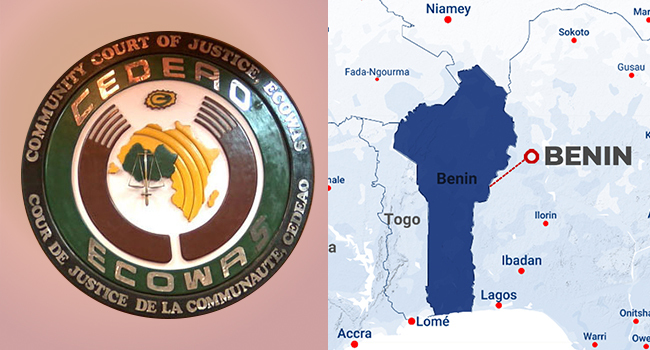
The Economic Community of West African States (ECOWAS) has ordered the immediate deployment of its standby force to the Republic of Benin after authorities successfully thwarted an attempted military takeover.

In a statement issued on Sunday, the regional bloc confirmed that troops—drawn from Nigeria, Sierra Leone, Côte d’Ivoire, and Ghana—are being mobilised to help safeguard Benin’s constitutional government and maintain stability. ECOWAS had earlier condemned the attempted coup and praised the Beninese government and military for acting swiftly to restore order.

According to the organisation, the deployment is in line with Article 25(e) of the 1999 Protocol on the ECOWAS Mechanism for Conflict Prevention, Management, Resolution, Peacekeeping and Security. The decision followed consultations among heads of state in the Mediation and Security Council.
The statement noted, “The ECOWAS Standby Force will support the Government and Republican Army of Benin in preserving constitutional order and protecting the territorial integrity of the country.”

Nigerian Air Force Engages in Benin
In a parallel development, Nigerian Air Force jets carried out airstrikes inside Benin after receiving an urgent request for assistance from the Beninese government. While the exact targets remain unclear, the operation was part of joint efforts to neutralise the coup plotters.
President Bola Ahmed Tinubu commended the Nigerian military for its rapid response, saying their actions helped defend Benin’s 35-year-old democratic system.
According to the Nigerian Presidency, Benin had made two formal requests for air and ground support—first to secure its airspace, and then to deploy Nigerian assets for surveillance and intervention operations coordinated under Beninese command. The government also asked for Nigerian ground troops, limited strictly to missions authorised by Benin’s defence authorities.

Attempted Coup ‘Under Control’
Earlier on Sunday, a group of soldiers appeared on state television, identifying themselves as the “Military Committee for Refoundation.” They declared a lieutenant colonel as their leader and announced the dissolution of state institutions, citing worsening security in northern Benin, poor welfare for fallen soldiers’ families, and allegations of unfair military promotions.
Gunfire was heard in parts of Cotonou, but Benin’s government later confirmed that the uprising had been contained.
ECOWAS denounced the coup attempt as unconstitutional and a direct attack on the democratic rights of Beninese citizens.

Benin, which gained independence from France in 1960, has experienced several coups in the past, although the country has enjoyed relative political stability since 1991. President Patrice Talon, in office since 2016, is set to complete his final term in 2026. His administration has been credited with economic reforms but frequently criticised for suppressing opposition.



