

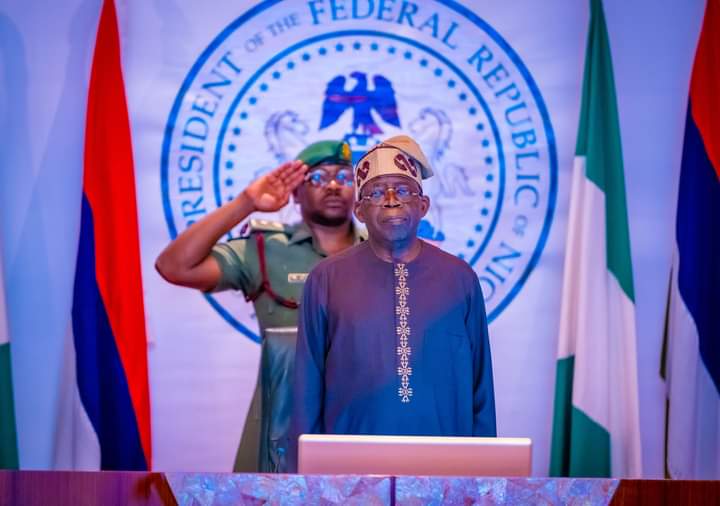
President Bola Ahmed Tinubu has unveiled a new security and economic strategy designed to unlock Nigeria’s marine and aquatic wealth, positioning the blue economy as a major pillar for the nation’s economic transformation.
The President has ordered all relevant ministries, departments, and agencies to immediately review and begin implementing the recommendations from a comprehensive National Institute for Policy and Strategic Studies (NIPSS) report on developing the blue economy.

Speaking at the Presidential Villa during an interactive session with participants of the Senior Executive Course 47 of NIPSS, Tinubu—represented by Vice President Kashim Shettima—reaffirmed the administration’s commitment to turning Nigeria’s maritime assets into engines of economic diversification, job creation, and long-term national prosperity.
According to him, the blue economy presents a significant opportunity to broaden national revenue sources, promote sustainable employment, and restore environmental systems essential to development. He added that with proper management, the sector could become a foundation of shared national wealth.

Tinubu praised the NIPSS study on Blue Economy and Sustainable Development in Nigeria, describing it as a timely guide that highlights the opportunities available, the obstacles to be addressed, and the policies that require strengthening.
He commended the institute for maintaining its tradition of rigorous research, innovation, and national service.
Highlighting Nigeria’s maritime strengths—including an 853-kilometre coastline, abundant fisheries, vast inland waterways, and a prime location in the Gulf of Guinea—the President said the country is well positioned to tap into new economic frontiers.

The administration, he noted, is focusing on expanding aquaculture, modernizing ports and maritime corridors, boosting coastal tourism, developing marine biotechnology, and investing in renewable ocean energy.
“These opportunities are within our reach if we remain focused and deliberate in our actions,” he stated.
Tinubu also emphasized that the creation of the Ministry of Marine and Blue Economy was a strategic move aimed at improving port management, strengthening maritime security, and encouraging private-sector participation. He acknowledged that more work remains and directed all MDAs to study and prepare for the immediate implementation of the NIPSS findings.

He stressed that no economic plan within the blue economy can succeed without ensuring safety and stability. Although piracy has declined due to the Deep Blue Project, he warned that oil theft, illegal fishing, smuggling, vandalism, and kidnapping continue to threaten national revenue and investor confidence.

“These threats are real, and this administration is taking firm measures to confront them,” he said.
The President further expanded NIPSS’ mandate, directing the institute to carry out a nationwide security diagnostic and produce actionable recommendations for improving Nigeria’s security structure. He assured that the resulting policy paper would receive priority attention.

Referring to NIPSS as the intellectual engine of national progress, Tinubu urged scholars to remain courageous, innovative, and grounded in Nigeria’s realities.
Earlier, the NIPSS Director-General, Prof. Ayo Omotayo, expressed gratitude to President Tinubu for the institute’s continued support and acknowledged the Minister of Finance, Wale Edun, for facilitating funding for the SEC 47 programme.
He explained that the team had visited several Nigerian states and 14 foreign countries before presenting their report titled “Blue Economy and Sustainable Development in Nigeria: Issues, Challenges and Opportunities.”
Colonel Murkar Dauda, who highlighted the report, noted that the Federal Government is already addressing several systemic gaps in the sector and commended the President for his leadership in strengthening the economy.
The report identified governance issues, weak institutional coordination, and outdated infrastructure as major obstacles but emphasized the significant opportunities ahead. It revealed that fisheries and aquaculture remain strong starting points for economic expansion and urged the government to diversify revenue sources for increased national earnings.
Among its key recommendations, the report advised the Federal Government to launch a national fisheries expansion project, supported by public-private partnerships, to increase fish production from 1.2 metric tonnes to 10 metric tonnes within two years.

It further recommended broadening the revenue streams of the marine and blue economy sector, establishing a comprehensive financing framework, reviewing and harmonizing all legal and policy documents, creating a modern skills and job-creation programme, and prioritizing the safety of inland waterways.



