

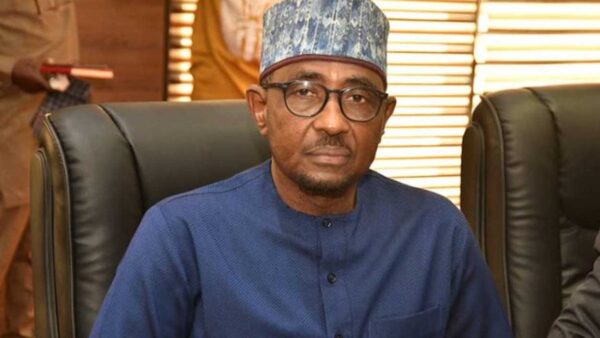
Breaking: Dangote Alleges NMDPRA CEO Ahmed Lives Beyond Means, Ahmed Denies Claims
Abuja, Nigeria — Farouk Ahmed, CEO of the Nigerian Midstream and Downstream Petroleum Regulatory Authority (NMDPRA), has denied allegations of corruption and living beyond his means, following a high-profile accusation by Aliko Dangote, president of Dangote Industries Limited.

In a statement sent to PREMIUM TIMES on Wednesday, Mr Ahmed clarified that a circulating response attributed to him “did not emanate from me.” He described the allegations against him and his family as “wild and spurious” and confirmed he has chosen not to engage in public disputes.
“Thankfully, the person behind the allegations has taken it to a formal investigative institution. I believe that would provide an opportunity to dispassionately distill the issues and to clear my name,” Mr Ahmed said.

The controversy began on Sunday when Dangote accused Mr Ahmed of economic sabotage undermining Nigeria’s domestic refining industry. Speaking at the Dangote Petroleum Refinery, Dangote alleged that the NMDPRA chief colluded with international traders and importers to frustrate local refining by issuing import licenses for petroleum products.
Dangote also claimed that Mr Ahmed’s personal spending raised serious questions about integrity and conflict of interest, citing that four of his children attend secondary schools in Switzerland at costs reportedly running into several million dollars.

The allegations intensified on Monday, with Dangote accusing Mr Ahmed of corruption and misappropriation of public funds. He provided estimated figures for the education of Ahmed’s children, claiming $5 million was spent on secondary education over six years, and $2 million on tertiary education, including $210,000 for Faisal Farouk’s 2025 Harvard MBA.
On Tuesday, Dangote formally petitioned the Independent Corrupt Practices and Other Related Offences Commission (ICPC), calling for the investigation, arrest, and prosecution of Mr Ahmed. The petition detailed the alleged $7 million spent on his children’s education in Switzerland and requested verification of schools and expenses.

Dangote cited section 19 of the ICPC Act, which allows the commission to investigate and prosecute corrupt practices, warning that a successful prosecution could carry up to five years in prison without a fine.
He also stressed his readiness to provide evidence supporting the claims, which has already sparked protests from civil society groups.
As the matter now moves into formal investigation, the nation watches closely for developments in what could be one of the most high-profile cases involving Nigeria’s petroleum regulatory sector.




