

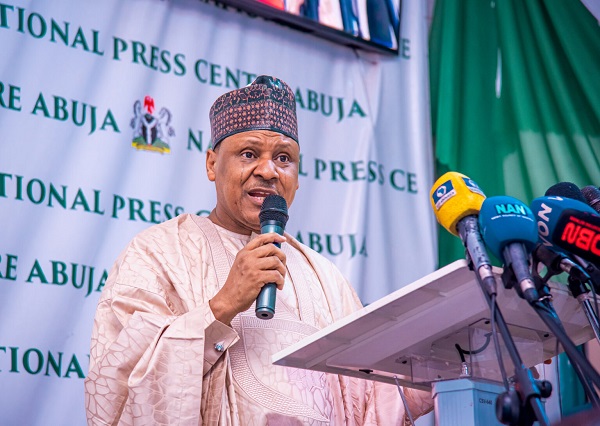
The Federal Government has confirmed that it will go ahead with the implementation of the new tax laws starting January 1, 2026, as originally planned.
Minister of Information and National Orientation, Mohammed Idris, stated that the government followed due process, including extensive consultations, legislative deliberations, approvals, and final enactment by the President. He emphasized that there is only one official version of the tax laws, which was duly processed by the National Assembly and signed into law.

Addressing reports about alleged alterations in the gazetted copy of the Tax Administration Act, Idris said the matter falls within the jurisdiction of the National Assembly, which is expected to investigate the claims. He stressed that the executive arm has no authority to comment on the issue.
“I think it is important to allow the National Assembly to examine whether there were discrepancies. This is their responsibility, and I have no jurisdiction over it. As far as the government is concerned, there is only one official version of the tax law,” Idris explained during a press briefing in Abuja reviewing the Tinubu Administration’s activities in 2025.

The position was supported by Chairman of the Presidential Fiscal Policy and Tax Reforms Committee, Taiwo Oyedele, and immediate past FIRS Executive Chairman, Muhammad Nami. Oyedele cautioned against relying on circulating documents that are not authentic and clarified that the only legally binding version of the tax bills is the harmonised copy certified by the Clerk of the National Assembly and submitted to the President.
Addressing a controversial provision, Section 41(8), which suggested a 20 percent deposit requirement, Oyedele explained that it appeared in the draft gazette but is not part of the final law. He noted that confusion arose from premature circulation of draft documents by unidentified individuals before the relevant House committee could deliberate.

Nami also weighed in, stating that the issue does not justify discarding the tax reforms. He highlighted that the laws were developed over years of research and legislative work starting in 2022, aimed at strengthening revenue collection, reducing leakages, funding development projects, supporting debt servicing, expanding social welfare programs, and attracting investment. He called for careful investigation to hold any responsible individuals accountable rather than abandoning the reforms.

The House of Representatives, acting on allegations raised by PDP lawmaker Abdulsamad Dasuki of Sokoto State, has set up a committee to probe the alleged alterations in the gazetted tax laws. Speaker Abbas Tajudeen announced the committee, chaired by Aliyu Mukthar Betara, alongside members Ahmed Idris Wase, James Abiodun Faleke, Fred Agbedi, Igarewey Iduma Enwo, and Babajimi Benson. The panel is tasked with investigating the claims and reporting back to the House.

President Tinubu had previously signed four major tax reform bills—the Nigeria Tax Act, Nigeria Tax Administration Act, Nigeria Revenue Service (Establishment) Act, and Joint Revenue Board (Establishment) Act—into law. Together, they establish a unified authority under the Nigeria Revenue Service. The reforms aim to simplify compliance, broaden the tax base, eliminate overlapping taxes, and modernise revenue collection at federal, state, and local levels.
Despite opposition from some northern lawmakers and concerns from governors, the President maintained the Bills should proceed, allowing stakeholders to raise issues during public hearings. Following consultations, the Bills were passed and are scheduled to take effect on January 1, 2026.




