

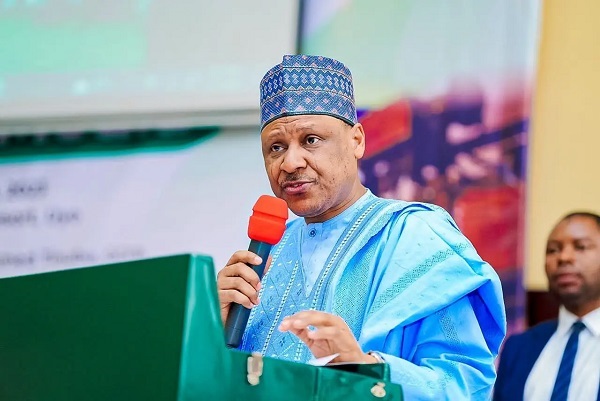
President Bola Ahmed Tinubu has made significant strides in meeting public expectations across key sectors of the economy, according to Information and National Orientation Minister Mohammed Idris.
Highlighting the administration’s achievements, Idris pointed to reductions in poverty, growth in Gross Domestic Product (GDP), enhanced security focus, stable electricity supply, and increased foreign and domestic investment. He said these gains would be further consolidated in 2026, with the President poised to break new ground in governance and national development.

The minister also noted that the 67 ambassadorial nominees recently screened by the Senate would assume their assignments next year, strengthening Nigeria’s diplomatic engagements globally.
On security, Idris stated that any armed group involved in kidnapping, attacks on farmers, or terrorizing communities would now be officially classified as a terrorist organization. He added that the presidential declaration of a nationwide security emergency in 2025 would soon translate into massive recruitment into the Armed Forces and Police, along with the deployment of trained Forest Guards to protect vulnerable areas.

He outlined the administration’s new national counterterrorism doctrine based on four pillars: unified command, intelligence, community stability, and counterinsurgency. Idris emphasized, “The era of ambiguous nomenclature is over. Any armed group committing such crimes will be treated as a terrorist organization.”
The minister celebrated the release of 130 pupils abducted from St. Mary’s Catholic School, Papiri, Niger State, acknowledging the efforts of security agencies in securing the freedom of all 230 abducted students.
Discussing the 2026 security budget, Idris revealed a massive allocation of N5.41 trillion to Defence and Security, aimed at protecting lives, property, and ensuring prosperity through modern equipment, a new national intelligence architecture, and secure digital border surveillance systems.

On economic performance, he reported that Nigeria’s GDP grew by 3.98% in Q3 2025, reflecting sustained expansion in the non-oil sector. Headline inflation fell for eight consecutive months to 14.45% in November, while food inflation also trended downward. External reserves strengthened to $44.56 billion, supporting currency stability and investor confidence, and the country recorded a trade surplus of N6.69 trillion in Q3, a 27.29% year-on-year growth.
Idris also highlighted energy sector milestones, including a record daily generation of 128,370.75 MWh on March 4, 2025, the launch of the Presidential Metering Initiative, and the first bond under the Presidential Power Sector Debt Reduction Programme. Oversubscribed Eurobond and government-issued bonds reflected strong investor confidence in macroeconomic reforms.
He added that Nigeria exited the Financial Action Task Force (FATF) Grey List, demonstrating progress in combating money laundering, terrorist financing, and other financial crimes.

The minister underscored major investments in agriculture and infrastructure, including the recapitalization of the Bank of Agriculture with N1.5 trillion and over N1.5 trillion invested in road networks. Key highway projects include the Lagos-Calabar Coastal Highway (750 km), Sokoto-Badagry Superhighway (1,068 km), Trans-Saharan Highway (477 km), and Akwanga-Jos-Bauchi-Gombe Expressway (422 km), designed to enhance connectivity and economic growth.
Youth empowerment initiatives included support for over 788,000 students through the Nigeria Education Loan Fund (NELFUND), disbursing interest-free loans and stipends exceeding N150 billion.
On diplomacy, Idris affirmed that Nigeria has strengthened its global presence, resolved issues with the United States amicably, and signed a five-year bilateral health agreement worth $5.1 billion, with the US contributing $2.1 billion and Nigeria $3 billion. The initiative aims to enhance the healthcare system, save lives, and attract investment.




