

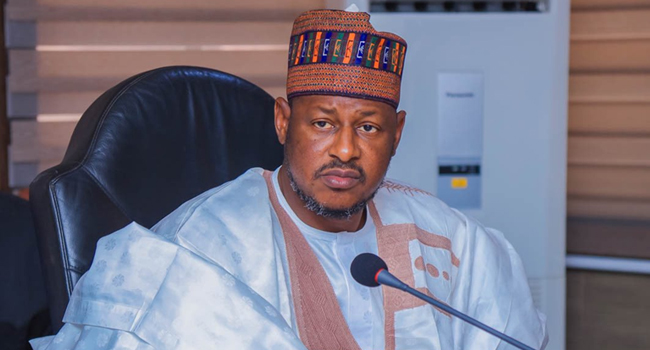
Katsina State Governor, Malam Dikko Radda, has appealed to Nigerians to reconsider the practice of placing sole responsibility for the country’s growing economic difficulties on state governors, noting that the Federal Government takes the largest portion of monthly federation revenue.
Speaking during an interview on Radio France Internationale (RFI) Hausa, the governor explained that the current revenue allocation structure leaves states and local governments with limited funds, contrary to the popular belief that governors control most of the nation’s resources.

His comments come at a time when state governments are facing increased public scrutiny over higher allocations received after the removal of fuel subsidy.
Governor Radda pointed out that frustration over economic hardship is often directed at governors and local council chairmen, even though the Federal Government receives the majority share from the Federation Account.
“Each time hardship is felt, governors and local governments are blamed. Yet, when revenue is distributed, 52 per cent goes to the Federal Government, while the remaining 48 per cent is shared among the 36 states and 774 local governments,” he said.
He added that the Federal Government has historically taken the larger share of national revenue and questioned how those funds have been utilised over the years.

“For many years, the Federal Government has received the biggest portion of federation revenue. Nigerians should therefore be asking what has been done with that money,” the governor stated.
Radda also rejected the widespread perception that corruption is mainly a problem at the state level, cautioning against generalising allegations against governors.
According to him, public officials should be assessed individually, stressing that integrity differs from one leader to another.

“Leadership should be judged on personal conduct. It is unfair to brand everyone as corrupt. In the end, every public office holder will answer for his or her actions,” he said.
Defending his administration’s continued focus on capital projects despite the harsh economic climate, the governor noted that infrastructure development remains a key strategy for stimulating local economies through employment opportunities.
He explained that capital projects help circulate money at the grassroots level, as workers earn wages, traders increase sales, and suppliers benefit from government spending.

Radda maintained that the effects of such investments are already evident across various local government areas in Katsina State.
“Anyone who visits our local governments today will notice increased economic activities because funds are reaching the communities,” he added.




