

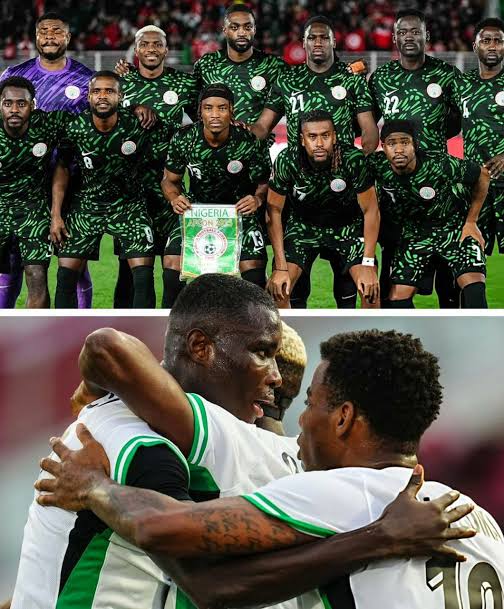
The quarter-final between the Nigeria Super Eagles and the Algeria national football team was the kind of contest that resists lazy conclusions.
On paper, many betting houses leaned Algeria’s way—experience, structure, and their disciplined defensive record gave them the statistical edge.
On grass, Nigeria answered with authority, intensity, and an unmistakable sense of collective purpose.
This was not a game decided by one moment or one player alone.
It was a performance built on layers: defensive discipline, midfield control, and ruthless efficiency when the openings came. Nigeria didn’t just beat Algeria; they outworked them, outthought them, and crucially, outlasted them.
From the first whistle, the Super Eagles set the tone. Algeria wanted rhythm; Nigeria denied them oxygen. The press was coordinated, not frantic.
The back line held its shape, refusing to be drawn into cheap duels.
In midfield, Nigeria understood the real battleground—not possession for possession’s sake, but control of transitions. Algeria’s attempts to slow the game were repeatedly punctured by quick vertical passes and intelligent movement off the ball.

This is where the conversation around “Man of the Match” becomes complicated—and honest football analysis demands we acknowledge that.
On nights like this, you could make a convincing case for three or four names.
One player shields the defence, another breaks lines with carries, another stretches play wide to unbalance the block, and someone else finishes the job.
Championship football often works that way.
And yet, symbolism matters in football. Leadership matters. Influence beyond statistics matters.
After the match, Victor Osimhen publicly handed his Man of the Match recognition to Rashidi Yekini.
That gesture raised eyebrows—and rightly so. Osimhen is not just Nigeria’s spearhead; he is one of the most tactically educated forwards in the modern game.
When such a player makes that call, it deserves to be taken seriously.

Why Yekini?
Because this was not merely about goals or highlights. It was about presence.
Yekini’s performance carried the quiet authority of a player who seemed to be everywhere the game needed stability.
When Algeria threatened to overload the midfield, he dropped deep to compress space. When Nigeria needed an outlet, he showed for the ball and recycled possession intelligently. When the tempo dipped, he raised it. When balance was required, he provided it.
In modern football language, Yekini played the “connector” role—the player who stitches phases together.
Those players rarely dominate headlines, but coaches, teammates, and elite professionals notice them immediately. Osimhen’s decision suggests exactly that: a striker recognising the invisible work that allowed the front line to function.

That does not diminish the contributions of others. Nigeria had multiple standout performers. The wide players disciplined themselves defensively while still offering width in attack. The centre-backs read danger early, stepping in front of Algeria’s forwards before moves could mature. In midfield, energy and intelligence coexisted—no small feat at this level of competition.
So, could this have been a match with two or three legitimate “men of the match”? Absolutely. Many analysts would argue that. But football is not a spreadsheet exercise. It is also a hierarchy of trust and influence. On the pitch, some players shape the game’s emotional and tactical spine, even when they are not scoring or assisting.
Nigeria’s win over Algeria was ultimately a statement performance. It showed adaptability, maturity, and a growing understanding of tournament football—when to press, when to pause, and when to strike. It also reminded us why individual awards, while useful, rarely tell the full story.
On this night, the Super Eagles won as a unit. But within that unit, one player embodied the game’s balance and intelligence so completely that even the team’s star striker felt compelled to say: this one belongs to you.
That, more than any stat, explains the choice.
Princess G. Adebajo-Fraser MFR.
First female in the World to preside over a popular male professional soccer club – Stationery Stores FC of Lagos.



