


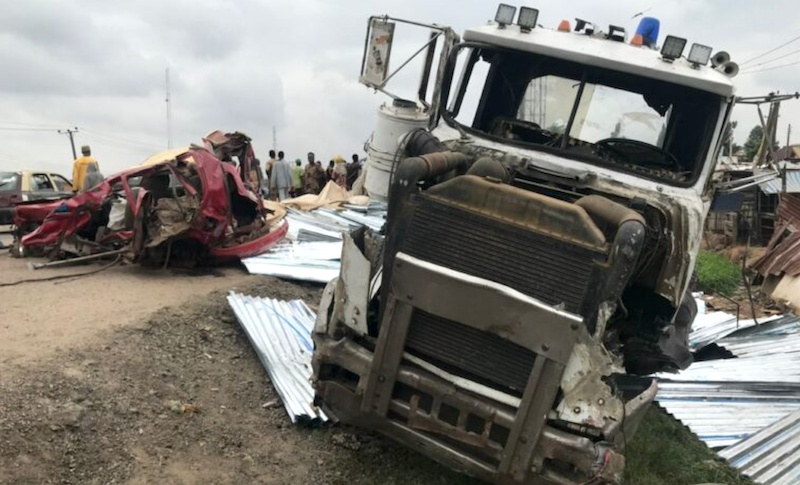
A Lagos State Traffic Management Authority (LASTMA) officer and two other road users were killed on Monday, 23 February 2026, after a fully loaded SHACMAN truck reportedly linked to Dangote Group logistics lost control at Badagry Roundabout inward Seme, Lagos.
Multiple reports said the incident followed an alleged brake failure, with the truck striking the officer on duty and two pedestrians, before coming to a stop about 200 metres away.
The driver reportedly fled but was later apprehended and handed over to the police.

The Lagos State Government has since mourned the dead, but on the streets the anger is sharper: residents say repeated “brake failure” explanations have become a predictable headline — and a warning that enforcement is failing.
“I watched the officer trying to control the traffic, then everything turned to chaos,” said “Kamal” , a commuter who told Headlinenews.news he was near the roundabout minutes before the crash.
“When you keep seeing these trucks inside crowded areas, you just know something bad will happen.”
A pattern of fatal crashes, not a one-off
This is not the first fatal incident publicly reported in Lagos involving a Dangote-branded truck and alleged brake failure.

In November 2024, Premium Times reported that three people were killed in Ayetoro, Epe, after a Dangote truck suffered brake failure and crashed, with officials confirming fatalities.
In December 2025, LASTMA-linked accounts carried by major outlets reported that a Dangote cement “silo mixer” truck, allegedly speeding, suffered brake failure at Iyana Meiran along the Lagos–Abeokuta Expressway, ramming a minibus and multiple tricycles, killing at least two people and injuring others.
To many residents, this growing list points to a basic question: why are high-risk vehicles repeatedly failing in high-density corridors without visible, lasting sanctions against the fleet operator chain?
“When accidents happen, they talk about the driver,” said “Mrs. Taiwo A.” a trader along the Badagry axis. “But who sent the truck out? Who certified the brakes? Who inspected it? If the company is big, does that mean we should die quietly?”
Compensation is where Nigeria feels most unjust
Beyond grief is a bitter second trauma: what happens after the burial.
Families often complain that compensation, when offered, is informal and inadequate — a payment that does not reflect the lifetime loss of a breadwinner or the future cut short for children.
There are repeated public allegations online that some settlements function like “hush money”; those claims are difficult to verify without court records.
What is clear is that in systems with strong liability enforcement, serious commercial-vehicle fatalities routinely trigger formal claims processes and court-supervised damages, not quiet bargaining at the roadside.

A retired security officer, “ASP (rtd.) Adetola”, told Headlinenews.news: “If you want deterrence, you must stop treating death like a negotiable inconvenience.
Once negligence is proven, compensation must be judicially determined and enforceable. Otherwise, the incentive to reform is weak.”
This is the pivot Nigerians are demanding: court-driven compensation and corporate liability, not discretionary “assistance” that leaves families trapped in poverty.

What stricter jurisdictions do when fleets keep killing people.
In the United Kingdom, regulators can revoke an operator’s licence and disqualify operators following serious safety failures, essentially removing unsafe operators from the road until they rebuild compliance.
Also in the UK, the Corporate Manslaughter and Corporate Homicide Act allows organisations to be held criminally accountable where serious management failures leading to a gross breach of duty of care result in death.
The Health and Safety Executive explains that the law targets management failure causing fatalities.

In the United States, the Federal Motor Carrier Safety Administration (FMCSA) has the power to place carriers out of service where violations pose an “imminent hazard” — a condition presenting a substantial likelihood of death or serious injury before lengthy proceedings can be completed.
In Rwanda, traffic authorities have publicly moved to enforce speed governor rules and penalise non-compliance — part of a broader culture of predictable enforcement that makes commercial driving less permissive.
In Ghana, the DVLA has published updated roadside penalties and reinforced roadworthiness compliance as part of safety enforcement, signalling that commercial road safety is treated as a regulatory discipline, not mere advice.

Nigeria does not need to copy foreign countries line-by-line.
But the principle is universal: repeated fatalities trigger escalating scrutiny of the operator, not sympathy for “another unfortunate accident”.
What Nigeria should do now.
If the Badagry deaths become just another condolence statement, the next crash is only a matter of time.
Headlinenews.news is calling for a clear, enforceable response:
First, publish the full chain of responsibility: truck ownership, contractor, route permit, driver credentials, speed limiter status, last maintenance/inspection records.
This must be disclosed in the official investigation summary, not buried.
Second, introduce “fleet accountability triggers”: after a set number of fatal incidents linked to a fleet (pending verified findings), regulators should mandate third-party audits, suspend operating permits on key routes, and compel corrective action before re-entry.

Third, designated truck corridors and time controls: ban high-load articulated trucks from dense urban corridors during peak hours, and enforce it with real penalties, not warnings.
Fourth, court-led compensation as a rule: where negligence is established, compensation should be determined through transparent legal processes aligned with global civil liability norms, reflecting long-term dependency loss.
That is how you end the culture of under-compensation. Families should not be pressured into accepting minimal payments that cannot sustain them.

Finally, prosecution where warranted: if maintenance negligence, overloading, speeding, falsified roadworthiness, or safety non-compliance is proven, charges should follow the evidence — not the company’s influence.
Dangote’s image — and Nigeria’s conscience.
Dangote Group is one of Africa’s most prominent corporate brands.
That status makes repeated fatal incidents a reputational threat.
But more importantly, it makes reform a moral obligation.
The deaths at Badagry were not “statistics”. They were a public officer on duty and citizens whose lives ended on an ordinary day.
The question Nigeria must answer is brutal and simple: will commercial logistics continue to enjoy a culture of impunity — or will the law finally value poor people’s lives the same way it values corporate power?
Dr. Imran Khazaly
Headlinenews.news Special Investigative Report.




