

The Nigerians in Diaspora Commission (NiDCOM) said on Monday, March 2, 2026, that it has not received any distress calls from Nigerians residing in Iran amid the ongoing hostilities between Iran and the United States and Israel.

NiDCOM Director of Media and Public Relations, Abdur-Rahman Balogun, disclosed this in a telephone interview with Vanguard, clarifying that while there may be Nigerians in Iran, none had officially reached out for assistance.
“I’m not saying there are no Nigerians there, I’m only saying nobody has sent any distress call,” he stated.

He explained that flight cancellations to the region are due to active hostilities, stressing that no airline will operate in a war zone.
“You cannot fly where bombs are going up and down. No airline will fly,” he said, noting that the situation affects all nationals, not just Nigerians.

“There may be ceasefire for two or three days to allow people who are stranded at the airport to be evacuated. That has not been done,” he added.
Asked about the estimated number of Nigerians potentially affected, Balogun said NiDCOM lacks such data and advised inquiries be directed to the Ministry of Foreign Affairs.

“We don’t have embassies there. The only person controlling embassies is the Minister of Foreign Affairs. They will be able to tell you,” he said.
He noted that Nigerians typically travel to Iran as private individuals, often connecting through countries such as the United Arab Emirates or Greece.
On the possibility of activating a full evacuation plan, Balogun said certain conditions must be met.
“You cannot force them; people went there voluntarily. In Sudan and Ukraine, some initially said they were not leaving. So people must seek for help and say, ‘our lives are in danger, can you evacuate us?’”

He affirmed that once such requests are made and conditions allow, the Federal Government could arrange emergency measures, including chartering aircraft and setting up a rescue committee.
“They must be Nigerians and be ready to come back home,” he stated.
He stressed that protecting Nigerians abroad remains a core responsibility of the Federal Government under its citizen diplomacy policy.

“If the life of any Nigerian is in danger and it reaches out to us, the Federal Government will look for a way out. Even if we don’t have an aircraft, we can lease or hire for that operation,” he added.
“As far as I know, I’m not aware that anybody has sent a distress call,” he maintained, noting that international protocols must also be observed amid global airspace restrictions.
Foreign Ministry monitoring situation
The Ministry of Foreign Affairs said it is considering evacuation options for Nigerians in the war-torn region as soon as normalcy returns.
Spokesman Kimiebi Imomotimi Ebienfa told Vanguard: “We are considering that option while monitoring the situation.”
Shi’ites protest attacks in Lagos
Also on Monday, members of the Islamic Movement in Nigeria (IMN), commonly known as Shi’ites, staged a peaceful protest in Lagos against the U.S.-Israeli attacks on Iran and the killing of Supreme Leader Ayatollah Ali Khamenei.
Protesters marched through parts of the Maryland area, carrying placards and banners denouncing what they called an “invasion” of Iran and chanting anti-U.S. and anti-Israel slogans.

South-West Coordinator of IMN, Muftau Zakariya, said the protest was to highlight persistent foreign incursions into sovereign nations, citing Venezuela as a recent example.
“Nothing good is coming from the US intervention. It is only interested in its economic gains, not minding the consequences thereafter,” he said.
Another IMN leader, Muhammadu Bashir, said the demonstrations would remain peaceful and continue across the region.
The protests follow similar demonstrations in Kano, Sokoto, Gombe, Niger, Kaduna, Bauchi, and Yobe states on Sunday.
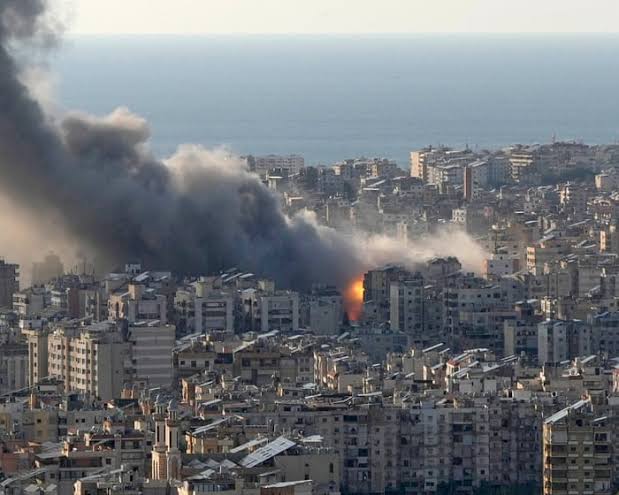
Conflict spreads to Lebanon as Iran strikes Saudi Arabia, Qatar energy sites
The war expanded across the Middle East and beyond on Monday, with Lebanon-based Hezbollah entering the conflict by targeting a British air base in Cyprus.
Lebanese officials reported at least 31 deaths in Israeli strikes.
In retaliation, Iran struck major gas plants in Qatar and Saudi Arabia, forcing a pause in operations at both facilities and driving oil and gas prices higher.

Several U.S. warplanes were reportedly shot down by Kuwaiti air defences in error, though all crew members survived.
Ayatollah Ali Khamenei’s wife, 79-year-old Mansoureh Khojasteh Bagherzadeh, died from injuries sustained three days after the strike that killed her husband and several senior Iranian commanders.
Vowing revenge, Iran’s security chief said Tehran is not willing to negotiate with the U.S., contradicting President Donald Trump’s claims that Iran had reached out for talks.
Trump said U.S. strikes will continue in full force until all objectives are achieved, adding that the war will likely last four weeks.
He admitted more casualties are possible after U.S. Central Command confirmed four U.S. soldiers killed in an Iranian attack.
UK Prime Minister Sir Keir Starmer said Britain has accepted a U.S. request to use some of its military bases.
Saudi Arabia halted some operations at its Ras Tanura refinery after an attack caused a fire, with the Energy Ministry reporting “minor damage from falling debris” due to the interception of two drones.
QatarEnergy also paused LNG production after attacks on facilities in Ras Laffan and Mesaieed.
The U.S. and allied Gulf states condemned Iran’s “indiscriminate and reckless attacks,” reserving the right to self-defence.
French Foreign Minister Jean-Noël Barrot expressed solidarity with affected Gulf nations, saying France stands ready to assist under defence agreements and international law if further attacks occur.
France, Germany, and the United Kingdom warned Iran against escalation, stating they are prepared to defend their interests and allies.
Bonny Light crude surged to $80 per barrel on Monday, up from $70 the previous day — the highest since July 2025 — amid fears of supply disruptions.
Other crudes also rose sharply: Brent to $79.08, Murban to $81.05, and WTI to $72.24 per barrel.
Shipping traffic through the Straits of Hormuz has declined sharply, with major carriers suspending transits despite no formal closure.
OPEC+ agreed to increase output starting April 2026, resuming the unwinding of 1.65 million barrels per day of voluntary adjustments.




