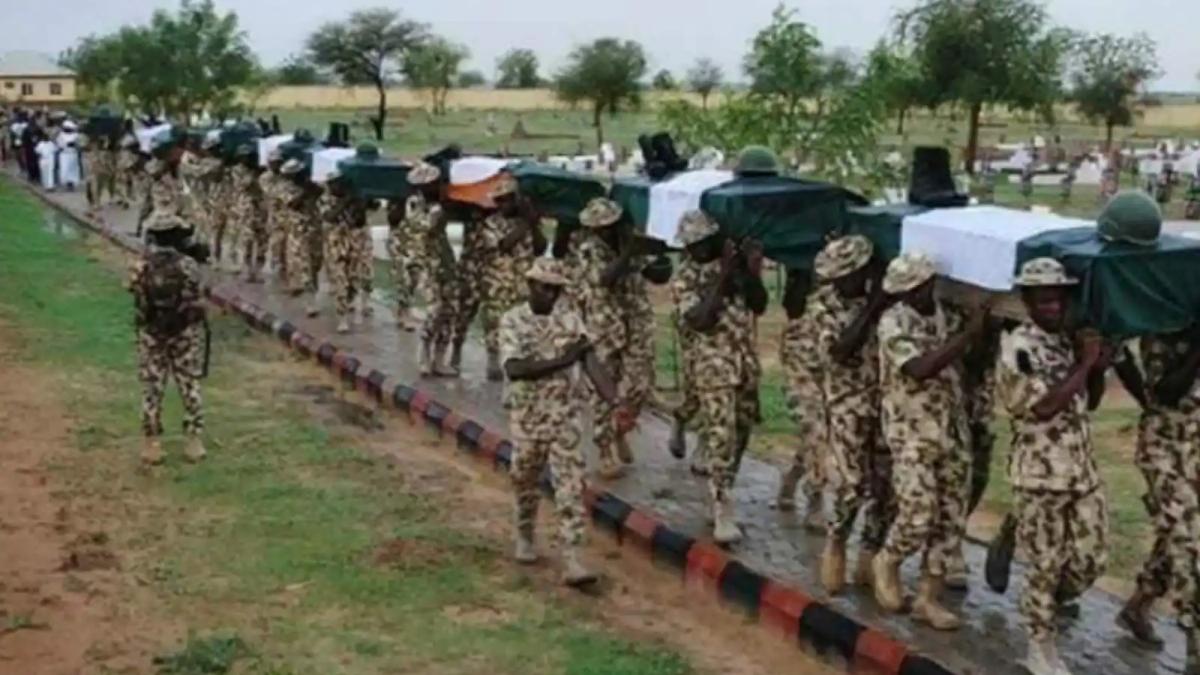
Concerns Grow After Deadly Boko Haram Attacks on Nigerian Military Bases in Borno
Fresh concerns and widespread speculation have emerged online following a series of deadly attacks carried out by Boko Haram insurgents on Nigerian military formations in Borno State.
Reports indicate that in the first week of March 2026, more than 100 Nigerian soldiers were killed after coordinated assaults on several military bases, including those located in Konduga, Mainok, Jakana and Marte.

The attacks, which reportedly occurred between late Thursday night and the early hours of Friday, were initially denied by the Nigerian Army before military sources later confirmed the incidents.
One military source described the situation as devastating, revealing the scale of the casualties.
“We lost over 40 soldiers to those attacks. It’s so sad. We still cannot find some of our men and we cannot say if they are alive or dead, but over 40 bodies have been recovered as of now,” the source said.
The severity of the attacks has sparked intense debate on social media, with some users questioning whether the timing may be linked to the recent arrival of United States military personnel in Nigeria.
A user on X, identified as Biggest Mack, alleged that the presence of American troops might be connected to the spike in attacks.
“The American troops who arrived to help ‘train’ Nigerian soldiers may well be the ones helping Boko Haram to ensure Nigeria has no soldiers left. They are probably feeding Boko Haram with the intelligence to ambush Nigerian soldiers,” the user wrote.
He further questioned the impact of the American deployment, asking whether there had been any tangible achievements since the troops arrived.

However, there is currently no official evidence supporting such claims.
In February 2026, military aircraft from the United States Armed Forces began arriving in Nigeria after both governments announced the deployment of about 200 American soldiers to assist with advisory and training roles as part of counterterrorism efforts.
According to U.S. officials, the mission is temporary and aimed at supporting targeted operations against extremist groups operating in the region.
Nigeria’s Defence Headquarters also clarified that the American personnel are technical specialists working strictly in advisory and training capacities.
Military authorities stressed that the foreign troops are not combat forces and that all activities are conducted under the authority and control of the Nigerian government in collaboration with the Armed Forces of Nigeria.
Despite these assurances, the deployment has drawn criticism from several Nigerian civil society figures.
In a joint statement titled “No to Foreign Forces in Our Land: Defend Our Sovereignty,” prominent individuals including Femi Falana and Jibrin Ibrahim raised concerns about the implications of foreign troops operating within the country.

Meanwhile, disturbing videos circulating online appear to show heavily armed insurgents firing weapons and setting parts of a military camp ablaze during the attacks. The footage also displayed weapons, ammunition, military vehicles and motorcycles which the fighters claimed were captured from Nigerian troops.
Among the officers reportedly killed were two lieutenant colonels identified as SI Iliyasu and Umar Farouq, as well as two majors, Segun Amusan and Ibrahim Mairiga, and a lieutenant identified as Ejeh.
The violence also spread to other parts of Borno State. Insurgents reportedly attacked forward operating bases at Banki Junction along the Bama–Gwoza Road and in Ngoshe. Another attack was reported in Kukawa Local Government Area.
In a separate incident, troops of the 21 Special Armoured Brigade conducting clearance operations in Sambisa Forest were reportedly ambushed while on patrol.
Nigeria continues to face multiple security challenges, including the long-running insurgency by Boko Haram and attacks by other armed groups such as Islamic State West Africa Province, the IS-linked Lakurawa faction, as well as criminal bandit groups involved in kidnapping for ransom and illegal mining.
Although the Nigerian military maintains that the insurgency has been significantly weakened over the years, attacks on troops and communities in parts of the North-East continue to raise serious security concerns.