By Dr. Mohammed Musa Zango, FPSN
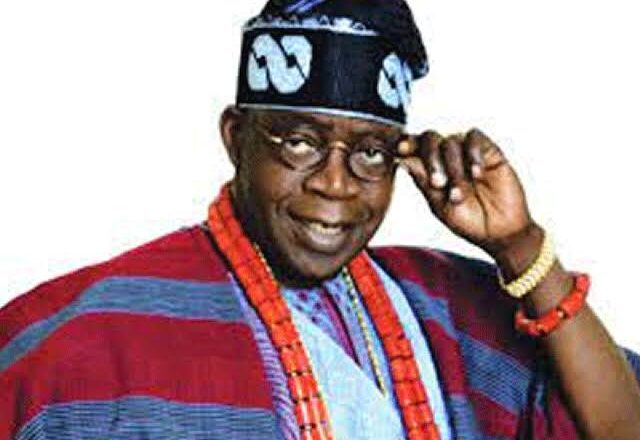
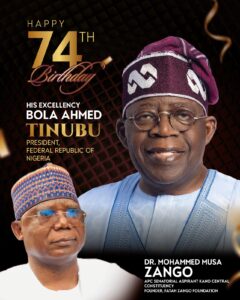
As President Bola Ahmed Tinubu marks his 74th birthday, Nigeria—particularly the North—faces a difficult but defining moment.
The reality is stark: rising hardship alongside far-reaching economic reforms.
This moment demands assessment not through emotion or regional sentiment, but through facts, constitutional responsibility, and a clear understanding of Nigeria’s federal structure.

Across Northern Nigeria, the pressures are real and immediate.
Food prices have surged, transport costs have risen, and small businesses are under strain. Insecurity continues to disrupt farming communities, limiting production and affecting livelihoods.
These are not abstract concerns; they are lived experiences. Recognising this hardship does not weaken the case for reform—it strengthens the urgency for those reforms to translate into visible relief.
President Tinubu assumed office at a time when Nigeria’s economy was burdened by long-standing distortions: an unsustainable fuel subsidy regime, multiple exchange rates, weak infrastructure, and a governance culture that often avoided difficult decisions.
His administration chose a different path—one defined by structural correction rather than short-term comfort.
Two policies have defined this shift: the removal of fuel subsidies and the unification of the foreign exchange market.
These decisions have been painful in the short term, but they have also freed significant fiscal resources.
Between March 2024 and August 2025, over ₦2.45 trillion was released to states and the Federal Capital Territory to support infrastructure, security, and social interventions.
This redistribution of resources presents both an opportunity and a test of governance at the subnational level.
This brings us to a critical issue that must be clearly understood, particularly in Northern Nigeria: under Nigeria’s federal system, the President sets national direction, but he does not run the states.
Governors hold primary responsibility for how federal allocations are utilised and how policies impact daily life.
If increased funding does not translate into improved healthcare, education, roads, agricultural support, and local security, then accountability must follow responsibility at the state level.

A useful case study is Kano State under Governor Abba Kabir Yusuf.
Recent initiatives in education, healthcare, infrastructure, agriculture, and youth empowerment reflect a deliberate attempt to translate public resources into visible outcomes.
These include expanded access to basic education, rehabilitation of healthcare facilities, infrastructure upgrades, and targeted support for farmers and small businesses.
While challenges persist, Kano demonstrates how state-level leadership can shape how federal reforms are experienced at the grassroots.
It also underscores a broader truth: national progress depends heavily on the effectiveness and accountability of state governments.
Another area that has generated concern is the rising cost of Premium Motor Spirit (PMS).
For many Nigerians, the increase appears sudden and burdensome, fuelling the perception that hardship is policy-driven.
However, the reality is more complex.
With subsidy removal, domestic fuel prices are now influenced by global oil markets, exchange rate fluctuations, and supply chain dynamics.
Geopolitical tensions affecting oil supply routes, including disruptions in key maritime corridors, have further compounded volatility. These are global pressures, not uniquely Nigerian.
What is required is clearer communication and targeted relief mechanisms to help citizens navigate this transition, alongside policies that gradually stabilise domestic supply chains.
Beyond macroeconomic reforms, the administration has prioritised infrastructure as a driver of long-term growth.
Several major road projects are underway across Northern Nigeria.
The Abuja–Kaduna–Kano Expressway is being reconstructed with significant federal investment.
The Kano–Maiduguri Road, Kano–Katsina Road, Zaria–Funtua–Gusau–Sokoto corridor, and Kano–Hadejia Road are all receiving attention.
According to the Minister of State for Works, a substantial portion of ongoing federal road projects is concentrated in the northern region, reflecting a deliberate effort to improve connectivity, trade, and mobility.
In addition, legacy infrastructure corridors are being developed to strengthen national integration.
These include the Sokoto–Badagry Superhighway, the Lagos–Calabar Coastal Highway, and strategic inland routes connecting key economic zones.
While some of these projects are long-term, their successful execution will significantly reshape economic opportunities across regions.
In the North-East, federal interventions are focused on recovery and stabilisation.
Road rehabilitation, housing projects, and community infrastructure are gradually restoring livelihoods disrupted by years of insurgency.
Agricultural support programmes, including the $158.15 million Value Chain Programme, are helping states such as Kano, Katsina, Jigawa, Sokoto, and Zamfara improve productivity and rural incomes.
Energy infrastructure also holds significant promise.
The Ajaokuta–Kaduna–Kano (AKK) gas pipeline, alongside planned power projects, has the potential to transform Northern Nigeria’s industrial landscape.
By providing reliable gas supply, the project can support power generation, revive manufacturing—particularly in Kano’s textile sector—stimulate petrochemical industries, and create large-scale employment.
It also offers a pathway toward cheaper and cleaner energy for transportation and households through compressed natural gas.

As the administration advances its reform agenda, several areas deserve accelerated attention, particularly in Northern Nigeria.
The Kaduna–Kano rail line and the Abuja–Kaduna–Zaria–Kano highway should be fast-tracked to completion, as they directly impact mobility, trade, and the cost of living.
A defined portion of savings from fuel subsidy removal and additional tax revenues should be ring-fenced to support education, healthcare, agriculture and transportation through dedicated trust mechanisms, ensuring reforms translate into visible social investments.
The Ajaokuta–Kaduna–Kano (AKK) gas pipeline and the concurrent independent power projects must be accelerated to ensure timely delivery of affordable energy, stimulate industrial growth, and unlock large-scale employment across the region.
It is therefore imperative that all stakeholders align behind the Federal Government to fast-track the completion and commissioning of this transformative project, which holds significant socio-economic promise for Northern Nigeria.
However, infrastructure and policy alone are not enough.
The success of these reforms will ultimately be measured by their impact on ordinary Nigerians.
This requires not only sustained federal commitment but also disciplined execution at the state and local levels. Transparency, monitoring, and accountability must become central to governance across all tiers.
President Tinubu has consistently projected himself as a leader for all Nigerians, emphasising unity and reform.
Concerns about regional balance and the pace of relief are legitimate and should be addressed through inclusive policies and open communication.
But it is equally important to separate structural reform from immediate outcomes.
Transformational policies often come with initial hardship; their success depends on how effectively they are implemented and how quickly they deliver tangible benefits.
At 74, President Tinubu stands at a critical juncture in Nigeria’s history.
The choices being made are not easy, but they are consequential.
For Northern Nigeria, the task is to engage with these reforms constructively—acknowledging hardship, demanding accountability at all levels, and measuring progress through real improvements in daily life.
Ultimately, governance in a federal system is shared responsibility.
The President can set direction and provide resources, but he cannot substitute for state leadership.
If reforms are to succeed, governors must be held accountable for delivering results to the people.
The National Patriots maintain that reform without execution is merely intention.
The true test of leadership lies not only in bold decisions, but in the speed and discipline with which those decisions translate into measurable improvements in the lives of citizens.
Northern Nigeria stands at a pivotal point where infrastructure, energy, and social investment must converge into visible progress.
As President Bola Ahmed Tinubu has affirmed, “the reforms we have undertaken are difficult but necessary to secure Nigeria’s long-term stability and prosperity.”

May Almighty Allah grant President Bola Ahmed Tinubu wisdom, strength, and good health.
May his leadership guide Nigeria toward greater stability, unity, and prosperity. And may the collective efforts of all levels of government translate into meaningful progress for every Nigerian. Amen.
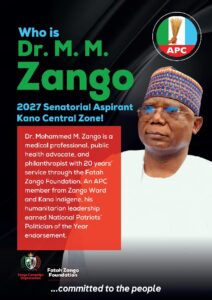
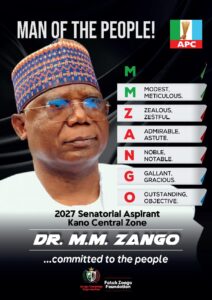
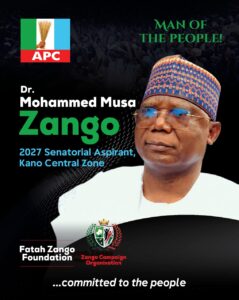
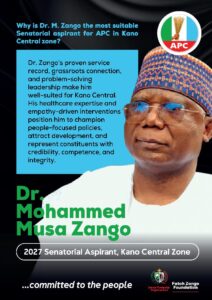
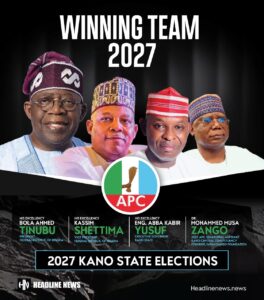
Dr. Mohammed Musa Zango, FPSN
2027 APC Senatorial Aspirant, Kano Central Constituency
Founder, Fatah Zango Foundation
Recipient, National Patriots Distinguished Service Award for Humanitarian Excellence