
By Princess Gloria Adebajo-Fraser, MFR
For Headlinenews.news
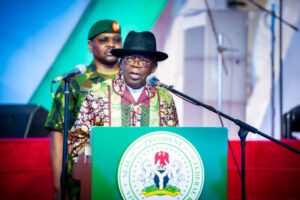
President Bola Ahmed Tinubu’s visit to Bayelsa State was not just another ceremonial outing. It was a carefully staged moment to confront a difficult national conversation—fuel prices, economic hardship, and the question Nigerians are increasingly asking: Is this pain justified?
Standing before a crowd in Yenagoa, the President did not attempt the usual political escape route. He admitted the obvious: fuel prices are high and the impact is severe. Transport costs have surged, small businesses are under pressure, and households are adjusting daily to a more expensive reality. But Tinubu took the argument further—into uncomfortable but necessary territory.

Nigeria, he said, is not alone.
That statement, simple as it sounds, is politically risky. Nigerians do not measure their hardship against Kenya, Ghana, or any other country. They measure it against what they could afford yesterday. Yet Tinubu’s point was strategic: the current energy strain is not purely a Nigerian failure—it is part of a wider global distortion driven by supply disruptions, geopolitical tensions, and structural inefficiencies across emerging economies.
This is where the real debate begins.
For decades, Nigeria operated an artificial fuel pricing system sustained by subsidy. It created short-term relief but long-term damage—discouraging local refining, encouraging smuggling, draining public finances, and distorting investment signals. The removal of subsidy did not create the crisis Nigerians feel today; it exposed it.
Tinubu’s argument, whether popular or not, is that Nigeria is now facing the true cost of energy.
And that truth is harsh.
But Bayelsa was not only about explaining hardship. It was about presenting a counterbalance—evidence that reform is not just subtraction, but construction.
The President commissioned key infrastructure projects, including a 60MW gas-fired power plant, major road networks, and a strategic bridge linking previously isolated communities. These are not symbolic projects. They speak to a broader shift in policy direction: decentralised energy, subnational development, and infrastructure-led growth.
This matters because Nigeria’s long-standing energy problem has never been fuel alone—it is power.
For years, Nigerians have paid twice for energy: once at the pump and again through generators. The absence of reliable electricity has made petrol and diesel not just transport fuels, but survival tools. Any serious reform must therefore go beyond pricing and address supply, distribution, and generation.
This is where Tinubu’s policy framework begins to take shape.

The Electricity Act reform, which allows states to generate and manage power independently, represents a structural break from the past.
Bayelsa’s new power plant is an early example of what that decentralisation can produce. If replicated across states, it could gradually reduce dependence on generators and, by extension, ease the indirect pressure caused by high fuel costs.
But here is the hard truth: policy direction alone does not ease immediate pain.
Nigerians are not wrong to feel frustrated.
Inflation has tightened living conditions.
Transport costs ripple into food prices.
Businesses are adjusting margins or shutting down. The expectation that a major oil-producing country should provide affordable energy is not unreasonable—it is logical.
This is where Tinubu’s comparison with other African countries must be understood carefully.
Yes, several economies are facing similar pressures. Yes, global energy volatility has raised costs across the board. But comparison is not comfort. It is context.
And context does not replace relief.
The real test for the administration is not whether Nigeria is “better off” than others in energy availability. It is whether Nigerians begin to feel measurable improvement in their daily lives—more stable electricity, reduced reliance on generators, improved transport efficiency, and gradual price stabilisation.
That is the benchmark.

What Tinubu did in Bayelsa was to reset the narrative: from denial to admission, from blame to explanation, and from explanation to demonstration. He acknowledged hardship, defended reform, and pointed to infrastructure as proof of forward movement.
But Nigerians will judge results, not reasoning.
The coming months will be critical. If decentralised power begins to scale, if refining capacity stabilises supply, and if targeted relief mechanisms are introduced for the most vulnerable, the current hardship may eventually be seen as a painful but necessary transition.

If not, the comparison with other countries will become politically irrelevant.
Because at the end of the day, citizens do not live in comparisons—they live in realities.
Tinubu has chosen a difficult path: confronting structural problems rather than masking them. That choice carries risk, but also the possibility of long-term stability if executed with discipline, speed, and empathy.
Bayelsa was not the solution.
It was the message.
The National Patriots observe that leadership is often tested not in moments of comfort, but in periods of necessary correction. Nigeria’s current energy challenges reflect years of structural imbalance now being confronted. While the hardship is undeniable, citizens must distinguish between temporary strain and long-term reform. Government, however, must match policy courage with practical relief—especially for vulnerable populations. Comparative narratives alone cannot substitute for tangible improvement in daily life. The path forward requires transparency, accelerated infrastructure delivery, and inclusive economic cushioning. National stability depends not just on reform, but on how fairly and effectively its burden is managed.
Princess G. Adebajo-Fraser MFR.
President, the National Patriots.