Tinubu, Zango, Others Secure APC Forms as 2027 Race Gathers Steam Nationwide
“In politics, timing is advantage—and early birds rarely wait.”
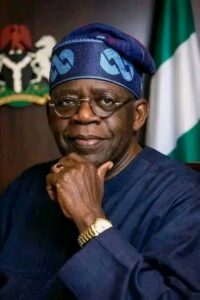
The 2027 political contest within the ruling All Progressives Congress (APC) moved from speculation to structure on Tuesday as President Bola Ahmed Tinubu and a widening field of aspirants formally obtained nomination forms, signalling the start of a high-stakes electoral cycle defined by early positioning, internal alignments and emerging rivalries.

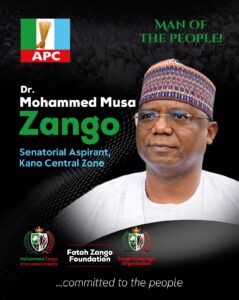
Among those drawing attention is Dr. Mohammed M. Zango, FPSN, Founder of the Fatah Zango Foundation and a leading APC senatorial aspirant for Kano Central, who picked up his form shortly after the President—an early entry that places him firmly within the first wave of contenders shaping the race. Within Kano political circles, Zango is increasingly framed as part of a new generation of leadership: one rooted in long-standing public service, philanthropy and constituency-focused engagement.
Having spent over three decades in the Nigerian National Petroleum Company (NNPC), his transition into electoral politics reflects a broader trend of technocrats seeking legislative influence. His supporters argue that his humanitarian track record and grassroots interventions through his foundation position him as a credible bridge between policy and people, particularly in a region where representation is often judged by visible impact rather than rhetoric.
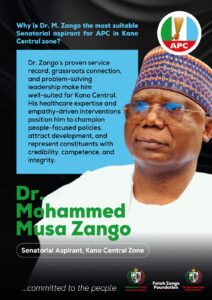
Importantly, political observers in Kano note that Zango’s entry comes at a time of heightened fragmentation within the state’s APC structure. He is being positioned by supporters as a neutral and unifying figure capable of bridging divides between legacy blocs that came together to form the party in Kano. This positioning—if it holds—could prove significant in a state where internal cohesion has often determined electoral outcomes. His messaging, which emphasises inclusive development and pragmatic governance, also aligns with broader calls for continuity in people-focused initiatives, including the “Kano First” development approach associated with Governor Abba Kabir Yusuf, suggesting a cross-party developmental outlook rather than a purely adversarial posture.

Further reinforcing his grassroots appeal, sources close to his campaign confirm that the purchase of his nomination form was collectively funded by the Fatah Zango Foundation, concerned stakeholders, and youth groups, who mobilised resources in a show of loyalty and confidence in his candidacy. While such gestures are not uncommon in Nigerian politics, the scale and diversity of contributors point to an organised support base and a perception among backers that he represents a viable and people-oriented option for Kano Central.
At the presidential level, Tinubu’s form was obtained by allies including Ikeja federal lawmaker James Faleke, who dismissed opposition coalition talks as politically routine and strategically inconsequential. The APC, he insisted, remains structurally prepared, citing grassroots mobilisation, data-driven campaign planning and internal cohesion as key strengths heading into 2027.
The party’s timetable places the sale of forms between late April and early May 2026, with primaries scheduled to conclude by the end of May. The Independent National Electoral Commission (INEC) has fixed presidential and National Assembly elections for January 16, 2027, and governorship polls for February 6, setting a compressed but decisive timeline for political consolidation.

Across states, the ripple effects are already visible. In Lagos, Deputy Governor Obafemi Hamzat secured the endorsement of the Governance Advisory Council (GAC) as a consensus governorship candidate—an outcome that has triggered internal dissent from aspirants who argue that consensus politics risks undermining competitive primaries.
In Ogun, former governor Gbenga Daniel’s senatorial ambition has collided with that of Governor Dapo Abiodun, raising the likelihood of direct primaries. Similar contestations are unfolding in Nasarawa, Bauchi, Rivers and Abia, where multiple aspirants—including former Inspector-General Mohammed Adamu, Senator Shehu Buba, and businessman Tonye Cole—have stepped forward, underscoring the scale of intra-party competition.
Beyond personalities, the early start to the race reflects deeper political recalibration. With reforms introduced since May 29, 2023—most notably the removal of fuel subsidy and ongoing fiscal restructuring—the Tinubu administration has anchored its re-election narrative on long-term economic correction rather than short-term populism. Indicators frequently cited by government supporters include improved fiscal flows to subnational governments, exchange rate unification, and renewed investor interest in key sectors such as oil, gas and digital infrastructure.

However, these gains remain contested. While macroeconomic indicators show signs of adjustment, the immediate cost-of-living pressures have sharpened public scrutiny, creating a political environment where performance narratives must compete with lived economic realities.
This is where the 2027 contest is likely to be decided—not merely on slogans or alliances, but on measurable outcomes, credibility of candidates, and the electorate’s willingness to weigh reform pain against projected long-term stability.

Figures like Zango, entering the race with a technocratic, humanitarian and unifying profile, illustrate an evolving voter expectation: competence anchored in service delivery and the ability to build bridges across factions. At the same time, established political heavyweights continue to rely on structure, incumbency advantages and party machinery.
As nomination forms change hands across the country, one reality is already clear—the 2027 elections will not be a quiet transition but a layered contest of ideas, performance, and political organisation.
For voters, the task ahead is straightforward but demanding: to interrogate claims rigorously, separate evidence from noise, and assess each contender—whether incumbent or challenger—on demonstrable capacity to deliver governance that is both effective and people-centred.
The National Patriots.
“As President Bola Ahmed Tinubu and Dr. Mohammed M. Zango join other aspirants in securing APC nomination forms, the 2027 race is taking structured shape nationwide. Zango’s early entry and grassroots-backed candidacy highlight emerging technocratic influence, while Tinubu’s reform-driven agenda anchors continuity debates.
Across states, competitive alignments are unfolding within a framework defined by party rules. The APC’s orderly process, adherence to timelines, and internal dispute mechanisms project an image of institutional discipline, signalling to Nigerians a party prioritising structure, legality, and political stability ahead of the elections.”
President Bola Ahmed Tinubu, GCFR, recipient of the National Patriots Distinguished Leadership Award for Courageous Economic Reforms and National Transformation…
Dr. M. Zango FSPN is a Recipient of the National Patriots Distinguished Service Award for Humanitarian Excellence (In Recognition of Outstanding Commitment to Community Development and National Service)
Dr. G. Fraser. MFR
The National Patriots.
Headlinenews.news Special Report.