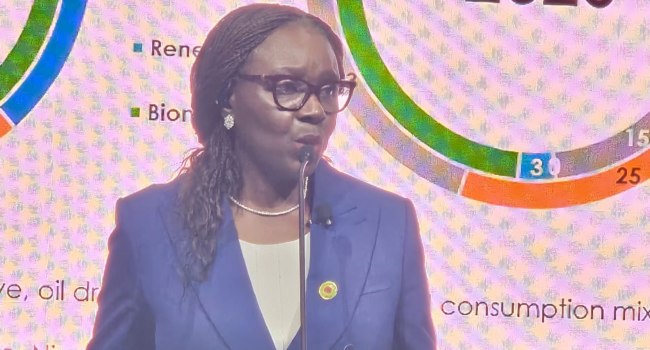
Nigeria has revealed strong investor interest in its latest oil and gas licensing round, with nearly 300 applications received for about 50 available assets, signaling renewed confidence in the country’s energy sector.
The Chief Executive Officer of the Nigerian Upstream Petroleum Regulatory Commission (NUPRC), Oritsemeyiwa Eyesan, made this known on Monday at the Nigerian Pavilion of the Offshore Technology Conference (OTC) 2026 in Houston, Texas.
According to her, the level of participation reflects growing global attention on Nigeria’s upstream sector and the opportunities emerging from ongoing reforms.
“We have about 50 assets on offer and nearly 300 applicants. That tells you the opportunities are significant, and the story will change rapidly,” Eyesan said.

She explained that the country’s oil and gas industry is undergoing what she described as a “quiet but far-reaching transformation,” driven increasingly by indigenous operators, regulatory reforms, and a shift toward cleaner energy practices.
Eyesan noted that nearly 100 Nigerian companies are now actively operating in the sector, a significant change from years past when international oil companies dominated the landscape.
At the centre of the government’s strategy are ambitious climate and energy targets, including an end to routine gas flaring by 2030 and net-zero emissions by 2060. She disclosed that gas flaring has already dropped below 10 percent, with efforts underway to further reduce it through commercial utilisation projects.
“We are not just penalising flaring. We are commercialising it,” she said, adding that flare gas recovery initiatives could generate up to three gigawatts of electricity.
She also pointed to emerging investments in solar-powered offshore facilities and carbon capture technologies as part of Nigeria’s broader decarbonisation push, stressing that the transition would be gradual and balanced rather than a complete departure from hydrocarbons.

Describing the Petroleum Industry Act as a “game changer,” Eyesan said the reform has improved regulatory clarity and investor confidence, though she noted that continued policy adjustments remain necessary to maintain competitiveness.
On the downstream sector, she highlighted the removal of fuel subsidies as a major shift that is already encouraging the adoption of alternative energy sources such as compressed natural gas (CNG), supported by expanding gas infrastructure.
“Nigeria is a major player, but I see us as a beacon for Africa. We have the resources to expand energy access, reduce energy poverty, and support industrialisation across the continent,” she said.
Speaking at the same event, PETAN Chairman Wole Ogunsanya said Nigeria’s strong presence at OTC 2026 reflects resilience in the face of global energy uncertainty and a collective commitment to boosting production capacity.
He added that the country is moving closer to achieving a major refining milestone, with projections suggesting up to one million barrels per day in domestic refining capacity—an achievement expected to significantly reduce import dependence and strengthen energy security.