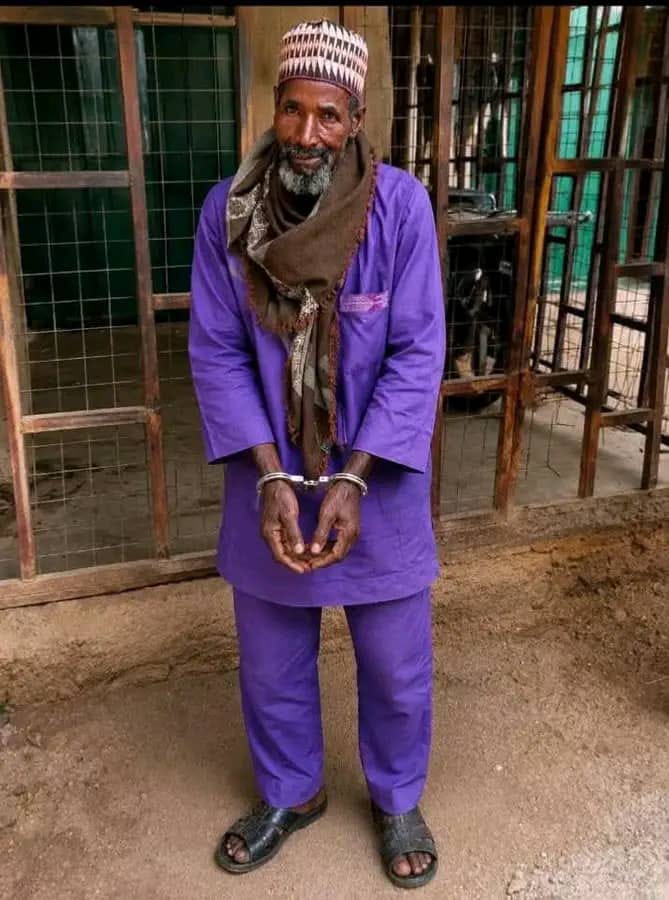
INSECURITY!
WHEN THE THREAT ALLEGEDLY CAME FROM WITHIN: MALLAM ADAMU REDDINGTON.
By Headlinenews.News Special Investigative Desk.
The disturbing case of the man dubbed “Ray-Adam” raises questions about informants, community infiltration and the hidden networks sustaining insecurity
There is the enemy carrying a gun in the forest. Then there is the potentially more dangerous figure: the familiar face inside the community who allegedly knows the houses, the families, the movements and vulnerabilities of those the gunmen intend to attack.
That is the disturbing allegation now surrounding Mallam Adamu Reddington of Hong — a man whose case, if the accusations against him are ultimately established, offers a chilling illustration of how criminal networks may penetrate the very communities they terrorise.

Call him the “Ray-Adam” of Hong: a man accused of operating between two worlds.
On one side was the public image of a family and community man, reportedly participating in peace and security discussions and moving among residents without attracting the suspicion ordinarily associated with violent criminality.
On the other side are allegations that he secretly served as an intelligence link for armed bandits — supplying information about the same community whose security he ostensibly appeared concerned about.
That contradiction is what makes the case particularly disturbing.
According to allegations surrounding his arrest, Adamu is accused of exploiting his familiarity with the community to provide criminal elements with information about residents, their homes and other details potentially useful in planning attacks.
These allegations remain allegations unless and until established through due process. But they raise an important security question that goes far beyond one suspect:
How does a community defend itself when those threatening it may already have someone on the inside?
An armed bandit approaching a village can be spotted. An informant who attends meetings, exchanges greetings with residents and enjoys their confidence is considerably harder to detect.
That is why intelligence networks are so valuable to organised criminal groups.
Attackers require more than weapons. They need information.
Who has money? Who recently returned home? Which family could pay a ransom? Where does a particular resident sleep? Which roads are monitored? When do security patrols pass? Who has travelled? Where are vulnerable access routes?
Someone, somewhere, may be supplying those answers.
If the allegations against Adamu are proven, the deepest betrayal would therefore not merely be association with criminals. It would be the alleged weaponisation of trust.
The irony is difficult to ignore. A person could participate in discussions about protecting a community while allegedly passing information to those threatening it. He could potentially stand among residents discussing an attack while knowing how the attackers obtained their intelligence.
That is not simply criminality. If established, it represents infiltration.
But this case must not become an excuse for ethnic or religious profiling.

Not every Fulani person is a bandit. Not every Muslim is associated with terrorism or violent crime. Criminal responsibility belongs to individuals and networks established by evidence, not entire ethnic groups, religions or communities.
Collective suspicion is both unjust and strategically foolish. It can alienate innocent citizens whose cooperation security agencies need.
The proper lesson is different: no criminal should receive protection because of ethnicity, religion, family ties, political connections or community affiliation.
Communities themselves have an important role to play.
The battle against banditry cannot be fought exclusively by soldiers, police officers and intelligence agencies. Residents must be prepared to report suspicious activities, unusual movements, unexplained relationships with criminal groups and individuals apparently supplying information to attackers.
At the same time, accusations must be investigated professionally. Suspicion cannot substitute for evidence, and vigilantism cannot substitute for justice.
Adamu’s appearance in custody therefore represents only the beginning of the legal process, not its conclusion. Investigators must establish precisely what happened, identify any communications or financial trails, determine whether other individuals were involved and, where credible evidence exists, place that evidence before a competent court.
Because if there was an intelligence pipeline, the arrest of one alleged informant may not dismantle it.
Nigeria’s experience with terrorism, kidnapping and banditry increasingly demonstrates that insecurity is sustained by ecosystems. Behind armed fighters can exist financiers, informants, logistics suppliers, arms traffickers, ransom negotiators, collaborators and individuals providing information about potential victims.
Breaking those networks is as important as confronting gunmen.
The most dangerous person, therefore, may not always be the armed stranger standing outside the gate.
Sometimes, it may be the trusted person who knows exactly what is behind that gate — who lives among the people, understands their routines and vulnerabilities, and allegedly tells the attackers when and how to enter.
If the allegations against Mallam Adamu Reddington are ultimately proven in court, his case should become more than another arrest statistic.

It should be a warning.
Nigeria cannot defeat insecurity by watching only the forests, highways and hideouts. Security agencies and communities must also identify the intelligence, financing and collaboration networks that enable violent groups to operate.
The question is no longer simply who is attacking the community from outside?
Increasingly, security must also ask the more uncomfortable question:


Who is secretly opening the door from within?
The National Patriots.
Headlinenews.News Special Investigative Desk.