BREAKING: Aviation Workers Ground Flights in Lagos, Abuja as Long-Threatened Industrial Action Erupts
Passengers stranded as unions picket Air Peace over alleged ₦15bn statutory remittances, workers’ unionisation rights
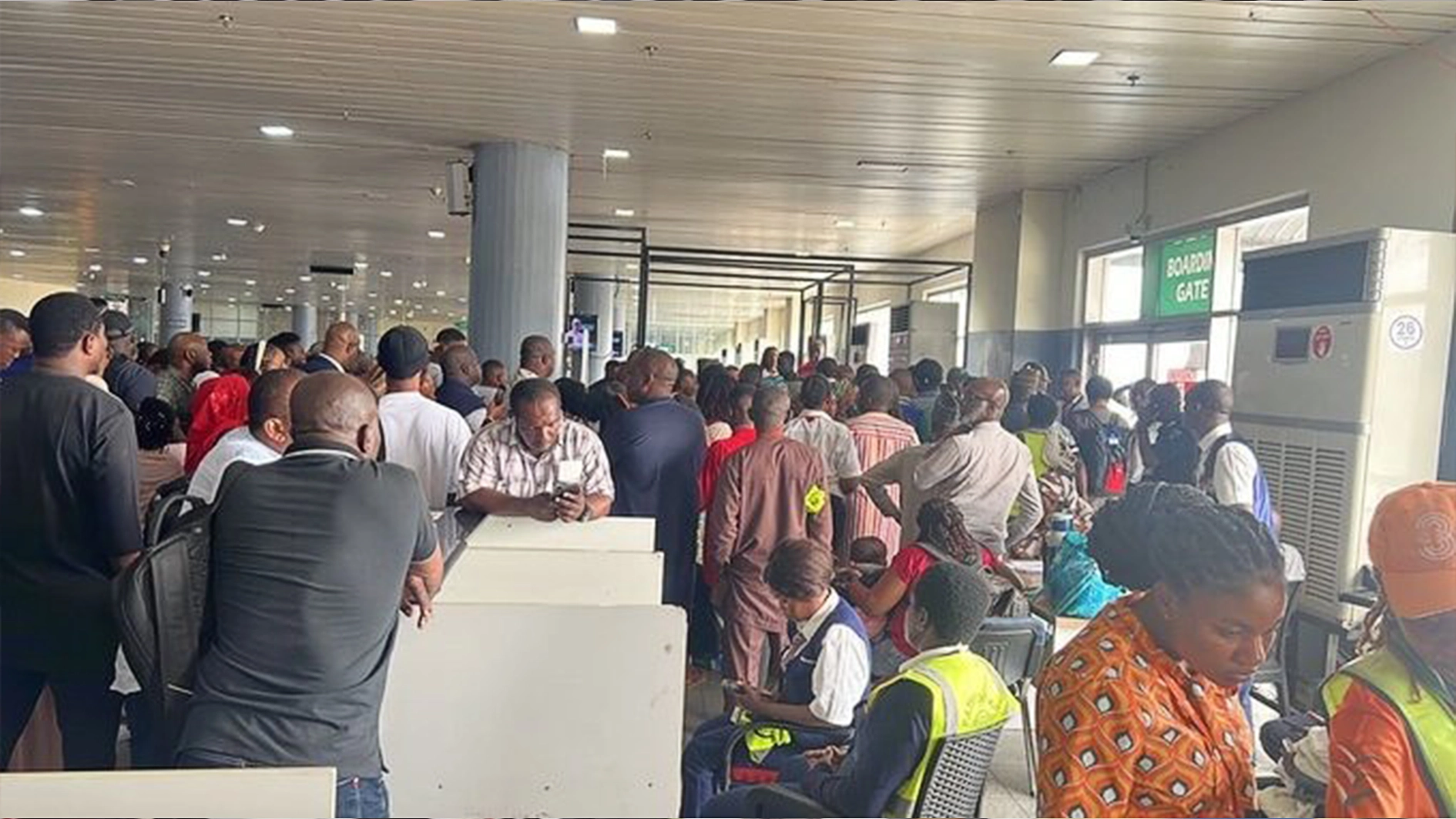
LAGOS/ABUJA — Nigeria’s aviation sector was thrown into major disruption on Tuesday morning as aviation workers launched industrial action at the country’s two busiest aviation hubs, grounding scheduled flights and leaving passengers stranded at airports in Lagos and Abuja.
The action, which had been threatened for weeks, escalated in the early hours of Tuesday, August 11, as aviation unions moved against Air Peace, blocking access to departure facilities at the Murtala Muhammed Airport in Lagos and the Nnamdi Azikiwe International Airport in Abuja.
The protest is being spearheaded by major aviation labour unions, including the National Union of Air Transport Employees (NUATE), Air Transport Services Senior Staff Association of Nigeria (ATSSSAN) and National Association of Aircraft Pilots and Engineers (NAAPE), with the backing of the Nigeria Labour Congress (NLC) and Trade Union Congress (TUC).
By Tuesday morning, the consequences were already being felt by travellers.
Access to Air Peace departure terminals at Murtala Muhammed Airport Terminal 1 — including the Alpha and Zulu terminals — as well as Terminal 2 was affected, while the airline’s operations at Nnamdi Azikiwe International Airport in Abuja were similarly disrupted.

Passengers arriving for scheduled flights encountered blocked access points, deserted check-in positions and uncertainty over departure times.
The development represents the culmination of a dispute that has been building since July rather than a sudden withdrawal of services by aviation workers.
On July 8, aviation unions issued airline operators a 14-day ultimatum demanding the remittance of outstanding statutory five per cent Ticket Sales Charges collected from passengers on behalf of aviation agencies.
When the dispute remained unresolved, the unions followed with another seven-day ultimatum in late July and subsequently warned on August 4 that industrial action could commence.
The unions maintain that the Ticket Sales Charge is not revenue belonging to individual airlines but statutory money collected from passengers for remittance to the Nigeria Civil Aviation Authority and distribution to designated aviation agencies.
Labour leaders have alleged that billions of naira collected through the mechanism have remained unremitted.
In the dispute involving Air Peace, unions have put the outstanding amount at approximately ₦15 billion, an allegation attributed to the unions and which should not be treated as an independently established debt until formally reconciled by the regulator and airline.
The unions argue that withholding the funds is starving aviation agencies of resources required for operations and frustrating the implementation of negotiated conditions of service for workers.
But money is only one half of the dispute.
Labour organisations are also accusing domestic airline operators of preventing employees from freely joining trade unions and allegedly creating working environments in which employees fear victimisation if they express an interest in union membership.

The unions are demanding explicit assurances from airline management that employees will be permitted to join unions of their choice without intimidation or retaliation.
Tuesday’s confrontation therefore represents the convergence of two longstanding grievances — statutory remittances and workers’ freedom to organise.
Air Peace confirmed that its operations had been disrupted, saying protesters barricaded entrances to its departure terminals in Lagos and Abuja.
The airline said the blockade prevented scheduled flights from departing the two cities and consequently affected passengers travelling across its network.
Air Peace apologised to stranded passengers and said customers scheduled to travel later Tuesday were being contacted with updates as the situation developed.
The disruption has also begun spreading beyond Air Peace.
United Nigeria Airlines announced a temporary suspension of flight operations, citing the industrial action and saying it would not compromise the safety of passengers and crew. The airline said operations would resume when normal conditions were restored.
The Nigeria Civil Aviation Authority has meanwhile intervened, appealing to the unions to suspend the action and return to negotiations.
Director-General of Civil Aviation, Capt. Chris Najomo, said the dispute could have been addressed at a meeting convened by Aviation and Aerospace Development Minister Festus Keyamo the previous week, but according to the NCAA, airline operators failed to honour the invitation.
The regulator has urged the unions to exercise restraint pending the minister’s return and has assured travellers that aviation safety oversight remains intact despite the industrial disruption.
That intervention has, however, come after weeks of escalating warnings.
The first major ultimatum in July was followed by another warning when the initial deadline failed to produce an agreement. By early August, the unions had made clear that airport picketing could follow without prolonged additional notice.
Tuesday’s disruption therefore raises questions over why negotiations were unable to produce a settlement before passengers became the immediate casualties of the industrial dispute.

Lagos and Abuja are the nerve centres of Nigeria’s domestic aviation network. Disruptions originating from the two airports can quickly produce knock-on effects across Port Harcourt, Kano, Enugu, Owerri, Benin, Uyo and other domestic destinations as aircraft and crews fall out of scheduled rotations.
A prolonged shutdown could consequently create considerably greater disruption than the passengers already stranded on Tuesday morning.
For thousands of Nigerians who depend on air travel for business, medical appointments, family commitments and connecting international flights, the dispute has moved beyond an argument between airlines and organised labour.
It has become a national transportation problem.
The immediate responsibility now falls on the Federal Ministry of Aviation and Aerospace Development, the NCAA, airline operators and organised labour to return urgently to negotiations and determine precisely what is owed, by whom, and within what timeframe it must be remitted.
Workers’ constitutional and statutory labour rights must equally be addressed without allowing disagreements to jeopardise the stability of an industry in which safety, employee morale and operational discipline are inseparable.
Nigeria’s aviation system cannot afford an industrial crisis in which warnings are repeatedly issued, negotiations fail and passengers eventually discover the seriousness of the dispute only after arriving at an airport to find their flights grounded.
Tuesday’s airport disruption was not without warning. The warnings had been coming for weeks. The urgent question now is how quickly government, labour and airline operators can resolve the dispute before a confrontation affecting one major carrier develops into a wider shutdown of Nigeria’s domestic aviation network.
Headlinenews.News Special Investigative Report