

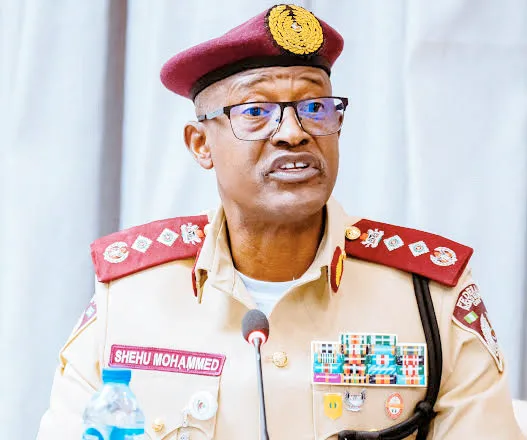
The Corps Marshal of the Federal Road Safety Corps (FRSC), Shehu Mohammed, was a special guest at the recent Nigeria Auto Industry Summit (NAISU), organised by the Nigeria Auto Journalists’ Association (NAJA).
The summit focused on Nigeria’s clean mobility future, particularly the development of electric vehicles (EVs) and compressed natural gas (CNG) vehicles under the administration of President Bola Ahmed Tinubu.
In an interview after the programme, the Corps Marshal spoke about the Presidential Initiative on CNG and EVs, road safety and the FRSC’s goal of reducing road fatalities by half by 2030.
What is your impression of the Presidential Initiative on CNG and EV?
Let me first appreciate President Bola Tinubu for allowing me to represent him at the recent United Nations Summit on Global Road Safety, where I addressed the General Assembly.
I also want to commend him for the Presidential Initiative on CNG and electric vehicles. The initiative aligns with Goal 13 of the United Nations Sustainable Development Goals, which focuses on climate action and green energy.
Green energy supports a cleaner and healthier transport system, where pedestrians and cyclists are also encouraged.
The initiative has attracted significant investments into Nigeria. We now have companies involved in the assembly and manufacturing of electric and CNG vehicles. There are also companies producing CNG cylinders, conversion kits and other technologies.
This development is creating opportunities for young Nigerians to acquire technical skills and find employment.
It is a massive investment in the country and is generating jobs for many unemployed Nigerians. I also appreciate the President and his administration for giving road safety agencies the support needed to participate in this process.
With initiatives such as the Lagos-Calabar Coastal Highway, the Sokoto-Badagry Super Highway and the rehabilitation of major roads across the country, we hope to achieve the United Nations’ Goal 11.2, which seeks to provide safe, accessible, affordable, reliable and sustainable transport systems for everyone by 2030.
I believe we are moving in the right direction, and I hope Nigerians will support the administration in achieving this objective.
What about the enlightenment of road users?
When the FRSC was established, one of its major responsibilities was public education and sensitisation. The corps has been carrying out this responsibility for more than three decades, although there is still much more to be done.
Road safety must be seen as a shared and collective responsibility. It should not be left to the FRSC alone.
The FRSC is a government agency that can drive the process, but every Nigerian has a role to play.
For example, we have seen cases of mixed loading, where passengers, goods and sometimes animals are transported together in trucks and trailers. Some of these practices are common among people coming from areas where literacy levels remain low.
Government officials, citizens, community leaders and traditional rulers all have important roles to play in educating the public.
That is why we have changed our approach. Rather than limiting our campaigns to motor parks and garages, we have taken sensitisation programmes to the grassroots through town hall meetings.
We bring together drivers, passengers, community leaders and other members of the public to discuss responsible driving and road safety.
It should not be the responsibility of the FRSC alone. Everyone has to participate.
We are making some progress, but we still need to do more. When people see someone driving dangerously, they should speak up and discourage the behaviour. That is what shared responsibility means.
What about the bad driving culture in Abuja?
That is another area where citizens need to support us.
As you mentioned, there is a serious problem with driving culture in Abuja. People create their own lanes on roads, and before you know it, a road has several unofficial lanes.
People also speed, overload vehicles and carry excessive loads and passengers.
We need to come together and address these problems.

Wherever we are, we should speak to one another. That is why we also encourage passengers to speak up when a driver is speeding or behaving dangerously.
The Nigerian Auto Journalists Association has provided an important platform for us to engage with citizens through the media. Journalists have supported the FRSC since its establishment.
This demonstrates the commitment to helping Nigeria reduce road traffic crashes by half by 2030.
We are now in 2026, which means we have only four years to achieve a 50 per cent reduction in crashes, fatalities and injuries.
We need everyone’s support.
The amount of money spent every month on FRSC personnel who are knocked down while carrying out their duties is significant. Many of them require treatment in orthopaedic hospitals, while some unfortunately lose their lives on Nigerian roads.
We therefore need journalists to continue reporting the facts and helping Nigerians understand what is happening.
Road safety should not be left to the FRSC alone. It is a collective responsibility that requires the participation of all Nigerians.
Government at the state and local levels also needs to play its part by educating citizens and improving literacy and awareness about road safety.
Passengers, goods and animals should not be transported together in the same vehicle. Different types of vehicles are designed for carrying passengers, goods and animals, and these regulations must be respected.
What legacy would you like to leave as the Corps Marshal of the FRSC?
One thing I believe in is consistency and sustainability.

The principles and strategies we have adopted at the FRSC include building a technology-driven organisation, having highly trained personnel and projecting a positive image of the country.
These are the areas I will continue to develop and improve.
Where there is a need to review, reorganise or restructure our approach to achieve better results, that is what I will do.
However, I am not changing the fundamental principles of the FRSC, particularly our mandate to reduce road traffic crashes and injuries.
Everything we do is ultimately about saving lives.

That is why we continue to partner and collaborate with other agencies.
The legacy I want to leave is one of partnership, collaboration and bringing out the best in FRSC personnel so they can serve Nigerians effectively and project the positive image of the corps.



