Osun at 35: How Successive Governments Shaped the State
Osun State was created from the old Oyo State in August 1991 by the military government of General Ibrahim Babangida. Since then, the state has been governed by military administrators and elected civilian governors, each leaving a mark on its political and developmental history.
The state’s first administrator, Colonel Leo Ajiborisha, focused on putting the basic structures of the new state in place before handing over to its first elected governor, the late Isiaka Adeleke, in January 1992.
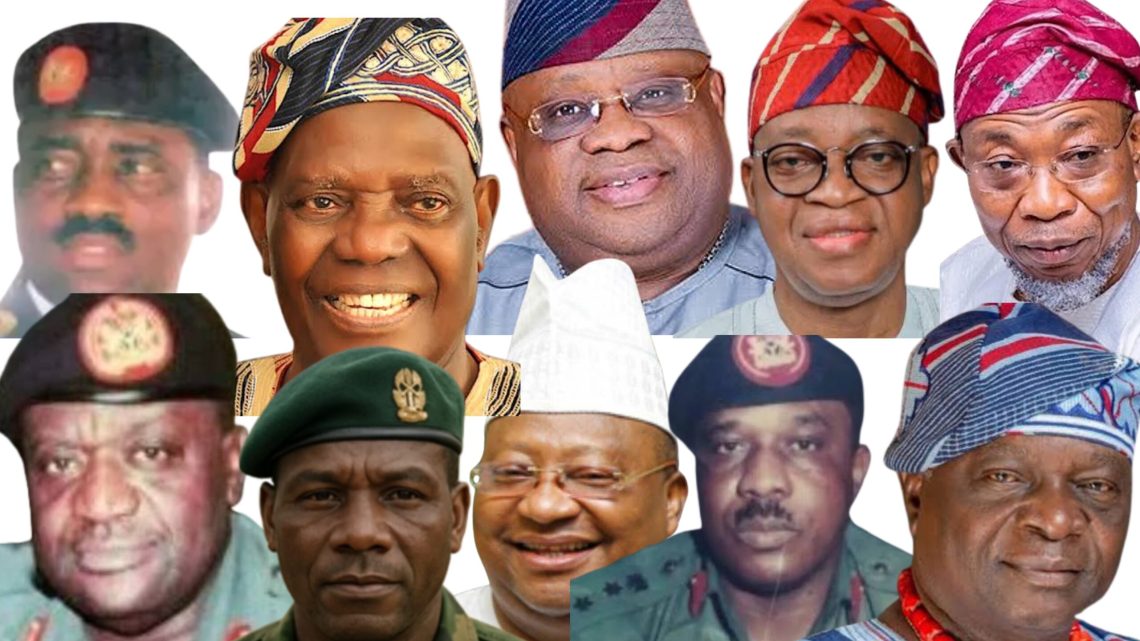
The return to democracy in 1999 brought successive administrations led by Bisi Akande, Olagunsoye Oyinlola, Rauf Aregbesola, Gboyega Oyetola and, currently, Ademola Adeleke.
Over the years, Osun has recorded major developments in education, healthcare, infrastructure and social welfare. At the same time, successive governments have faced challenges ranging from financial constraints and labour disputes to electoral controversies, political divisions and allegations of financial mismanagement.
As the state heads into another governorship election, a look at the administrations that have governed Osun since its creation offers an insight into how the state has evolved.
Leo Ajiborisha: Laying the Foundation
Colonel Leo Ajiborisha became the first administrator of Osun State after its creation in 1991.
His brief tenure was largely focused on establishing the institutions needed to run the new state and preparing it for civilian administration.
His administration established the Osun State Civil Service Commission in September 1991. It also established the Osun State Broadcasting Corporation, with its radio station in Ile-Ife beginning operations in November of the same year.
Ajiborisha handed over power to Isiaka Adeleke in January 1992, bringing the state’s first military administration to an end.
Isiaka Adeleke: Osun’s First Civilian Governor
Isiaka Adeleke became Osun’s first elected governor in January 1992 on the platform of the defunct Social Democratic Party.
As the pioneer civilian governor, Adeleke was tasked with consolidating the institutions established during the state’s early years.
One of the notable achievements of his administration was the establishment of Osun State Polytechnic, Iree, which remains part of the state’s tertiary education system.
His administration, however, was cut short by the military coup of November 1993, which ended the Third Republic.
Adeleke later returned to politics and served as senator representing Osun West. He was elected on the platform of the PDP in 2007 and later won re-election under the APC in 2015. He died in April 2017.
Anthony Udofia, Anthony Obi and Theophilus Bamgboye: The Military Years
Following the 1993 military takeover, Osun returned to military rule.
Anthony Udofia became the second military administrator of the state under the regime of General Sani Abacha. His administration focused mainly on running government and implementing social and developmental programmes.
He was succeeded by Anthony Obi, who served from August 1996 to August 1998. His tenure came during one of Nigeria’s most politically uncertain periods.
Theophilus Bamgboye later became the fourth military administrator under General Abdulsalami Abubakar’s transition programme. His administration focused largely on maintaining government institutions and preparing the state for the return to democracy in 1999.

Bamgboye eventually handed over to Bisi Akande, marking the beginning of the Fourth Republic administration in Osun.
Bisi Akande: Fiscal Discipline and Tough Reforms
Bisi Akande governed Osun from 1999 to 2003 on the platform of the Alliance for Democracy.
His administration became known for fiscal discipline, institutional reforms and efforts to reduce government spending.
Akande also introduced free education and healthcare programmes, reflecting the social-democratic policies associated with the AD governments that controlled much of the South-West at the time.
However, his efforts to restructure and reduce the size of the civil service triggered strong opposition from organised labour.
The resulting tension contributed to the political challenges faced by his administration, and Akande lost the 2003 election to Olagunsoye Oyinlola.
Olagunsoye Oyinlola: Infrastructure and Education
Retired Brigadier-General Olagunsoye Oyinlola governed Osun from 2003 to 2010 on the platform of the Peoples Democratic Party.
His administration focused on infrastructure, agriculture, education, healthcare, water supply, transportation, security and job creation.
One of its most significant achievements was the establishment of Osun State University, a multi-campus institution created to expand access to university education across the state.
The administration also introduced various development and welfare programmes, particularly in rural communities.
However, Oyinlola’s tenure was eventually overshadowed by a prolonged legal battle over the 2007 governorship election.
The dispute ended in 2010 when the Court of Appeal nullified his election victory, leading to his removal from office and the emergence of Rauf Aregbesola.

The development also contributed to Osun becoming one of the states with off-cycle governorship elections.
Rauf Aregbesola: Ambitious Projects, Social Programmes and Financial Strain
Rauf Aregbesola governed Osun from 2010 to 2018, making him the state’s longest-serving elected governor to date.
His administration was known for large-scale infrastructure projects, education reforms and social intervention programmes.
Among its major initiatives was the Osun Youth Empowerment Scheme, popularly known as O-YES, which provided employment opportunities for thousands of young people.
In education, the government introduced the Opon Imo digital learning initiative, which provided students with electronic educational materials. It also built mega schools across the state.
Another major programme was O-MEALS, which provided meals to pupils in public primary schools.
The administration also embarked on extensive road construction and rehabilitation projects while promoting Osun’s cultural identity.
However, Aregbesola’s tenure was also marked by serious financial challenges.
Declining federal allocations and the state’s debt obligations contributed to difficulties in paying workers and pensioners. The government introduced a “modulated” salary system under which some workers received only part of their monthly salaries, leading to prolonged disputes with labour unions.
His education reforms also generated controversy, particularly over the restructuring and reclassification of schools, the merger of some historically single-sex schools and the use of hijab.

The state’s rising debt also became a major political issue, with critics arguing that borrowing used to finance infrastructure projects placed a heavy burden on subsequent administrations.
Gboyega Oyetola: Fiscal Consolidation Amid Political Rivalry
Gboyega Oyetola succeeded Aregbesola in 2018 after a highly contested election and remained in office until 2022.
The 2018 election was one of the most controversial in Osun’s political history. The initial result was declared inconclusive after the margin between Oyetola and PDP candidate Ademola Adeleke was smaller than the number of cancelled votes.
A supplementary election was subsequently held, with Oyetola eventually declared the winner.
The election deepened the rivalry between the APC and PDP and left the state politically polarised.
Oyetola inherited significant salary and pension obligations and made financial management one of his administration’s priorities.
His government stopped the payment of modulated salaries and restored full salaries to workers while also beginning efforts to address inherited pension arrears.
The administration invested in healthcare, upgraded primary healthcare centres and improved facilities at the State Specialist Hospital in Asubiaro, Osogbo.
It also constructed the Olaiya Flyover and reversed some of the education reforms introduced under Aregbesola.
However, political tensions within the APC became increasingly intense, particularly between Oyetola and his predecessor.
The internal division weakened the party ahead of the 2022 election, which Oyetola narrowly lost to Adeleke.
Ademola Adeleke: Infrastructure, Welfare and Political Controversies
Ademola Adeleke became governor in November 2022 after defeating Oyetola.
His administration has focused heavily on infrastructure, workers’ welfare, healthcare and education.
The government has embarked on road construction and rehabilitation projects, alongside major infrastructure projects, including flyovers in Osogbo.
Adeleke’s administration has also highlighted efforts to clear inherited salary and pension arrears and improve the welfare of workers and pensioners.
In healthcare, the government has rehabilitated primary healthcare centres and introduced measures aimed at improving services, including power supply to health facilities.
The administration has also supported the development of the University of Ilesa and promoted initiatives aimed at expanding the state’s digital economy.
Despite these projects, the administration has faced its own share of political and legal battles.
One major dispute has involved the control of local governments and the status of elected council officials, resulting in prolonged legal and political tensions between the state government and opposition figures.
The administration also came under criticism following its decision to terminate the appointments of some workers employed by the previous government, including teachers and health workers.

Its handling of state finances has also attracted scrutiny from opposition politicians, who have questioned some expenditures and projects. The government has rejected allegations of financial impropriety and defended its spending as necessary for development.
Adeleke’s public image has also generated debate. His frequent dancing at public events has become a recognisable part of his political style, with supporters seeing it as evidence of his closeness to ordinary people, while critics have questioned whether it projects the seriousness expected of a governor.
What Osun’s Political History Shows
The history of Osun State mirrors many of the challenges faced by subnational governments across Nigeria.
The early military administrations concentrated on establishing institutions and maintaining stability. The return to democracy brought greater attention to education, healthcare, infrastructure and social welfare.
However, successive administrations have repeatedly faced the difficult balance between delivering ambitious projects and managing limited financial resources.
Akande’s fiscal reforms triggered labour resistance. Oyinlola’s tenure became entangled in electoral litigation. Aregbesola pursued large-scale infrastructure and welfare programmes but faced a severe salary crisis and growing concerns over debt.
Oyetola attempted to consolidate the state’s finances but struggled with political divisions within his party. Adeleke has continued to prioritise infrastructure and welfare while facing legal disputes, opposition pressure and political tensions.
Ultimately, Osun’s experience shows that successful governance is not only about launching projects. It also requires financial sustainability, institutional stability, continuity and the ability to maintain programmes beyond individual administrations.
As Osun enters another political cycle, the competing records of its past and present leaders will remain central to the debate over what the state needs most: infrastructure, social welfare, fiscal discipline, strong institutions or greater political stability.