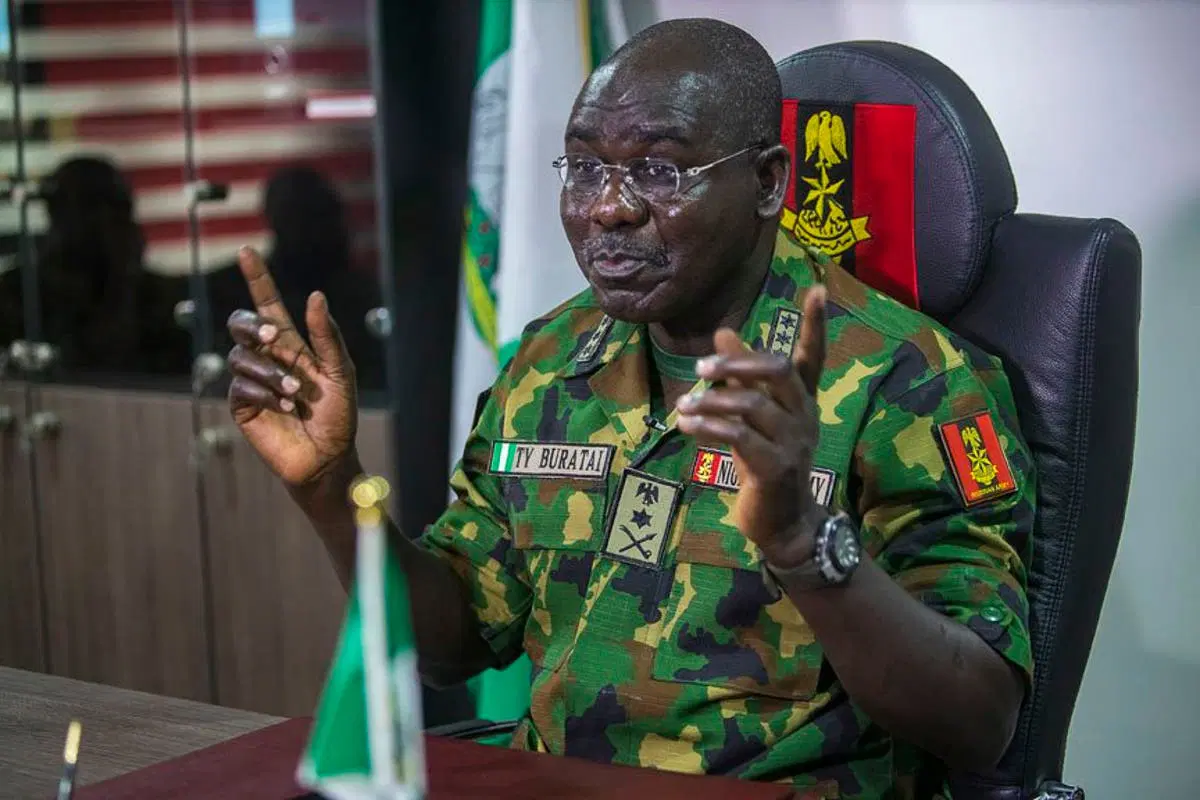
Former Chief of Army Staff, retired Lieutenant General Tukur Yusuf Buratai, has clarified that the $1 billion approved for military equipment procurement during his tenure was released to the Federal Ministry of Defence, rather than directly to the Nigerian Army, Navy or Air Force.

Buratai made the clarification on Monday while speaking at the Defence Correspondents Association of Nigeria (DECAN) conference in Abuja. He maintained that neither he nor the accounts of the three military services received the money for direct procurement.
According to the retired general, the funds were approved by the National Economic Council (NEC) for defence procurement, with the Ministry of Defence responsible for managing the entire process.
He described allegations surrounding the funds as politically motivated and malicious, explaining that the controversy emerged during the 2019 general election when opposition figures alleged that the money had been diverted for electoral purposes.

Buratai said the Federal Government had publicly refuted the allegations at the time. However, he argued that the controversy continued to damage the reputations of the service chiefs, even though, according to him, they were not directly responsible for managing the funds.
He stressed that the institution responsible for handling the money should provide the necessary explanations about its expenditure.
The former Army chief also criticised the Ministry of Defence for failing to publicly clarify how the funds were disbursed and how contracts were awarded.
He called for accountability to be directed at the appropriate institution, insisting that the public deserved clear information about the procurement process.

BURATAI CALLS FOR TRANSPARENCY IN MILITARY PROCUREMENT
To prevent similar controversies in the future, Buratai proposed the establishment of a Defence Procurement Transparency Portal.
He suggested that the platform should publish information about defence contracts, the organisations awarded the contracts and expected delivery timelines, while protecting sensitive information that could affect national security.
According to him, greater transparency would help Nigerians understand how funds allocated for military equipment are spent and which institutions are responsible for procurement decisions.

He argued that the Ministry of Defence should take responsibility for maintaining and explaining procurement records, rather than leaving military officers to face public criticism over funds they did not directly control.
Buratai also recommended the publication of quarterly accountability bulletins containing summaries of court-martial outcomes involving allegations of human rights violations and misconduct during military operations.
He noted, however, that such disclosures must respect the rights of accused personnel and avoid compromising ongoing military operations.
MILITARY MUST BE HELD ACCOUNTABLE FOR RIGHTS VIOLATIONS
Addressing allegations of human rights violations involving members of Nigeria’s security forces, Buratai maintained that credible complaints should be investigated and prosecuted where sufficient evidence exists.
He emphasised that the military was not above the law and acknowledged the importance of demonstrating that its disciplinary procedures were effective, transparent and capable of addressing wrongdoing at every level.
The retired general further argued that better communication by the Armed Forces and the Ministry of Defence could improve public understanding of security operations.
He said media reports should reflect the full context of military activities, while security institutions should provide accurate information to address legitimate public concerns.
LAWAN ADVOCATES DEDICATED SECURITY FUNDING
Also speaking at the event, former Senate President and Chairman of the Senate Committee on Defence, Senator Ahmed Lawan, called for a dedicated percentage of Nigeria’s revenue to be allocated to the Armed Forces and other security agencies.
He said predictable funding would help the country acquire additional military equipment and strengthen the operational capacity of its security institutions.

Lawan maintained that the National Assembly had consistently supported requests for resources from the executive arm of government, particularly those intended to improve national security.
He noted that, in his more than 27 years in the National Assembly, he had not seen a request from the executive for the Armed Forces and other security agencies that was rejected, adding that security remained a priority.
DEFENCE MINISTER STRESSES INTELLIGENCE AND TECHNOLOGY
In his remarks, the Minister of Defence, General Christopher Musa, highlighted the increasingly complex nature of Nigeria’s security challenges.
Represented by retired Air Commodore Steven Ogunmodede, his Senior Special Assistant on Foreign Relations, the minister said terrorist organisations, criminal networks and other hostile groups were exploiting technology, financial systems, intelligence gaps and weaknesses in coordination.

He argued that tackling these threats required more than conventional combat operations. Effective responses, he said, must combine timely intelligence, modern technology, strategic planning and cooperation among relevant security institutions.
The minister explained that intelligence-led operations could help security agencies identify threats early, understand criminal networks, anticipate attacks and respond more precisely.
He also noted that technological investments could improve surveillance, reconnaissance, communication and intelligence analysis, but stressed that technology alone could not replace trained personnel, sound judgement and professional discipline.

According to him, the Ministry of Defence and the Armed Forces were pursuing approaches aimed at improving situational awareness, intelligence coordination and operational effectiveness.
He further called for stronger cooperation across Nigeria’s security architecture, noting that no single agency possessed all the information and capabilities required to address the country’s evolving security threats.
The conference focused on the role of technology and intelligence-led operations in strengthening Nigeria’s national security, bringing renewed attention to the need for effective military procurement, institutional accountability and improved coordination among security agencies.