

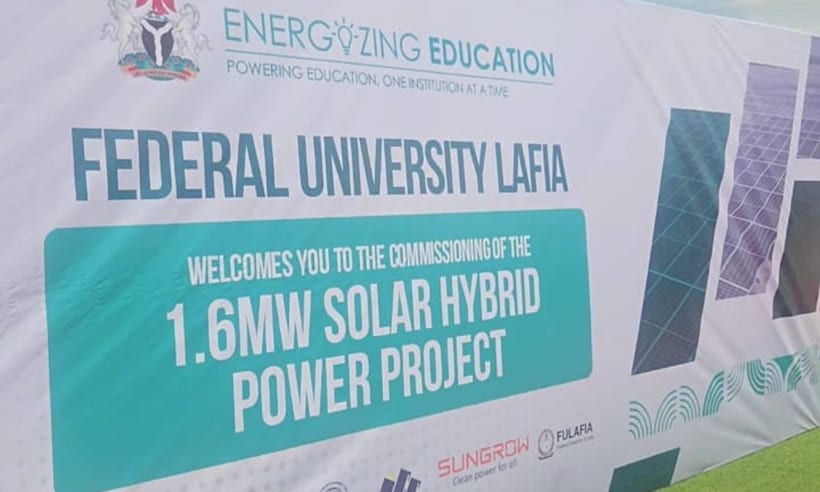
The Federal Government has commissioned a 1.6-megawatt (MW) solar hybrid power plant at the Federal University of Lafia, Nasarawa State, in a move expected to reduce the institution’s electricity costs by N30 million monthly.
The project, delivered under the Rural Electrification Agency’s (REA) Energising Education Programme (EEP), is designed to provide a more reliable and sustainable electricity supply across the university.

The facility comprises a 1.6MW-peak solar photovoltaic installation, alongside a power conditioning system and an energy storage system. The infrastructure is expected to improve power reliability, manage peak electricity demand and supply critical facilities beyond daylight hours.
Speaking at the commissioning ceremony on Thursday in Lafia, Nasarawa State Governor, Abdullahi Sule, commended President Bola Ahmed Tinubu for extending the intervention to the university.
Sule said the project would ease the institution’s electricity burden and called for the expansion of mini-grid systems across the country, describing them as an important part of Nigeria’s electricity future.
He maintained that decentralised power solutions could help address the country’s electricity challenges, particularly in communities and institutions with limited access to reliable supply.

The Minister of Power, Joseph Tegbe, reaffirmed the Federal Government’s commitment to expanding electricity access and improving power infrastructure across the country.
Tegbe said the government’s investment in electricity was aimed at supporting essential services and productive activities, particularly in education, where reliable power is necessary for teaching, research and technological development.
Reflecting on the facility’s three-month test run, the minister said the government’s ambition was to extend the benefits of uninterrupted electricity already being enjoyed by the Federal University of Lafia and other institutions under the programme to more Nigerians.
The Managing Director of the Rural Electrification Agency, Abba Aliyu, said the government was moving away from fragmented electricity interventions towards coordinated and scalable electrification projects.

He commended the Nasarawa State Government for its support for renewable energy development and acknowledged the contributions of development partners, particularly the African Development Bank (AfDB), in implementing the Energising Education Programme.
Aliyu also disclosed that the agency had funded the completion of 22 mini-grid projects in Nasarawa State, with another 37 projects expected to be developed.
Highlighting the impact of improved electricity supply on academic activities, a 300-level student, Raimat Abdullahi, said the stable power supply had enabled her to study for longer hours without interruptions.
Aliyu said her experience demonstrated how dependable electricity could remove barriers to learning and create better opportunities for students.
He added that the initiative went beyond providing electricity to a university, describing it as an investment in human capital, research, innovation and Nigeria’s future workforce.

The Vice-Chancellor of the Federal University of Lafia, Professor Mohammed Isa Kida, said the institution had enjoyed uninterrupted electricity since the commencement of the facility’s test run.
Kida described the project as a major development that would strengthen the university’s academic and administrative operations, with more than 30,000 students and staff expected to benefit.
He said reliable electricity would improve digital services, support research and teaching activities, and create opportunities for practical training in renewable energy.
The vice-chancellor also acknowledged the inclusion of a training programme for women in Science, Technology, Engineering and Mathematics (STEM), adding that the university would ensure proper maintenance and protection of the facilities to guarantee their long-term benefits.
The Federal University of Lafia solar project forms part of the Federal Government’s broader efforts to improve electricity supply in public institutions through renewable energy infrastructure and strategic partnerships.