

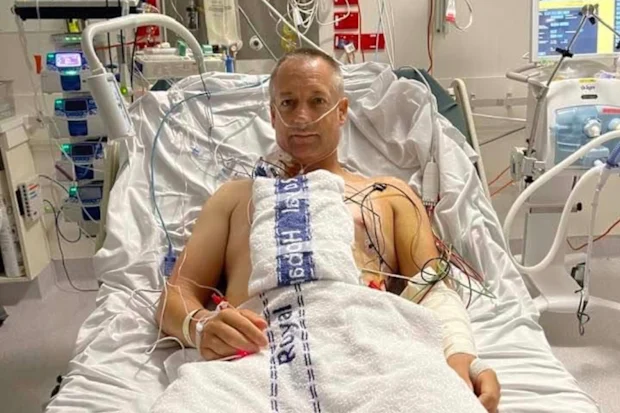
A 44-year-old marathon runner has revealed how a routine visit to his doctor for a blocked ear led to the discovery of four severe blockages in his heart arteries and emergency open-heart surgery.
Daniel Gardner, from Hobart, Australia, was physically active and appeared to be in excellent health. He regularly ran marathons, covered about 100 kilometres weekly, surfed, sailed and played football.
However, despite his active lifestyle, Gardner had dangerously high cholesterol levels and was unaware that his heart was at risk.
His condition came to light when he visited his general practitioner (GP) to seek treatment for a blocked ear. Since it had been several years since his last medical check-up, the doctor conducted a general examination, including blood tests.

The results showed that his cholesterol levels had increased significantly compared with his previous test. He was subsequently referred to a cardiologist for further investigations.
Gardner initially struggled to understand the seriousness of the results, believing his fitness and active lifestyle meant he was unlikely to have a major heart problem.
He told Nine.com.au that he had assumed his high cholesterol would only require medication, as he continued running long distances without experiencing any noticeable symptoms.
Further medical examinations, however, revealed a more serious situation.
His cardiologist, Dr Warrick Bishop, ordered a coronary artery calcium scan to investigate possible plaque build-up in his arteries. The results raised concerns, prompting a treadmill stress test.

According to Gardner, the cardiologist stopped the exercise test after just three minutes, warning that continuing could put him at risk of suffering a heart attack.
An angiogram subsequently confirmed four major blockages in his heart arteries, each exceeding 90 per cent. One particularly dangerous blockage, involving an artery commonly known as the ‘widowmaker’, was found to be 98 per cent.
Gardner described the discovery as frightening, acknowledging that he was fortunate to have sought medical attention when he did.
He was placed on an emergency waiting list and spent two weeks awaiting open-heart surgery, which he described as one of the most traumatic periods of his life.
Although the operation was successful, his recovery was initially complicated by an infection in his leg, where a vein had been removed for the heart bypass procedure. He also experienced significant pain caused by fluid accumulation in his lungs.
After approximately six weeks, his recovery began to improve. He gradually returned to walking longer distances and managed his first slow jog about 10 weeks after the operation.

Four months after surgery, he received medical clearance to resume surfing and celebrated by hiring a wave pool in Melbourne to enjoy the experience with his friends.
Almost six years after the operation, Gardner, now 50, has returned to an active lifestyle. However, he has lost much of his enthusiasm for long-distance running.
He has also changed his eating habits, focusing more on whole foods and undergoing regular blood tests to monitor his cholesterol levels.
Reflecting on the experience, Gardner admitted that his physical fitness had given him a false sense of security.
He said the experience taught him that looking healthy and maintaining an active lifestyle did not necessarily mean there were no underlying health problems.

CARDIOLOGIST WARNS AGAINST CHOLESTEROL MISCONCEPTIONS
Gardner’s experience highlights a common misconception about cholesterol: that people who exercise regularly, maintain a healthy weight and appear physically fit cannot have dangerous cholesterol levels or heart disease.
Dr Bishop, who treated Gardner, said physical activity, healthy eating and weight management were important but did not guarantee protection against heart attacks.
He explained that cholesterol levels alone could not provide a complete picture of an individual’s cardiovascular health.
According to the cardiologist, some people with high cholesterol may have relatively healthy arteries, while others with lower cholesterol levels may already have significant plaque build-up.
He stressed the importance of considering other factors, including family medical history, when assessing an individual’s risk.
Dr Bishop also warned that high cholesterol often develops without noticeable symptoms, making regular medical examinations particularly important.

He recommended that people in their 30s and 40s begin checking their cholesterol and blood pressure every one or two years, or earlier where there is a family history of heart disease.
He also highlighted the importance of coronary artery calcium scoring for assessing possible plaque build-up, particularly among older adults and individuals with a family history of premature coronary artery disease.
OTHER FACTORS THAT INCREASE HEART DISEASE RISK
Dr Bishop explained that cholesterol is only one of several factors that contribute to cardiovascular disease.
Other risk factors include:
-
Age: The risk of heart attacks generally increases as people grow older.
-
High blood pressure: Uncontrolled blood pressure can increase the risk of cardiovascular complications.
-
Diabetes: The condition can contribute to damage affecting the heart and blood vessels.

-
Physical inactivity: A lack of regular exercise can increase cardiovascular risk.
-
Obesity: Excess body weight can contribute to several conditions associated with heart disease.
-
Smoking: Tobacco use is a significant risk factor for cardiovascular disease.
-
Stress: Prolonged stress can contribute to poor cardiovascular health.
-
Genetic factors: Inherited conditions, including elevated lipoprotein(a), can increase an individual’s risk.
He emphasised that doctors must consider these factors together rather than relying on a single cholesterol reading.

EXPERT URGES PEOPLE NOT TO WAIT FOR SYMPTOMS
The cardiologist’s strongest warning was that people should not wait until they experience symptoms before taking their heart health seriously.
He noted that some heart attacks occur without previous warning signs, making early assessment and prevention essential.
Dr Bishop also highlighted the dangers of assuming that feeling healthy means the heart is functioning properly.
Gardner has since taken his experience as a personal responsibility to encourage others to undergo medical checks. He said he had persuaded at least a dozen of his friends to visit their doctors after learning how close he had come to a potentially fatal situation.
He urged people to take advantage of available medical services, including routine blood tests and consultations with doctors, stressing that early detection had saved his life.