

By Headlinenews Global Affairs Desk
A historic shift is quietly unfolding within the Western alliance system as the United Kingdom, Canada, Australia, and New Zealand deepen plans for a new Commonwealth economic security pact that could redefine the global balance of power.
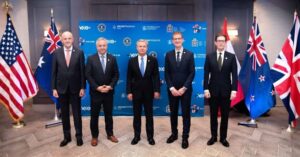
For nearly eight decades, these countries formed the backbone of the Five Eyes intelligence alliance with the United States, a partnership rooted in the 1946 UKUSA signals intelligence agreement that emerged from wartime cooperation between Washington and London.
Now, geopolitical tensions, economic pressures, and diplomatic friction—particularly during the second presidency of Donald Trump—are pushing these traditional allies toward greater strategic autonomy.
The Birth of a New Anglo-Commonwealth Bloc
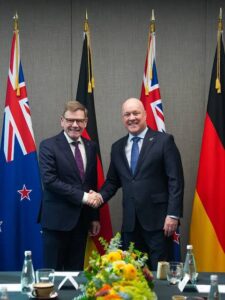
The emerging framework, often discussed within policy circles as a CANZUK-style economic and security partnership, envisions deeper integration among the four Commonwealth powers: the United Kingdom, Canada, Australia, and New Zealand.
Combined, these economies represent roughly $6.8 trillion in GDP, rivaling Japan and forming one of the most advanced economic clusters in the world.
CANZUK International.
Beyond economics, the proposed structure includes:
Coordinated defense procurement.
Integrated supply chains for critical minerals and technology.
Expanded trade and mobility agreements.
Financial cooperation that could gradually reduce reliance on U.S. financial markets.
The concept itself is not new. Policy thinkers have promoted CANZUK cooperation for years, arguing that shared legal systems, language, democratic institutions, and historical ties make the four nations uniquely suited for closer integration.
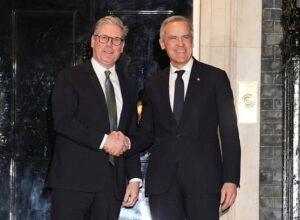
But what has transformed the idea from theory into policy urgency is the deterioration of trust between Washington and its closest English-speaking allies.
Trump’s Confrontation With Allies.
Diplomatic sources say the catalyst was a series of policy demands from Washington that many British and Commonwealth policymakers viewed as intrusions into national sovereignty.
Among the issues reportedly raised in negotiations were U.S. pressure on the UK to accept American agricultural standards, including genetically modified crops, hormone-treated beef, and chlorine-washed poultry—policies that remain controversial in Europe.
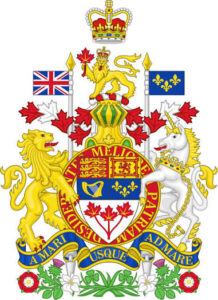
At the same time, President Trump’s public remarks describing Britain as a “losing nation” during trade negotiations triggered political backlash in London.
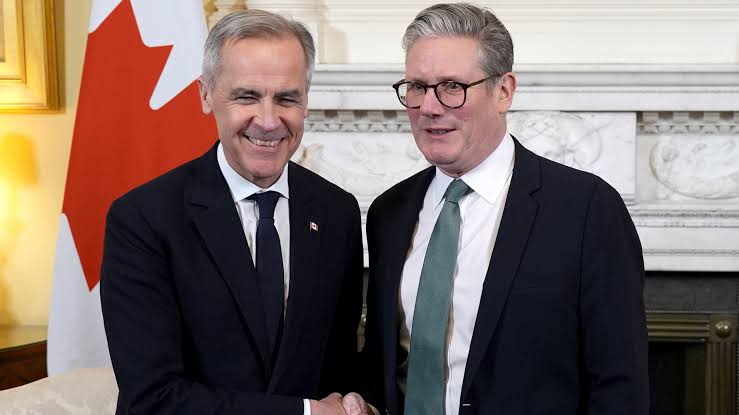
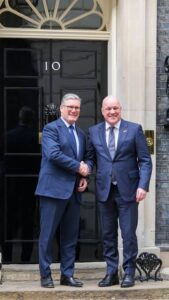
Prime Minister Keir Starmer reportedly responded with a strong parliamentary address at the historic House of Commons dispatch box, the same position where Winston Churchill delivered wartime declaration.
For many lawmakers, the message was clear:
Britain would cooperate with the United States—but not under conditions perceived to weaken British sovereignty or regulatory standards.
The Strategic Logic Behind the Pact.
The shift is also driven by deeper structural realities in the global economy.
Three key trends explain why the Commonwealth bloc is gaining momentum.
1. Trade Diversification
Canada remains heavily dependent on U.S. markets, with roughly two-thirds of its exports historically flowing south of the border.
Tariffs and unpredictable American trade policies have forced Ottawa to search for alternatives.
2. Supply Chain Security
Australia controls significant deposits of lithium, rare earths, and other critical minerals vital to green energy and advanced technology industries.

Integrating these resources with British financial markets and Canadian industrial capacity could create a resilient supply chain independent of geopolitical disruptions.
3. Post-Brexit Realignment
Britain’s departure from the European Union has accelerated its search for new strategic trade partnerships.
London has already joined the Comprehensive and Progressive Agreement for Trans-Pacific Partnership (CPTPP) to expand economic ties with Indo-Pacific markets.
Closer Commonwealth cooperation fits naturally into that strategy.
Intelligence Allies Becoming Economic Partners.
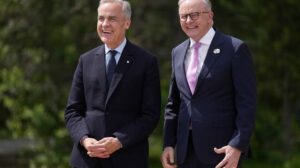
Despite tensions, the United States still maintains extensive military and intelligence cooperation with these countries through the Five Eyes network, the most sophisticated intelligence-sharing alliance in modern history.
However, analysts say the emerging Commonwealth pact reflects a subtle but significant shift.
Rather than abandoning Washington, the four countries appear to be building strategic redundancy—ensuring that their economic and security architecture can function even without American leadership.

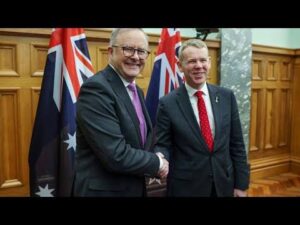
Recent diplomatic missions between Canada and Australia have already emphasized stronger collaboration in defence, security, investment, and artificial intelligence, highlighting a new willingness among “middle powers” to coordinate independently.
The Currency Question: Can the Dollar’s Dominance Fade?.
Perhaps the most controversial implication of the new partnership concerns global finance.
For decades, Wall Street and the U.S. dollar have served as the central nervous system of global trade.
But economic integration among advanced Commonwealth economies could eventually strengthen alternative financial corridors through London, Toronto, and Sydney.
The idea is not immediate dollar replacement—something no currency currently has the scale to achieve—but gradual diversification of financial influence.

If successful, the Commonwealth bloc could create a parallel investment ecosystem capable of absorbing global capital flows.
What This Means for the United States.
The United States remains the world’s largest economy and most powerful military force.
No alliance of middle powers can replace that influence overnight.
Yet Washington faces a strategic warning.
For the first time since World War II, America’s closest cultural and intelligence allies are quietly designing a future in which U.S. leadership is optional rather than indispensable.
Historically, the strength of American power rested not only on military might but on a dense network of trusted alliances.

If those alliances begin to hedge their bets, the geopolitical architecture of the Western world may gradually evolve from U.S.-centric leadership to a more distributed system of power among democratic states.
A New Chapter in Western Alliances.
Ironically, the emerging Commonwealth partnership may represent a return to history.
Before the rise of American dominance after 1945, Britain and its dominions formed the backbone of a global political and economic network spanning multiple continents.

What is unfolding now could be the 21st-century version of that system—modernized, technologically integrated, and economically ambitious.
Whether it becomes a genuine geopolitical bloc or remains a strategic hedge will depend largely on one factor:
How Washington chooses to treat its allies in the years ahead.
If cooperation prevails, the new Commonwealth framework may simply strengthen Western unity.
If confrontation deepens, historians may one day mark this moment as the beginning of a post-American era in global alliances.
Nigeria must observe emerging geopolitical shifts with calm strategic clarity. The evolving Commonwealth economic bloc and growing BRICS influence signal that the global order is becoming multipolar. For Nigeria, the wise path is strategic independence. While maintaining cordial relations with the United States, Nigeria should deepen engagement with BRICS economies, expand trade settlement in alternative currencies, and strengthen defence cooperation with partners such as Türkiye, China, Pakistan, Brazil, and India, where existing security agreements already exist. Abuja should also accelerate domestic defence manufacturing, intelligence technology, and regional security leadership. A confident Nigeria must diversify alliances, protect sovereignty, and ensure that no single power holds decisive leverage over its security or economy.
Dr. G. Fraser. MFR
Headlinenews.news Special Report.




