

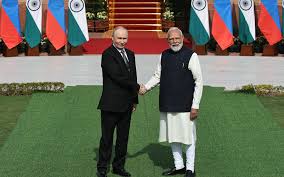
India–Russia Relations After the Ukraine War.
Russia’s invasion of Ukraine unexpectedly strengthened India–Russia ties, mainly through energy trade. While the relationship has deep historical roots, recent gains are tactical rather than strategic and face clear limits.
Energy and Trade
Western sanctions pushed Russia to sell oil at discounted prices, and India significantly increased its imports. Indian refiners benefited from lower costs and re-exported refined fuel to Europe and other markets. Bilateral trade expanded rapidly after years of stagnation.
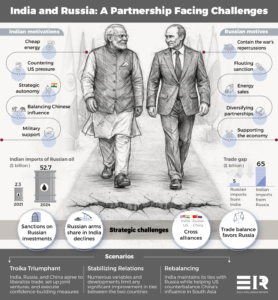
The main weakness is a severe trade imbalance. India imports far more from Russia than it exports in return. Sanctions have also forced trade to be settled in national currencies, leaving Russia with large amounts of Indian rupees that cannot be used outside India.
Political and Strategic Alignment
Russia views India as an important partner in a multipolar world. India has avoided condemning or sanctioning Russia over the Ukraine war, and Prime Minister Modi has called for peace without pressuring Moscow.
However, alignment has limits. Russia’s growing dependence on China restricts its ability to balance Beijing in India’s favor, while India continues to prioritize strategic autonomy and avoids firm alignment with any single power.

Defense Cooperation
Russia remains important for maintaining India’s legacy Soviet-era weapons systems. At the same time, Russia’s share of India’s defense market is steadily declining. India now sources more advanced systems from the United States, Europe, and Israel.
Russian defense contracts have faced delays, quality concerns, and technology shortfalls. The Ukraine war has further reduced Russia’s ability to supply weapons. Notably, the latest India–Russia summit produced no major new arms agreements.
Investment and Connectivity Challenges
Russian investment in India remains limited compared to Western and Japanese capital. Indian firms are cautious about entering the Russian market due to transparency and regulatory risks.
Large connectivity and infrastructure proposals—including Arctic shipping routes, energy pipelines, and transport corridors—remain stalled because of high costs, sanctions, and geopolitical uncertainty.




