


By Princess G. Adebajo-Fraser MFR.
Nobel Laureate Professor Wole Soyinka has publicly questioned the scale of security personnel seen escorting Seyi Tinubu, son of President Bola Ahmed Tinubu, describing the deployment of armed soldiers, police officers, and Department of State Services (DSS) operatives as excessive.
His remarks have triggered a nationwide debate on power, privilege, law, insecurity, and public perception, especially at a time when many Nigerians are battling a high cost of living and limited access to state protection.

While Soyinka’s intervention reflects his long-standing role as a civic conscience, the controversy also raises important questions about what the law allows, how security is allocated, and what the public actually sees versus what is really happening.
Soyinka’s Alarm: Optics in a Time of Hardship
Professor Soyinka’s concern is primarily about optics and symbolism: why does the president’s son appear to move with what looks like a small battalion, when ordinary citizens and even some high-risk figures have lost police escorts?
For a man who has spoken against excess under both military and civilian regimes, this fits a consistent pattern: he sees the normalisation of heavy force around power as dangerous in a democracy that is still fragile and struggling with trust.
In a climate where people are contending with rising fuel prices, food inflation, and general hardship, the sight of an overwhelming security convoy around a private citizen naturally touches a nerve. Soyinka’s criticism taps into that emotional reality.

His concern is understandable — but it is only one side of a more complex issue.
The Legal Basis: Protection Is Not Invented on the Spot
Many assume that security extended to Seyi Tinubu is purely a matter of privilege. Legally, that is not the full picture.
Section 14(2)(b) of the 1999 Constitution (as amended) states:
> “The security and welfare of the people shall be the primary purpose of government.”
This is not decorative language. It imposes a positive duty on the Nigerian state to protect lives wherever credible threats exist — including the lives of a sitting President’s immediate family.
Additionally, Section 217(2)(c) of the Constitution empowers the Armed Forces to:
> “…act in aid of civil authorities to restore order when called upon to do so by the President.”
This provides constitutional backing when the military supports civil security operations, especially in high-threat situations.
The Nigeria Police Act, 2020, further clarifies the role of the Police. Under Section 4, the Police are authorised to:
> “…provide protective and security services for persons, communities, institutions and property as may be required.”
The language is broad for a reason: protection is meant to be threat-based, not status-limited. It is not restricted to elected officials alone. If security agencies assess that a president’s family member is at risk, they have the legal authority to deploy protective services.
In short: it is lawful to protect Seyi Tinubu — the real questions are about scale, proportionality, and transparency, not legality.
Security Reality: Threats Are Real, Not Imagined
Nigeria’s security situation is not theoretical. The country faces persistent:
Kidnappings for ransom,
Banditry and terrorism,
Politically charged violence and targeted attacks.
During the #EndSARS period, separatist leader Nnamdi Kanu, in widely circulated audio, explicitly called on his followers to attack Bola Tinubu or any member of his family. That type of incitement places a permanent red mark on security risk assessments.
Globally, once such threats are recorded, security agencies treat them as enduring risk factors, especially when the target is in public office and enacting controversial reforms.
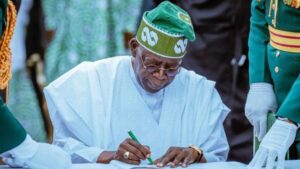
President Tinubu’s government has pushed through policies such as:
Removal of fuel subsidy,
Currency reforms,
Anti-corruption and fiscal tightening measures.
Whether one supports these policies or not, they have hurt powerful interests and worsened short-term economic pain. That combination tends to produce both political enemies and heightened anger on the street, increasing risk to the leader and his family.
In such a context, giving Seyi Tinubu a protection detail is not surprising — it is practically inevitable.
The Cost-of-Living Angle: Why Emotions Are High
It would be dishonest to ignore the economic backdrop. Nigerians are facing:
Rising food prices,
Costly transport,
Higher energy costs,
General inflation pushing many households to the brink.
These pressures have dragged down President Tinubu’s popularity. In such times, public tolerance for anything that looks like lavish privilege or over-the-top security is understandably low.
This is where Soyinka’s voice resonates: he is speaking to a public that feels squeezed and abandoned. But it’s also precisely why facts and context matter, so that justified anger at hardship does not turn into misdirected rage at individual targets based on incomplete information.

Global Practice: Nigeria Is Not Alone
Protecting the families of national leaders is standard across democracies:
In the United States, children of presidents receive Secret Service protection.
In France, presidential families are guarded by specialised units.
In South Africa and India, security details extend to immediate relatives where threats are identified.
Nigeria has followed a similar pattern for decades. Even before insurgency escalated, governors, ministers, National Assembly members and heads of agencies often had their families covered by state security when needed.
What has changed in Nigeria is not the existence of such protection but the danger level in which it is being provided.
The Real Contention: How Big, How Visible?
The core issue in this controversy is not whether Seyi Tinubu should be protected, but how much protection is appropriate and how it appears in public.
Security professionals point out that:
A standard close-protection team is usually small and discreet.
For public events, additional, temporary reinforcements are common — for crowd control, route security, and deterrence.
Such reinforcements may include Police, DSS and, in some cases, military support from nearby barracks.
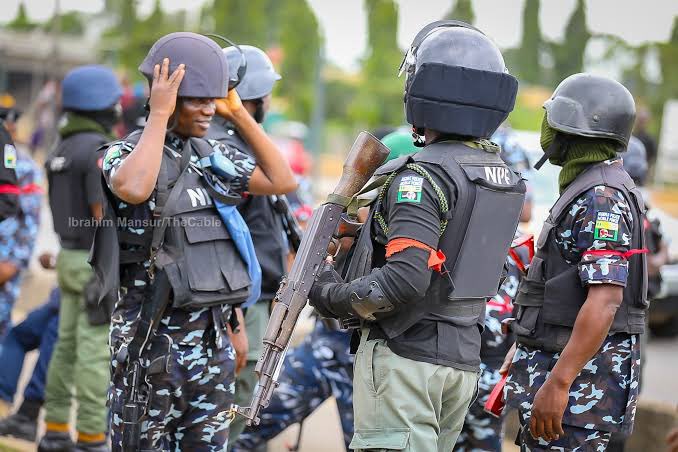
It is entirely possible that what the public saw was event-specific security, not a standing personal army that escorts Seyi Tinubu 24/7. Without official clarification, however, images can easily be misinterpreted.
Why the Police Must Clarify
A key lesson from this episode is the importance of institutional communication.
The Nigeria Police Force, as lead agency for VIP protection, should clarify:
Whether the deployment around Seyi Tinubu was temporary or permanent,
What threat assessments justify such deployments,
And how security decisions balance public safety, resource constraints and perception.
Clear communication would help defuse tension, reassure citizens that security is threat-led rather than privilege-led, and ensure that legitimate concerns — like Soyinka’s — are answered with facts, not silence.
Lawful Protection, Cooler Heads
This is a debate where more than one thing can be true:
Soyinka’s insistence on restraint and symbolism in governance is necessary in a democracy.
Nigeria’s Constitution and laws clearly permit threat-based protection of the President’s family.
The public’s anger, sharpened by a harsh cost-of-living crisis, is real.
Security agencies still have a duty to protect those they assess to be at serious risk.
The way forward is not outrage for its own sake, but fact-driven discussion:
Security agencies should explain themselves.
Commentators should seek verification before drawing conclusions.
Citizens should insist on transparency but also recognise that not all security decisions can be made in the open.
In a tense and insecure country, the challenge is to protect both lives and democracy without feeding unnecessary bitterness.

Conclusion:
National Patriots urges Nigerians to exercise restraint and sound judgment in reacting to security-related images or reports, particularly in this period of heightened national tension and insecurity. Not all situations are as they appear at first glance, and conclusions drawn without verified facts risk inflaming public sentiment unnecessarily. Security deployments are professional decisions guided by threat assessment, intelligence, and situational demands, many of which are not immediately visible to the public. At a time when the nation requires unity and calm, National Patriots calls for fact-checking, institutional clarification, and measured commentary, rather than assumptions that could deepen division or escalate avoidable controversy.
Princess G. A. Adebajo-Fraser MFR.
The National Patriots.




