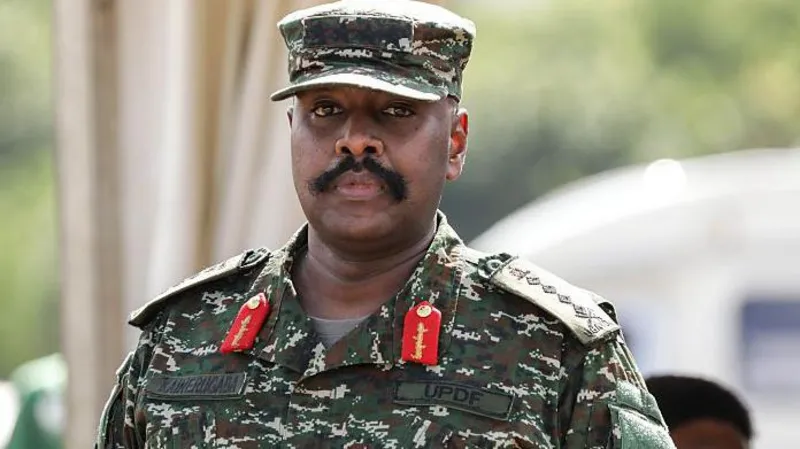
Uganda’s powerful army chief, Gen Muhoozi Kainerugaba, has once again ignited controversy following a series of inflammatory social media posts in which he threatened to castrate opposition leader Bobi Wine and claimed his bloodline descends from Jesus Christ.
Known widely as the country’s “tweeting general,” Kainerugaba — the son of long-serving President Yoweri Museveni — has become a central figure in Uganda’s tense post-election atmosphere. Critics describe him as part of an “unholy trinity” ruling the country with an iron grip: President Museveni, his son Muhoozi, and the president’s brother and powerful adviser, Salim Saleh.

The controversy erupted after Uganda’s fiercely contested presidential election, which saw the 81-year-old Museveni secure a seventh term. Analysts believe this is likely to be his last, with growing signs that Muhoozi, now 51, is being positioned as his successor.
Following the vote, Bobi Wine, who officially received 24% of the ballots, rejected the outcome as “fake,” alleging widespread ballot-stuffing. That claim drew the fury of Kainerugaba, who publicly ordered Wine to surrender himself to police within 48 hours.
“If he doesn’t, we will treat him as an outlaw,” the general wrote in a post that was later deleted. In another now-removed tweet, he went further, threatening to have Wine’s testicles removed.

Wine, who went into hiding after security forces raided his home, later reposted screenshots of the deleted messages. Kainerugaba responded mockingly: “Boo hoo hoo Mr. 24%.” A separate tweet declaring Wine wanted “dead or alive” remains visible, despite government assurances that the opposition leader is free.
The army chief also accused the United States of helping Wine escape and announced a suspension of military cooperation — a statement he later walked back, apologising and blaming “wrong information.”
Beyond threats, Kainerugaba has repeatedly invoked religion to bolster his political image. Earlier this month, he claimed: “I fear no one on this planet because my bloodline is from Jesus Christ,” a post he later deleted.
Analysts say such statements are not random. Nicodemus Minde of the Institute for Security Studies argues they fit into Uganda’s succession politics, describing them as deliberate provocations aimed at solidifying loyalty within the ruling establishment.
Others defend the general. A long-time friend compares his style to Donald Trump, calling him outspoken but deeply loyal and “a man of complex character.” Supporters argue that in a post-conflict country like Uganda, security experience matters more than public relations.
Still, critics warn that Kainerugaba’s behaviour risks both domestic stability and international relations. In 2022, he sparked regional outrage by threatening to invade Kenya, forcing President Museveni to personally apologise to Kenyan President William Ruto.
Human rights concerns have also mounted. By Kainerugaba’s own admission, at least 30 people were killed and 2,000 detained by security forces after the election. The United Nations said the vote took place in an environment of repression and intimidation, while rights groups continue to accuse elite military units of abductions and torture.
Despite the backlash, Muhoozi Kainerugaba remains one of the most powerful figures in Uganda — loyal to his father, unapologetic in tone, and increasingly central to conversations about who will rule the country next.