

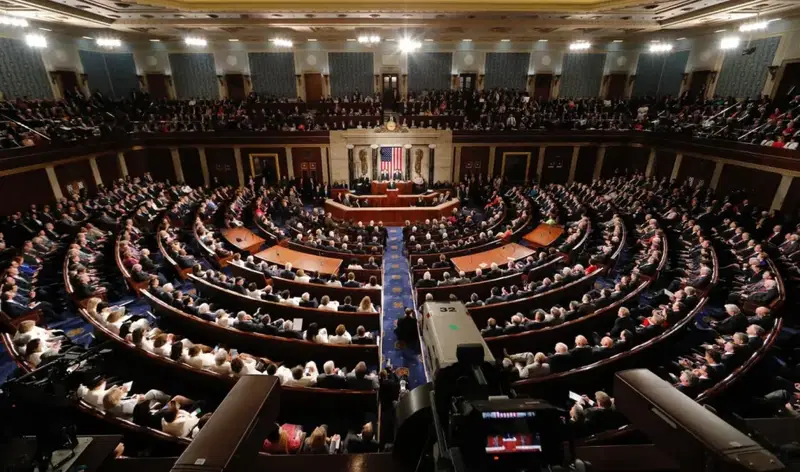
The United States Congress has proposed a series of targeted measures to address what it describes as escalating persecution of Christians in Nigeria, including institutional strengthening, improved policing, enhanced anti-money laundering efforts, and support for legal reforms.

The recommendations were contained in a joint report submitted to President Donald Trump by the House Committee on Appropriations and the House Committee on Foreign Affairs on Monday, February 23, 2026.

The report followed months of investigations, hearings, bipartisan fact-finding visits, and consultations with administration officials after Trump redesignated Nigeria as a Country of Particular Concern (CPC).
The lawmakers described Nigeria as “the deadliest place in the world to be a Christian,” citing ongoing violent attacks by Fulani militias and terrorist groups that have resulted in tens of thousands of deaths, destruction of thousands of churches and schools, and widespread kidnappings over nearly two decades.

They urged the Trump administration to:
– Invoke and announce CPC presidential directives to name and shame perpetrators of violence against Christians
– Impose targeted sanctions on individuals responsible for the violence
– Expand visa restrictions against perpetrators
– Condition U.S. funding on demonstrable action to halt attacks on Christian communities
– Repeal Sharia codes and criminal anti-blasphemy laws in northern states, which they argue are used to silence dissent and target minorities
– Compel Fulani herdsmen to disarm, potentially by restricting beef and cattle exports to countries like Ghana, South Africa, and Senegal

– Support legitimate self-defence for farmers and implement programmes to disrupt terrorist financing networks
– Divest from Russian military equipment in favour of American systems
– Counter Chinese influence, particularly allegations of Beijing paying protection money to Fulani militias
– Require a Government Accountability Office (GAO) audit of U.S. aid effectiveness to ensure transparency and accountability

The committees emphasised that protecting religious liberty and countering extremism require policy shifts backed by measurable accountability.
Chairman Tom Cole stated: “Liberty continues when strength stands guard. Protecting the freedom to worship requires vigilance that deters evil, confronts violence, and stands watch so prayer is never left undefended.”

Subcommittee Chairman Mario Díaz-Balart added: “We must stand with vulnerable communities and ensure those responsible for this violence are held accountable.”
The report warned that failure to curb extremist attacks could destabilise West Africa and threaten U.S. national security interests.
FG rejects persecution claims
In a swift response on Tuesday, Nigeria’s Minister of Information and National Orientation Mohammed Idris rejected the characterisation of state-backed religious persecution.

“Nigeria does not have, and has never had, a state policy of religious persecution,” Idris said.
He described the violence as stemming from “complex security threats, including terrorism, organised criminality, and longstanding communal tensions,” rather than government policy or religious bias.
Idris reaffirmed Nigeria’s constitutional guarantee of freedom of religion and worship for all citizens and equal protection under the law.
He highlighted intensified military and law enforcement operations, improved intelligence-sharing, deployment of forest guards, and investments in security assets as part of ongoing efforts to address insecurity.
CAN cautions against Sharia repeal
The Christian Association of Nigeria (CAN) warned that U.S. congressional calls to repeal Sharia and blasphemy laws risk inflaming religious tensions and destabilising the country.

A senior CAN official, speaking anonymously due to the sensitivity of the issue, said international pressure must be handled with caution.
“This is a very sensitive issue. Mishandling it could create serious tension,” the official said.
CAN instead advocated for a new, people-driven constitution that fairly accommodates all faiths and ethnic groups, arguing that piecemeal amendments to the 1999 Constitution may not address deeper structural problems.
The association emphasised that religion remains an extremely sensitive matter in Nigeria, requiring wisdom, responsibility, and care in public discourse.
Kano Assembly responds to U.S. claims on Kwankwaso
The Kano State House of Assembly urged the state government to formally address U.S. allegations reportedly linking former Governor Rabiu Kwankwaso to terrorism and proposals to freeze his assets.
The motion, moved by Usman Tasiu (NNPP–Kiru), praised Kwankwaso’s contributions to peace, education, and infrastructure, describing him as a unifying figure who mediated regional tensions and opposed terrorism during his tenure.




