

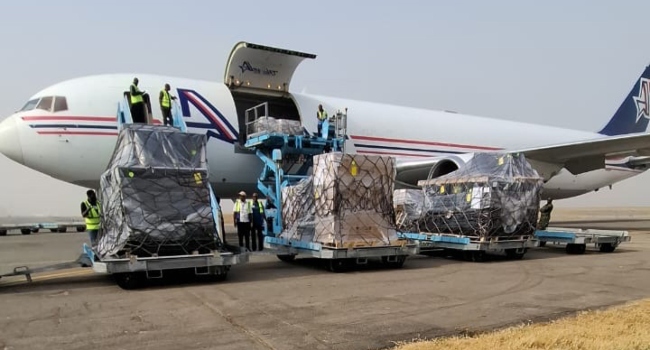
The United States military is ramping up the delivery of equipment and intelligence support to Nigeria as part of a broader effort to intensify operations against Islamic State-linked militants across Africa, the deputy commander of US Africa Command (AFRICOM) has said.
Lieutenant General John Brennan told AFP that the move forms part of Washington’s increasingly aggressive posture toward ISIS-affiliated groups on the continent, alongside closer collaboration with African militaries.

He disclosed that the Pentagon has also maintained communication with the armed forces of junta-led Sahel countries — Burkina Faso, Niger and Mali — despite strained diplomatic relations following recent coups.
According to Brennan, the expanded cooperation with Nigeria follows diplomatic pressure from Washington over persistent jihadist violence, as well as a renewed US strategy to more directly target IS-linked threats.

Under the Trump administration, Brennan said the US has adopted a more forceful approach, working with partners to kinetically target extremist groups, particularly ISIS.
He noted that militant activity across Africa is interconnected, from Somalia to Nigeria, making intelligence sharing and coordinated action essential. He added that the US is focusing on enabling partner forces by providing equipment, capabilities and actionable intelligence with fewer restrictions.

The comments followed the inaugural US-Nigeria Joint Working Group meeting held in Abuja last week, coming about a month after the US carried out surprise Christmas Day airstrikes on IS-linked targets in northwestern Nigeria.
Diplomatic tensions
Despite renewed military cooperation, diplomatic tensions persist, particularly over claims by former US President Donald Trump that Christians are being targeted for mass killings in Nigeria. Nigerian authorities and independent analysts have rejected that characterisation, describing the country’s security challenges as complex and multi-layered.

These tensions surfaced during the Abuja meeting when a senior US State Department official urged Nigeria to protect Christians without referencing Muslim victims of violence, drawing criticism in a country deeply sensitive to religious and ethnic balance.
Brennan, however, stressed that US intelligence support would not be limited to protecting any single religious group.
He said future American assistance would focus on intelligence sharing to support Nigerian air operations in Sokoto State and the northeast, where Boko Haram and its splinter group, Islamic State West Africa Province (ISWAP), have waged an insurgency since 2009.

Brennan described ISWAP as the most concerning extremist group currently operating in Nigeria.
While analysts have observed increased US intelligence flights over Nigerian airspace in recent months, questions remain about whether air support alone can significantly weaken militant groups operating in impoverished and poorly governed rural areas.
Continued Sahel engagement
Brennan said US-Nigeria cooperation would involve comprehensive intelligence sharing, exchange of tactics and procedures, and support for Nigeria’s acquisition of military equipment.

He revealed that recent US strikes targeted militants linked to Islamic State Sahel Province, raising concerns among analysts about the group’s potential expansion from the Sahel into coastal West African states, including Nigeria.
The effectiveness of the strikes remains unclear, with limited confirmation of militant casualties. Nigeria’s information minister, Mohammed Idris, described the operation as “still a work in progress.”
Brennan also said the US continues to collaborate informally with the militaries of Burkina Faso, Mali and Niger, despite reduced official engagement since military coups disrupted civilian rule.
He added that the US is not seeking to establish new military bases in the region following its exit from Niger, stressing that Washington’s focus is on rapidly delivering capabilities where needed rather than maintaining permanent bases.
The remarks underscore a shift toward more flexible, partner-driven security cooperation as the US intensifies efforts to counter jihadist threats in Nigeria and across West Africa.




