

The Federal Government is in advanced talks with Chinese investors to revive the long-dormant Ajaokuta Steel Company with a $2 billion investment package and a production-sharing model aimed at restoring large-scale steel production in Nigeria.

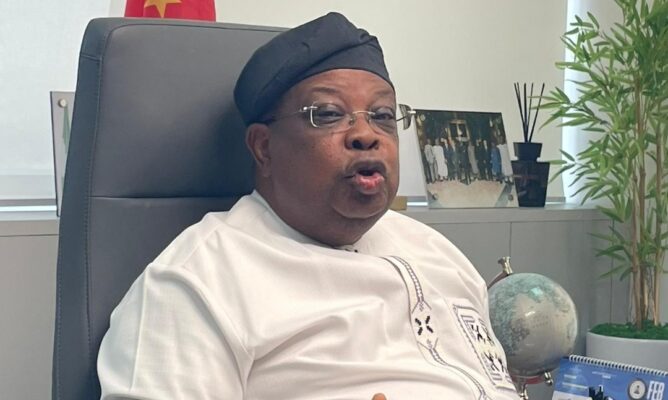
Joseph Tegbe, Director-General and Global Liaison for the Nigeria-China Strategic Partnership, disclosed this in an exclusive interview on Wednesday in Abuja.
Tegbe described the framework as a potential game-changer to position Ajaokuta as the cornerstone of Nigeria’s industrialisation drive.

Built in 1984 with an installed capacity of 1.3 million metric tonnes per annum, Ajaokuta has remained largely non-operational for decades due to legal disputes, failed concessions, and inconsistent policy implementation.
Nigeria currently requires about 10 million metric tonnes of steel annually but produces only around 1.2 million metric tonnes — mostly from recycled scrap.

“Even the 1.2 million metric tonnes produced locally is largely scrap-based. That is not sustainable when we have significant iron ore deposits in Itakpe and other parts of Kogi and Niger States,” Tegbe said.
The selected Chinese investor chosen after engagements with nearly 10 companies has already conducted a technical assessment of the plant.
About 20 engineers were deployed to Nigeria at the investor’s expense for a two-week evaluation, concluding that while much of the equipment is outdated, the core infrastructure remains viable.
“They told us that within six months of commencement, a steel rolling mill can begin operations,” Tegbe revealed.

Under the proposal, the Chinese partner will inject approximately $2 billion to rehabilitate and expand the complex — starting with the existing 1.3 million metric tonne rolling mill and scaling capacity to 10 million metric tonnes annually within months of stabilised operations.
The project will not require direct federal funding. The Chinese firm will raise financing (subject to approval by China’s National Development and Reform Commission) and recover its investment through a production-sharing arrangement.

Tegbe emphasised that Nigeria will retain ownership of Ajaokuta, rejecting any notion of asset sale.
“They are not going to own Ajaokuta. Nigeria still owns Ajaokuta. What we are doing is production sharing,” he clarified.
Under the still-negotiated sliding-scale model, the investor may initially take 60–70 per cent of output as repayment, with that share gradually declining to zero over five to 10 years.
“For us, it is better to own 10 per cent of a working factory than 100 per cent of a non-functional one,” Tegbe argued.

The government is also working to integrate the iron ore supply chain from Itakpe with Ajaokuta under a coordinated framework involving the Ministry of Steel Development and plant management.
Supporting infrastructure including rail links from Warri Port through Itakpe to Ajaokuta, road upgrades, and inland waterway improvements is part of the broader discussions.

Tegbe dismissed concerns about Nigeria’s iron ore quality (34–44 per cent purity), noting that plants in China operate with ore as low as 14 per cent purity after beneficiation.
If agreements are finalised by mid-year, rolling mill operations could resume by December 2026 or January 2027.
A key component is technology transfer and capacity building, with plans to send hundreds of Nigerian engineers to China for specialised steel production training once deals are signed.
Tegbe positioned the Ajaokuta revival within a wider Nigeria-China industrial cooperation agenda covering steel, agriculture, logistics, and value addition.

The long-term goal is to reduce import dependence, create jobs, stabilise foreign exchange, and rebalance trade — currently skewed heavily in China’s favour.
Bilateral trade stands at about $23 billion, with Nigeria exporting only around $2 billion to China while importing over $20 billion.
Tegbe said the target is to grow total trade to $40 billion within five years while achieving at least $15 billion in Nigerian exports — with emphasis on value-added products rather than raw commodities.
“We must stop exporting raw products. Value addition is critical if we are serious about industrialisation,” he concluded.




