

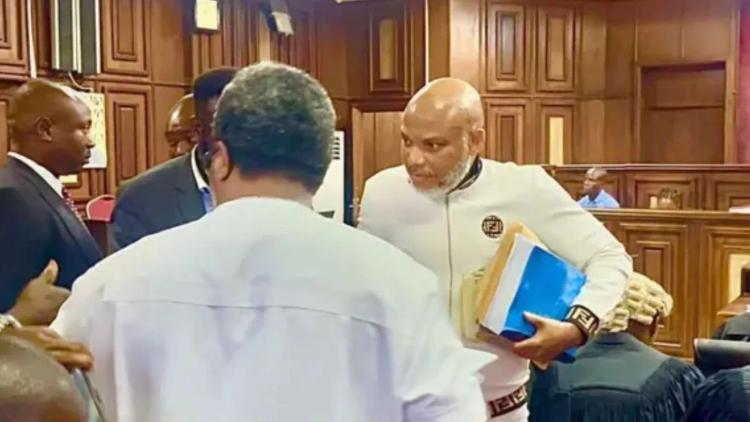
Justice James Omotosho of a Federal High Court in Abuja has sparked religious debate after referencing the Bible while delivering the judgement that sentenced the leader of the proscribed Indigenous People of Biafra (IPOB), Nnamdi Kanu, to life imprisonment.
On November 20, Justice Omotosho convicted Nnamdi Kanu on a seven-count charge of terrorism and sentenced him to life imprisonment.
The court held that Kanu used his broadcasts to incite attacks on security agencies, destroy infrastructure, and threaten diplomatic missions.

Justice Omotosho said Nigeria remained an indivisible state and ruled that self-determination could not be pursued through violence.
He ordered the forfeiture of Kanu’s transmitter and directed his detention in a secure facility without digital access.
The judge noted that the sentence for Nnamdi Kanu was the death penalty, but that he had to show mercy because of the teachings of the Holy Book.

Omotosho said, “The court is only being merciful to Kanu because we are joined by our lord Jesus Christ to be merciful. Kanu has not shown any remorse; he is arrogant, cocky, and unruly. I will temper justice with mercy.”
Omotosho further quoted a Bible verse saying, “Matthew Chapter 23 of the holy Bible, in which it preaches mercy.”
He further said the death penalty is gradually being abolished in many countries, while religious doctrines also advocate mercy.
Judge’s Bible quote sparks religious debate

However, the judge quoting the Bible has sparked religious debate with many Nigerians taking to social media to question whether such references align with the secular nature of the country’s judicial system.
One of the critics, Misbahu El-Hamza, expressed surprise at the judge’s choice of words.
“Who else noticed how Justice Omotosho kept quoting the Holy Bible while sentencing the designated terrorist Nnamdi Kanu? I was like, where’s the secularism Nigeria claims?” he wrote on his Facebook page.
Similarly, Bolárìnwá Oládeìndé Akinadé questioned the legality of the judge’s approach.

“Come to think of it, what is Justice Omotosho’s business with quotes from the Bible? Is that part legal too?” he asked.
But some individuals believe the reactions are unnecessary. Fatima Abdulhadi Zubairu argued that the context of the case makes the judge’s choice unsurprising.
“To me, it didn’t mean anything. Since the judge is a Christian, the person being sentenced is a Christian, and the followers, too, are mostly Christians,” she said.
However, others felt the issue would have been controversial if the roles were reversed.

Isah Ogedengbe Abu Khuzaimah criticised what he described as selective outrage. “Why would this judge base his judgment on quotations from the Bible? I thought they said we are the ones Islamizing Nigeria. Had it been a Muslim judge quoting the Qur’an, what would these shallow minds be saying?”
He added that it is sad that Nigerians still struggle with religious tolerance.
A similar argument came from Sanusi Lafiagi, who challenged critics to respond the same way if a Muslim judge referenced the Qur’an.
“The day a Muslim judge will sentence a Muslim criminal, citing verses of the Qur’ān or even Hadīth, I dey wait to see any Muntula who will come online to shout Islamization of the judiciary,” he said.

Calls for Understanding and Tolerance
Meanwhile, some commentators urged Nigerians to see the issue through a lens of coexistence rather than division.
Abubakar Saddiq Malami said the controversy highlights the need for mutual respect among Nigeria’s diverse religious groups.
“If a Muslim judge had quoted the Qur’an, the response might have been different,” he said.
He added that religious tolerance remains essential to Nigeria’s unity: “Islam teaches respect for all prophets, including Jesus and Moses… Let’s celebrate the tolerance and understanding that exists among Nigerians of different faiths.”
A Tradition of Judicial Wisdom

Awaisu Yusuf, a civic advocate commenting on the matter, provided a more technical explanation, saying judges often draw from various sources, including scripture, to reinforce moral points, not legal authority.
He explained: “Judges sometimes quote the Bible, the Qur’an, or philosophers, not because those texts determine the case, but to add moral weight to their reasoning.”
He maintained that the judgment remains grounded in Nigerian law: “Justice Omotosho, quoting the Bible, doesn’t mean the ruling was based on religion. Courts operate under the Constitution. Quotations simply enrich the judgment with universal wisdom.”
Yusuf described such references as Judicial Wisdom, a tradition in which judges use moral or philosophical insights to illuminate principles of justice without compromising legal objectivity.
Kanu was first arrested in 2015 for terrorism and treasonable felony. He fled Nigeria in 2017 after a military raid on his home. He was re-arrested in Kenya in 2021 and returned to Nigeria under disputed circumstances.
His trial continues to generate controversy and remains one of Nigeria’s most sensitive legal battles.




