

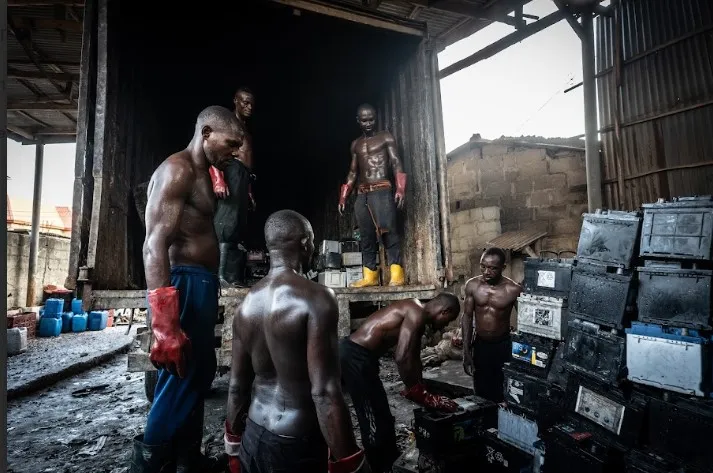
The Ogun State Government has ordered an immediate halt to all lead ingot export activities in the state due to rising concerns about toxic exposure in Ogijo, located in Sagamu Local Government Area.
Along with the suspension, the government has shut down seven Used Lead-Acid Battery (ULAB) recycling plants operating in the Ogijo community.

This directive was revealed on Thursday by Emmanuel Ojo, Senior Special Assistant on New Media to Governor Dapo Abiodun, through a post on X.
The decision comes after a joint investigation by PREMIUM TIMES and The Examination, which exposed hazardous working conditions and significant lead contamination affecting residents of Ogijo, a border community between Lagos and Ogun.
According to the media aide, the Commissioner for Environment, Ola Oresanya, visited the affected area on Monday with a technical delegation drawn from the Ministries of Environment and Health, the Ogun State Environmental Protection Agency (OGEPA), and the National Environmental Standards and Regulations Enforcement Agency (NESREA).

Following their on-site inspection, the government sealed seven ULAB recycling plants in the area.
During the visit, Mr. Oresanya told residents that the shutdown and suspension were precautionary steps to safeguard the public while a detailed investigation is carried out.
He assured the residents that the state will run a comprehensive health and environmental audit, including testing the presence of lead in humans, as well as in the air, soil, and water across Ogijo.

According to him, the findings from the audit and updated laboratory results will be made public. He also stated that the government will examine the processes used to generate earlier test results that caused panic in the community.
The investigation by PREMIUM TIMES and The Examination showed that lead recycling plants in Ogijo have severely polluted the air and soil. Scientists who collected 70 blood samples from factory workers and residents found toxic lead levels in every worker tested, with some reaching up to 38 µg/dL — far above the World Health Organisation’s recommended limit.
Children were also affected; eight out of 14 tested children had blood-lead levels above five µg/dL, a threshold known to impair cognitive development.

Soil and dust samples from homes, farms, and even a nearby school contained extremely high levels of lead. In one school playground, contamination reached over 1,900 ppm — nearly five times higher than many global safety standards.
Mr. Oresanya added that any company found violating environmental regulations will face strict sanctions once the audit is completed. He urged residents to stay calm as authorities assess the extent of pollution in the Ogijo industrial zone.
OGEPA’s Enforcement Visit
Separately, OGEPA announced that it led an inspection team to six ULAB recycling plants ahead of the mandatory 72-hour shutdown issued to nine facilities statewide.
Another statement posted on X explained that the shutdown, which began on 24 November, is part of a broader health and process audit designed to ensure battery recycling activities do not endanger workers, residents, or the environment.
The inspected facilities include African Non Ferrous Industry Limited, Vendanta Metal Industries Limited, Metal Manufacturing Nigeria Limited, Hanushi Manufacturing Limited, BPL Limited, and GBMT.
OGEPA’s General Manager, Kehinde Bello, emphasized the urgency of reducing human exposure to lead, reaffirming the agency’s commitment to maintaining a safe and pollution-free environment.
Timeline of Events
Since the investigative report was published, several federal and state agencies responsible for enforcing labour and environmental laws have taken action after nearly a decade of weak regulation.
On 24 November, the Minister of State for Labour and Employment, Nkeiruka Onyejeocha, sealed True Metals Nigeria Limited and Phoenix Steel Mills Limited.
During her inspection of True Metals — a central feature of the investigation — she said workers were found operating in “hazardous and dehumanising conditions.”
On Thursday, 27 November, Commissioner Oresanya led a joint team from Environment and Health ministries, OGEPA, and NESREA to Ogijo, where seven additional lead recycling factories were shut down.

Earlier in September, NESREA sealed nine lead recycling factories after reviewing soil and blood test results conducted by The Examination in collaboration with STRADev, an environmental health organisation.
Furthermore, Chris Pruitt, executive chairman of East Penn Manufacturing — a major U.S. battery manufacturer connected to Nigerian suppliers — told investigators that the company has stopped buying lead from Nigeria and has strengthened its supplier code of conduct.



