

Tavor Rifles in Bandit Hands: A New and Dangerous Phase in Nigeria’s Security Crisis
By HeadlineNews.News – Special Report
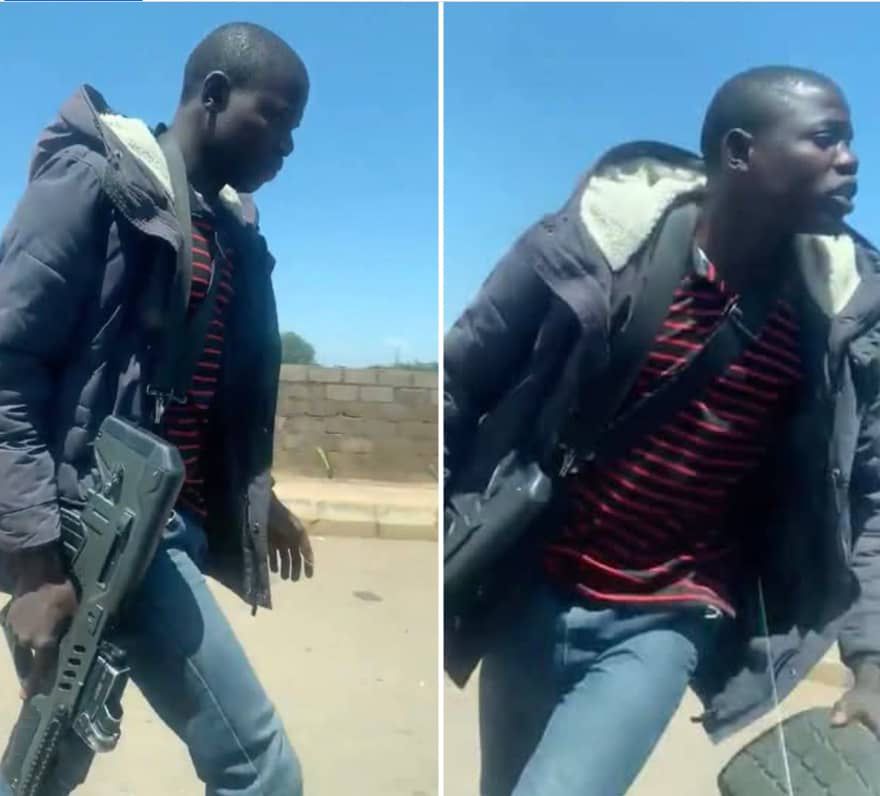
Recent images circulating online show suspected Fulani armed bandits carrying what appears to be an IWI Tavor TAR-21/X95 rifle – a next-generation Israeli bullpup weapon usually reserved for elite military units, not rural criminals.
In a security environment where bandits and insurgents in Nigeria typically rely on locally made Dane guns, stolen AKs, and aging G3/FN FAL rifles, the sudden appearance of a Tavor is not a curiosity; it’s a strategic alarm bell.
This report examines what this development means for Nigeria’s security architecture, and why ignoring it would be a serious mistake.
■ The Tavor: A Weapon That Shouldn’t Be Here
The IWI Tavor family is a line of modern assault rifles designed for professional militaries:
Bullpup configuration (magazine behind the trigger) for compactness
Used by elite units in Israel, India, Mexico, Colombia and others
Built for urban, desert, and close-quarters fighting
Optimized for optics, night operations, and high mobility
Unlike the ubiquitous AK-47 – cheap, rugged, and widely trafficked – the Tavor:
Is far more expensive and harder to source
Is typically acquired only via state-level procurement
Is rarely seen in informal or low-level black markets
In plain language: Tavors don’t just “show up” in bandit camps. Their presence points to a serious, structured supply chain.
■ How Does a Tavor Reach a Bandit Camp?
The appearance of such a rifle suggests one or more of the following pathways.
(A) Foreign Sponsorship and Proxy Networks
West Africa and the Sahel are awash with:
Transnational jihadist networks
Arms traffickers operating from Libya, the Middle East, and Eastern Europe
Criminal organizations moving weapons along migration and smuggling routes
A Tavor hints at more than just opportunistic banditry. It suggests that certain groups in Nigeria may be:
Receiving foreign funding or weapons as proxies
Tapping into international arms pipelines used in other conflict zones
Being tested or groomed as regional destabilization tools
This would mean Nigeria’s “local bandit problem” is increasingly plugged into global conflict economies.
(B) Leakage from Military or Government Channels
Weapon diversion from official stocks is a well-known pattern in Africa and beyond:
After the fall of Gaddafi, Libyan arsenals flooded the Sahel
In Mali, government weapons have repeatedly ended up in jihadist hands
In Nigeria, Boko Haram has previously captured or diverted army weapons
If the Tavor came from an official or semi-official procurement, it implies:
High-level corruption or collusion
Weak control and tracking of weapons inventories
A shift from petty diversion (ammunition, old rifles) to strategic leakage of advanced systems
In that scenario, criminality and governance failures merge in a way that directly undermines the state’s monopoly on force.
(C) Battlefield Capture and Resale
Some peacekeeping contingents and private military contractors operating in the Sahel use modern rifles, including Tavor-type systems or similar platforms.
Captured weapons can:
Enter informal markets in Mali, Niger, or Burkina Faso
Move southwards along smuggling routes into Nigeria
Be sold to whoever can pay – jihadists, militias, or bandits
The net effect is the same: weaponry designed for professional forces ends up with non-state actors.
■ Tactical Impact: When Bandits Outgun the Infantry
Many Nigerian ground units still use:
AK-47 / AKM and Type 56
Older G3 and FN FAL rifles in some formations
Limited or no access to optics, night-vision, and modern accessories
By contrast, a Tavor-equipped group gains:
Better maneuverability in forest and bush due to compact design
Higher accuracy and faster handling in close quarters
Optics-ready rails for red-dot sights and night optics
Improved reliability in hot, dusty conditions
This creates a dangerous reality: in certain engagements, bandits may be better equipped than the very soldiers deployed to fight them.
That has three immediate consequences:
● Higher casualty risk for security forces
● Lower morale for frontline soldiers who feel outgunned
● Greater confidence and boldness among bandits.
This is how small, poorly organized groups evolve into coherent, confident armed actors.
● Lessons from Other Conflict Zones
Nigeria is not the first country where upgraded weapons signaled a shift in the nature of armed violence.
Somalia
When Al-Shabaab began fielding more modern rifles and night-fighting capabilities, their operations expanded beyond rural ambushes into larger, more coordinated attacks on urban centers and heavily defended targets.
Afghanistan
After 2021, Taliban fighters gained access to significant quantities of modern NATO weapons and equipment. This accelerated their consolidation of control and weakened local resistance, including from regional militias.
Colombia
FARC’s access to better arms in the 1990s correlated with a transformation from localized guerrilla bands into a quasi-conventional force capable of large-scale operations, high-level kidnappings, and control of territory.
Mali & Burkina Faso
Jihadist and insurgent groups evolved from lightly armed bands into coordinated insurgent forces once they gained access to more advanced small arms, vehicles, and communication tools. Governments struggled to catch up.
The recurring pattern is clear: when non-state actors upgrade from “whatever they can find” to “modern, modular weapons,” the conflict changes shape – often faster than the state can adapt.
● Why This Is a Critical Moment for Nigeria
Nigeria’s insecurity is already multidimensional:
Banditry and mass kidnapping in the Northwest
Boko Haram/ISWAP terrorism in the Northeast
Farmer–herder clashes across multiple states
Separatist-linked violence and criminal militias in the Southeast
The presence of Tavor-type rifles among Fulani bandits is a warning that some of these actors are moving from chaotic criminality toward structured insurgency.
Key implications:
Escalation of Capability
A bandit cell with access to sophisticated weapons, training, and funding is no longer just a rural nuisance. It becomes a persistent non-state force capable of resisting or ambushing organized security operations.
Erosion of State Authority in Rural Areas
Many rural communities already feel abandoned. If they see bandits with more advanced weapons than government forces, their trust in the state declines further, and informal arrangements with criminals may become normalized.
Higher Risk of Urban and Strategic Targets
As their confidence and capabilities grow, such groups may:
Move closer to major highways and towns
Attempt attacks on security convoys or critical infrastructure
Engage in targeted killings or high-value kidnappings deep into urban areas
Deepening Internationalization
The weapon is not just metal; it’s a traceable indicator of connections beyond Nigeria’s borders. That pulls Nigeria’s internal crisis deeper into the broader Sahel and global security equation.
● What Nigerian Authorities Need to Do Differently
This development should force a reset in thinking at the highest levels of government and security.
● Treat Arms Flows as a Priority Intelligence Target
Map routes, brokers, and nodes responsible for moving advanced weapons into Nigeria
Collaborate with neighboring states and international partners on forensics and tracing
Follow the money: arms flows are tied to financial networks, politicians, and business interests
● Audit and Secure Official Stockpiles
Conduct independent audits of military and police armories
Implement verifiable tracking systems for sensitive weapons
Hold officers criminally accountable for losses, diversions, and falsified records
● Upgrade the Basic Soldier, Not Just Special Forces
Modernize infantry weapons gradually but systematically
Provide optics, better training, and maintenance support
Improve conditions, welfare, and discipline to reduce insider collusion
● Strengthen Border and Corridor Controls
Focus not only on borders but also inland corridors, markets, and known smuggling hubs
Use aerial surveillance, human intelligence, and financial intelligence together
● Recognize This Is No Longer “Ordinary Banditry”
The language used by policymakers matters. Framing this as “mere banditry” understates the threat and encourages underreaction.
In reality, Nigeria is facing armed non-state actors evolving into hybrid insurgents, enabled by regional and possibly international networks.
Conclusion: One Rifle, Many Warnings
A Tavor rifle in the hands of a Fulani bandit is more than a shocking image.
It is a signal:
That someone with money, access, and intent is upgrading Nigeria’s non-state armed groups.
That gaps in border control, arms tracking, and internal accountability are being exploited.
That the line between bandit, insurgent, and proxy force is blurring.
If Nigeria’s security response remains slow, fragmented, and politically constrained, these weapons will not remain rare. They will spread. And when they do, recovering control over large parts of the country will become far more costly – in money, in territory, and in lives.
Headlinenews.news Special Investigative Report.



