

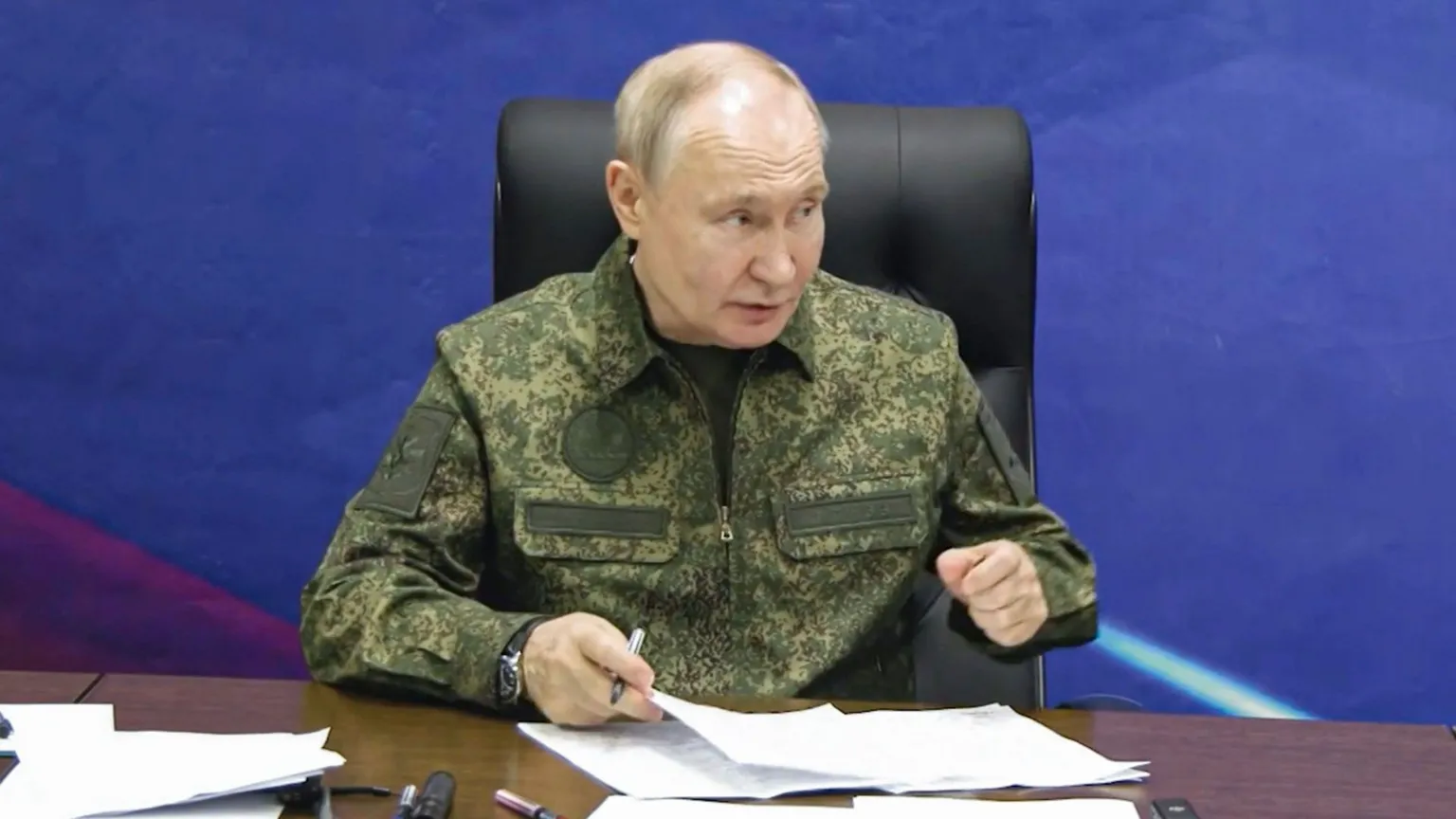
Russian President Vladimir Putin is set to hold talks in Moscow on Tuesday with U.S. special envoy Steve Witkoff, shortly after the White House expressed strong optimism about reaching an agreement to end the war in Ukraine.

Jared Kushner, the son-in-law of U.S. President Donald Trump and an informal adviser involved in diplomatic efforts, is also expected to participate in the meeting.
The upcoming talks follow two days of negotiations in Florida involving Ukrainian and American officials — including Witkoff and Kushner — aimed at fine-tuning a U.S.-supported peace proposal that many observers say favors Russia.

Ukrainian President Volodymyr Zelensky described the discussions as “constructive,” though he admitted several difficult issues still need to be resolved.
Kremlin spokesman Dmitry Peskov confirmed that Putin’s meeting with Witkoff will take place in the latter half of Tuesday.
Speaking earlier in Paris after talks with French President Emmanuel Macron, Zelensky reaffirmed that Ukraine’s priorities in any peace agreement remain preserving national sovereignty and securing firm security guarantees. He stressed that the toughest part of the negotiations remains the territorial question, as Russia continues pressing Ukraine to surrender eastern regions still under Kyiv’s control — something Ukraine has repeatedly rejected.

The meeting in Moscow comes just hours after Russian officials claimed to have taken control of the key eastern town of Pokrovsk — known in Russian as Krasnoarmeysk — as well as the border town of Vovchansk in the northeast. However, Ukrainian authorities denied that either city had fallen, and independent monitoring groups also reported no confirmation of full Russian control.
Andriy Kovalenko, head of Ukraine’s Center for Countering Disinformation, suggested that Russia’s main objective is to shift all the pressure in the U.S. peace proposal onto Ukraine.
Russia has spent nearly 18 months attempting to seize Pokrovsk. Over the weekend, it released footage of Putin visiting a command post, where he said Russian forces had made progress in “a very important direction.”

Before heading to Moscow, Witkoff also met with U.K. Prime Minister Sir Keir Starmer, President Zelensky, and Ukraine’s chief negotiator Rustem Umerov. Several European leaders joined the Macron-Zelensky meeting virtually.
White House Press Secretary Karoline Leavitt said on Monday that the draft peace agreement had been “significantly improved,” adding that the administration remains “very optimistic” about ending the conflict.
She declined to share details, saying negotiators should continue their work, but emphasized that Washington hopes to see a resolution soon.

Last week, Putin acknowledged reviewing a U.S.-proposed draft peace plan and suggested it might serve as a “basis” for a future settlement. However, the Kremlin later expressed doubts about accepting it after Kyiv and European partners introduced revisions.
The earlier draft circulated in November drew backlash in Kyiv and across Europe. Critics said it heavily favored Moscow’s demands and attempted to dictate how billions in frozen Russian assets in Europe should be managed, along with terms affecting Ukraine’s access to European markets.

President Macron insisted Monday that no final peace plan currently exists and stressed that any legitimate proposal must involve both Ukraine and European countries. He added that only Zelensky can determine any territorial decisions and highlighted that issues such as frozen Russian assets, security guarantees for Ukraine, and the country’s path toward EU membership must involve European voices.
Macron also acknowledged the Trump administration’s efforts to bring the conflict to an end. The war began with Russia’s annexation of Crimea in 2014 and escalated into a full-scale invasion in 2022.

EU foreign policy chief Kaja Kallas described this week as potentially decisive but warned that Moscow is interested only in negotiations with those willing to offer concessions. She cautioned that pressure could fall unfairly on Ukraine “because forcing the weaker side to surrender is the easiest way to stop the war,” although such an outcome is unacceptable.
Although Russia has occasionally shown openness to U.S.-mediated talks in recent months, many of its demands directly violate Ukraine’s sovereignty and remain unacceptable to Kyiv.
While territorial control remains the biggest obstacle, the issue of security guarantees for Ukraine is also proving contentious. Kyiv and its European allies insist Ukraine must receive long-term protection — including potential NATO membership — to prevent future attacks.
But Russia strongly opposes Ukraine joining NATO, and Trump has also ruled it out.




