

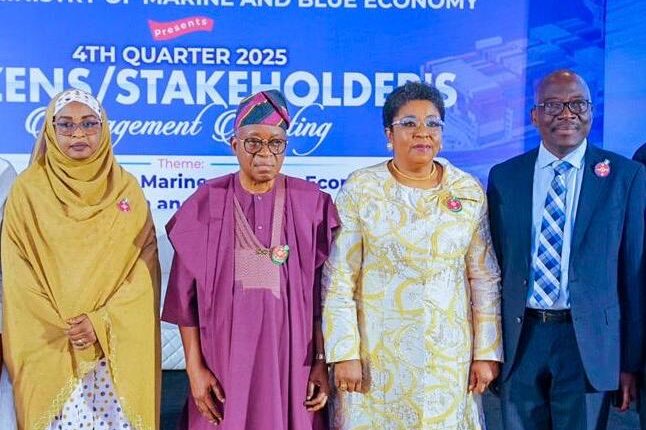
The Federal Ministry of Marine and Blue Economy on Wednesday officially unveiled its Enterprise Content Management System (ECMS), a major milestone in the Ministry’s digital transformation and institutional reform initiatives.
The launch was jointly performed by the Honourable Minister, Dr. Adegboyega Oyetola, CON, and the Head of the Civil Service of the Federation, Mrs. Didi Esther Walson-Jack, during the Ministry’s Fourth Quarter 2025 Stakeholders and Citizens Engagement in Abuja.

The event, themed “Positioning Nigeria’s Marine and Blue Economy for Investment, Innovation and Expansion: The Pathway,” brought together a wide range of stakeholders from across the marine and blue economy sector.
In his keynote address, Dr. Oyetola hailed the engagement as a landmark moment in Nigeria’s efforts to position the marine and blue economy as a central driver of economic diversification, growth, and global competitiveness. He emphasized that the forum was designed to enhance transparency, accountability, partnership, and shared ownership of reforms, in line with President Bola Ahmed Tinubu’s Renewed Hope Agenda.
On the launch of the ECMS, Dr. Oyetola described the platform as a strategic tool that goes beyond administrative functions to promote efficiency, transparency, and improved service delivery. “A digitally enabled Ministry is a more responsive Ministry,” he said, adding that the system would streamline workflows, strengthen records management, improve decision-making, and support investors and partners with speed and clarity.

Highlighting the sector’s potential, the Minister noted Nigeria’s extensive coastline, inland waterways, and strategic location as key assets for maritime trade, fisheries, aquaculture, logistics, tourism, and related services, all of which can drive inclusive growth, job creation, and regional integration.
Dr. Oyetola also outlined the Ministry’s achievements over the past year, particularly in fisheries and aquaculture, where local fish production increased from 1.1 million metric tonnes to 1.4 million metric tonnes. While still below the nation’s annual consumption of 3.6 million tonnes, the progress reflects targeted interventions, improved coordination, technology adoption, and better planning.
He further revealed ongoing discussions with financial institutions to offer single-digit interest loans to fishermen nationwide, aiming to expand access to affordable finance, enhance productivity, empower operators, and combat illegal, unreported, and unregulated fishing.

On the international front, Dr. Oyetola highlighted Nigeria’s election into Category C of the International Maritime Organization (IMO) and its emergence as Chairman of the Conference of Ministers of the Fisheries Committee for the West Central Gulf of Guinea, signaling renewed global confidence in the country’s maritime leadership and policy reforms.
The Minister added that the Ministry’s reform efforts have gained national recognition, citing a 96% performance rating by the Central Results Delivery Coordination Unit (CRDCU), positive assessments from the Presidential Enabling Business Environment Council (PEBEC), and recent National Bureau of Statistics data ranking water transportation among the fastest-growing sectors of the Nigerian economy.

Mrs. Didi Esther Walson-Jack commended the Ministry for its reforms and achievements, describing the ECMS as a critical step toward paperless governance, improved records management, and faster, more efficient service delivery. She noted that the platform would enhance institutional memory, reduce bureaucracy, strengthen accountability, and align the Ministry with the broader digital transformation agenda of the Federal Civil Service.

The launch attracted regulators, private sector operators, investors, development partners, and other stakeholders, all of whom pledged continued support for the sustainable growth of Nigeria’s marine and blue economy.



