

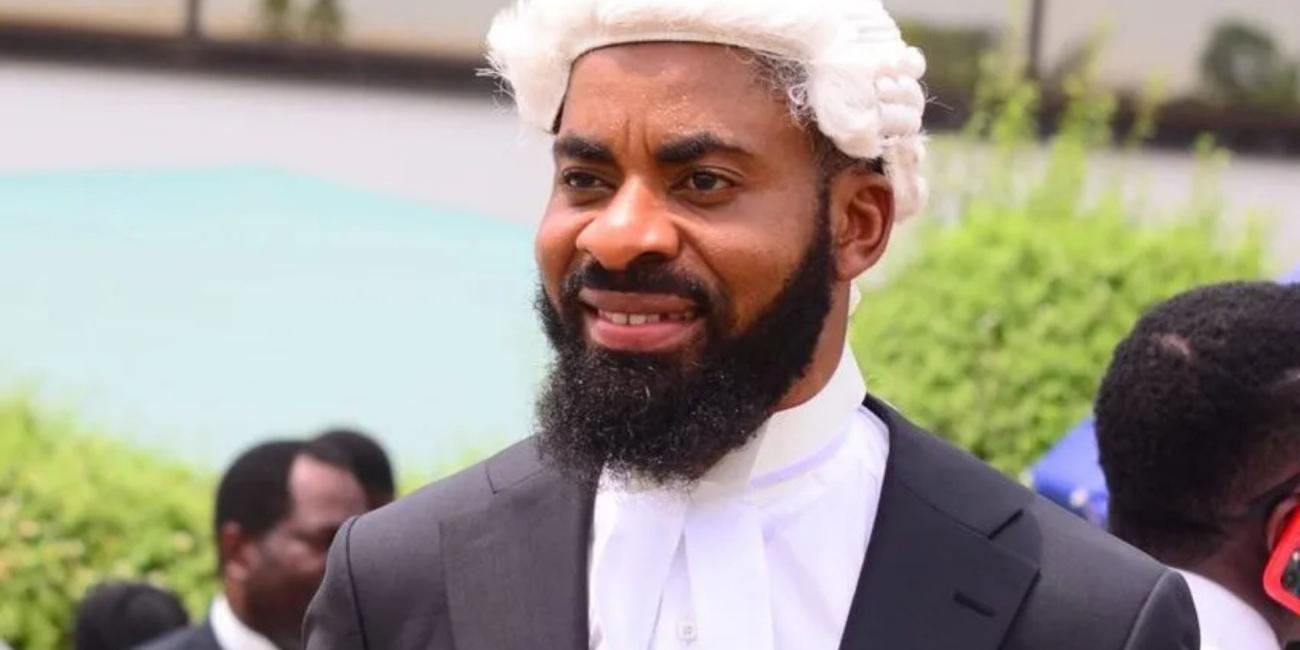
Human rights lawyer, Deji Adeyanju, has urged Nigeria’s anti-corruption agencies to immediately probe allegations involving the Chief Executive Officer of the Nigerian Midstream and Downstream Petroleum Regulatory Authority (NMDPRA), Farouk Ahmed.
Adeyanju also warned the Federal Government against yielding to what he described as pressure and “economic blackmail” from billionaire industrialist Aliko Dangote in a bid to secure monopoly control of the oil and gas sector.

His remarks come amid a growing public confrontation between Dangote and the NMDPRA leadership, a dispute that has highlighted longstanding structural tensions within Nigeria’s petroleum industry.
In a statement obtained by SaharaReporters, Adeyanju called on the EFCC and ICPC to investigate claims that Ahmed allegedly spent about $5 million on his children’s secondary education in Switzerland.

“If this allegation is true, it raises serious questions about how such an amount could be legitimately financed on a public servant’s income,” he said, adding that the issue speaks to broader concerns about transparency and accountability in the oil sector’s regulatory system.
However, Adeyanju stressed that the controversy should not be misinterpreted as Dangote acting in the public interest.
“This dispute does not mean Aliko Dangote has suddenly become a national crusader,” he said. “At its core, this is about market dominance and monopoly power.”

According to him, Dangote’s grievance is not regulation itself, but regulatory oversight that limits his ability to dominate a sector he entered recently through the Ibeju-Lekki refinery.
Adeyanju cautioned the government against weakening state authority due to public pressure, urging it to support regulators—so long as they operate within the law. He noted that the petroleum industry is governed by the Petroleum Industry Act (PIA), which promotes competition under a willing buyer–willing seller framework, rather than private sector control.
He further questioned the pricing of fuel produced by the Dangote Refinery, describing it as illogical for locally refined petrol to be more expensive than fuel imported from countries such as Brazil or Argentina.

“If Dangote expects Nigerians to embrace locally refined products and reduce imports, prices must be competitive,” he said.
Adeyanju also referenced widespread but disputed claims that some of the refinery’s products are substandard, insisting such concerns should be addressed through proper regulatory checks rather than political pressure.
“No one forced Dangote to build a refinery of this scale,” he added. “Every investment carries risk, and those risks should not be shifted to Nigerians through higher prices or limited choices.”
He warned against using patriotism as a justification for making Nigerians “pay more and get less” simply because products are locally produced.

In closing, Adeyanju disclosed that the dispute between Dangote and Farouk Ahmed predates the current controversy and has been ongoing behind the scenes. He called on the Federal Government to conduct a comprehensive investigation into the matter.
“The probe should cover not only allegations against the regulator, but also whether inducements were offered and rejected,” he said.




