


President Bola Ahmed Tinubu has formally presented Nigeria’s ₦58.18 trillion 2026 Appropriation Bill to the National Assembly.
The budget was laid before a joint sitting of lawmakers on Thursday, December 12, 2025, with top government officials in attendance. Present at the session were Senate President Godswill Akpabio, Speaker of the House of Representatives Tajudeen Abbas, the APC National Chairman, and other key political figures.
Tagged “The Budget of Consolidation, Renewed Resilience and Shared Prosperity,” the proposal is designed to sustain recent economic improvements, strengthen investor confidence and translate recovery into employment opportunities and better living conditions for Nigerians.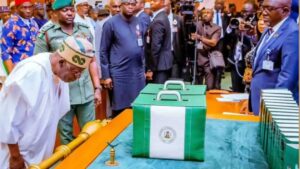
While addressing the lawmakers, Tinubu said he was fulfilling his constitutional responsibility by presenting the 2026 Appropriation Bill, describing the moment as a critical phase in Nigeria’s reform journey. He acknowledged the hardship caused by reforms over the past two and a half years but reassured citizens that their sacrifices were yielding results.
According to the President, the economy has begun to stabilise, pointing to a 3.98 per cent GDP growth in the third quarter of 2025, eight consecutive months of easing inflation which dropped to 14.45 per cent in November, increased oil output, stronger non-oil revenue and growing investor confidence.
He also disclosed that Nigeria’s external reserves rose to about $47 billion by mid-November 2025, the highest level in seven years, enough to cover over 10 months of imports. Tinubu noted that these gains were the outcome of tough but intentional policy decisions, stressing that the next step was to ensure stability translates into shared prosperity.

Under the 2026 proposal, government revenue is estimated at ₦34.33 trillion, while total spending is pegged at ₦58.18 trillion. This includes ₦15.52 trillion for debt servicing, ₦15.25 trillion for recurrent (non-debt) expenditure and ₦26.08 trillion for capital projects. The projected deficit of ₦23.85 trillion represents 4.28 per cent of GDP.
The budget assumptions include an oil price benchmark of $64.85 per barrel, daily production of 1.84 million barrels and an exchange rate of ₦1,400 to the dollar. Tinubu described the figures as a reflection of national priorities, underscoring commitments to fiscal discipline, transparency and efficient spending.
Security received the highest sectoral allocation at ₦5.41 trillion, followed by infrastructure with ₦3.56 trillion, education with ₦3.52 trillion and health with ₦2.48 trillion.
On security reforms, the President announced a new unified counter-terrorism strategy, declaring that all armed groups operating outside state authority would now be treated as terrorists. He warned that those who finance, protect or facilitate such groups—including arms dealers, ransom handlers and collaborators—would face the same designation.
Tinubu also admitted that the 2025 budget faced implementation challenges, revealing that by the third quarter, only 61 per cent of projected revenue and 60 per cent of expenditure had been recorded. Capital releases stood at just 17.7 per cent by Q3. He promised stricter enforcement in 2026, directing finance and budget officials to adhere strictly to approved timelines and details.

Heads of government-owned enterprises were also warned to meet revenue targets, with plans to fully digitise operations to curb leakages.
On social investments, the President said over 418,000 students have benefitted from the Nigerian Education Loan Fund across 229 tertiary institutions. He added that health spending accounts for six per cent of the total budget, excluding liabilities, with over $500 million in expected U.S. grant support for health programmes.
Agriculture, he noted, would receive increased attention through mechanisation, irrigation, climate-smart farming and agro-processing to reduce post-harvest losses and boost farmers’ incomes.
Concluding his address, Tinubu said the true value of any budget lies in its execution, not its announcement. He expressed confidence that collaboration between the executive and legislature would ensure successful delivery of the Renewed Hope Agenda.
“It is with great pleasure that I lay before this distinguished Joint Session of the National Assembly the 2026 Appropriation Bill of the Federal Republic of Nigeria,” he said, praying for God’s blessing on the nation.
How would you assess the performance of the previous budget, and what are your expectations for 2026? Share your thoughts in the comments.




