

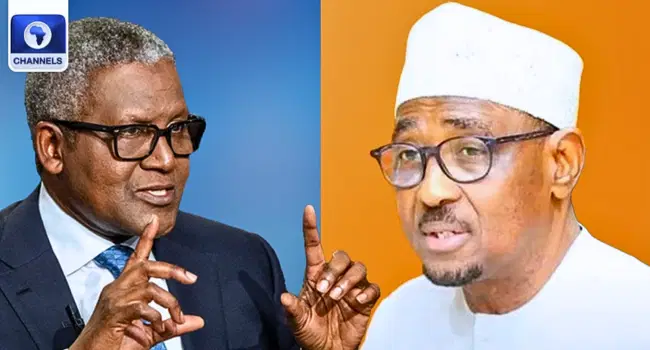
Engr. Farouk Ahmed, Chief Executive Officer of the Nigerian Midstream and Downstream Petroleum Regulatory Authority (NMDPRA), has rejected claims suggesting that public funds were used to finance his children’s foreign education, describing the allegations as unfounded and detached from documented financial realities.
Ahmed said the controversy ignores long-standing financial arrangements that existed well before his appointment as head of the petroleum regulator, as well as the independent nature of the office he currently occupies.

According to him, the education of his children was supported through multiple legitimate channels, including academic scholarships, family-backed education funds and personal resources earned over decades of service within Nigeria’s public sector.
He challenged claims that up to $5 million was spent on Swiss schools, insisting that the figure does not reflect the actual financial burden borne by him personally.

The NMDPRA boss explained that three of his four children secured partial scholarships based on academic performance, significantly reducing tuition costs. He said the awards were granted strictly on merit and not through influence or special consideration.
In addition, Ahmed disclosed that his family benefited from education trust funds established by his late father, who died in 2018. He noted that the arrangement followed a family tradition in which elders make long-term provisions for the education of younger generations.

He further stated that whatever balance remained was paid from his personal savings, accumulated since he joined the civil service in 1991 and spent over 30 years in petroleum regulatory institutions.
Ahmed maintained that when all funding sources are taken into account, his financial contributions align with his career history and declared earnings.
He also pointed out that his remuneration as NMDPRA chief, estimated at about ₦48 million annually including allowances, is publicly captured in audited financial records, while his assets are routinely declared to the Code of Conduct Bureau as required by law.

To demonstrate openness, Ahmed said he has permitted schools attended by his children to release payment records to authorised investigative bodies, expressing confidence that such disclosures would settle the matter.
He dismissed claims that questionable funds could have been used to pay foreign school fees, noting that international institutions operate strict financial compliance standards and require payments from traceable sources.
Ahmed suggested that the timing of the allegations coincides with tougher regulatory actions by the NMDPRA, including stricter licensing conditions, enforcement of fuel quality standards, transparent pricing policies and public disclosure of import and supply data under the Petroleum Industry Act.
He said regulatory bodies are often targeted when reforms disrupt entrenched commercial interests.

On the issue of fuel import approvals, Ahmed clarified that such decisions are guided by law and national energy needs, stressing that import licences are issued only when domestic supply cannot meet demand.
He described claims that the policy undermines local refining as a misinterpretation of the regulator’s statutory mandate.
The NMDPRA chief said he has formally invited the Code of Conduct Bureau, the Economic and Financial Crimes Commission and the National Assembly to independently examine his financial records and regulatory decisions.

He pledged full cooperation with any inquiry, stating that both his personal finances and professional conduct are capable of withstanding thorough scrutiny.
Ahmed concluded by reaffirming his commitment to transparency and institutional independence, adding that criticism and personal attacks would not deter the NMDPRA from carrying out its responsibilities in line with the law and in the interest of Nigeria’s energy security.




