

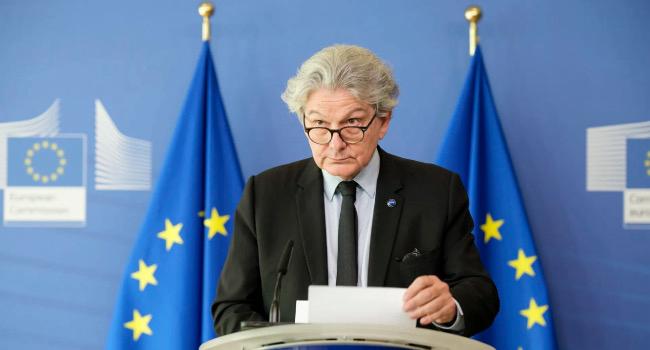
The U.S. State Department announced on Tuesday that it would deny visas to a former European Union commissioner and four other individuals, accusing them of attempting to pressure American social media companies into censoring content they disagree with.

In a statement, the department said the individuals and certain NGOs had promoted censorship initiatives backed by foreign governments, targeting both U.S. companies and American users. The sanctions specifically singled out Thierry Breton, the former EU commissioner responsible for tech regulation, who frequently clashed with figures like Elon Musk over compliance with EU rules. The State Department called Breton the “architect” of the European Union’s Digital Services Act (DSA), legislation that requires major platforms in Europe to moderate content and meet transparency standards.

French Foreign Minister Jean-Noel Barrot condemned the visa restrictions on social media, stating that Europe will not allow other countries to dictate its digital regulations. He emphasized that the DSA, adopted democratically in Europe, does not apply outside EU borders and has no effect on the United States.
The DSA obliges platforms to explain moderation decisions, offer transparency for users, and allow researchers to study online risks, including exposure of minors to harmful content. Breton, who left the European Commission in 2024, criticized the U.S. action as a “witch hunt,” likening it to McCarthy-era purges.

The move follows heightened tensions after Brussels fined Musk’s X for failing to comply with DSA transparency rules. The U.S. has also warned that European companies, including Accenture, DHL, Mistral, Siemens, and Spotify, could face retaliatory measures.
Other individuals affected by the visa ban include Imran Ahmed of the Center for Countering Digital Hate, Anna-Lena von Hodenberg and Josephine Ballon of German group HateAid, and Clare Melford of the UK-based Global Disinformation Index. The U.S. has similarly criticized the UK’s Online Safety Act, suspending parts of a tech cooperation agreement with Britain in protest.
Secretary of State Marco Rubio said the administration opposes any “extraterritorial overreach by foreign censors targeting American speech,” reaffirming the U.S. commitment to protecting domestic sovereignty in online matters.




