

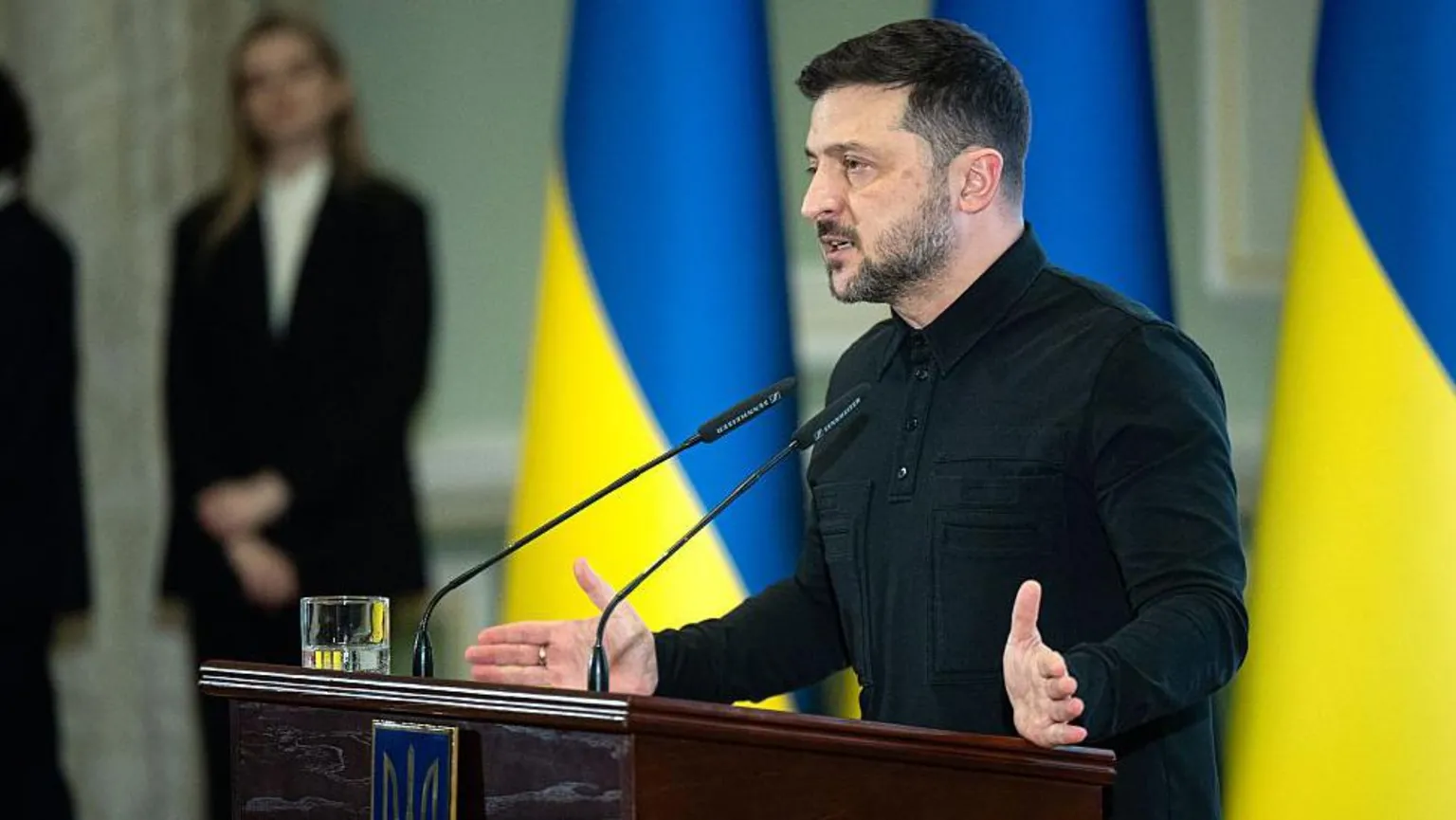
Ukrainian President Volodymyr Zelensky has outlined a revised peace proposal that could see Ukrainian forces partially pulled back from eastern regions, replaced by demilitarised or economically neutral zones as part of efforts to end the war with Russia.
Speaking to reporters, Zelensky said the new 20-point framework was finalised during talks between US and Ukrainian representatives in Florida over the weekend. He added that Washington was expected to brief Moscow, with Russia’s response anticipated on Wednesday.

Zelensky described the document as a central blueprint for ending the conflict, noting that it includes firm security guarantees for Ukraine from the United States, Nato and European partners. These guarantees would commit allies to a coordinated military response should Russia launch another invasion.
Addressing the contentious issue of eastern Ukraine, particularly Donbas, Zelensky said proposals include the creation of a free economic zone or a demilitarised buffer. While Kyiv opposes a full military withdrawal, he explained that US negotiators are exploring options that would reduce troop presence without surrendering control. Any territory vacated by Ukrainian forces would remain under Ukrainian administration and policing, he stressed.

According to Zelensky, Ukraine could consider pulling heavy weaponry back by distances ranging from five to 40 kilometres in areas of Donetsk still under its control, provided Russian forces made equivalent withdrawals. The aim would be to establish a largely demilitarised zone along the front line.
The revised plan updates an earlier 28-point proposal negotiated weeks ago by US envoy Steve Witkoff and Russian officials, which critics said leaned heavily in Moscow’s favour. Russia has demanded that Ukraine withdraw from nearly a quarter of Donetsk region as a condition for peace, with remaining areas already under Russian occupation.

Zelensky acknowledged that decisions on territorial matters would ultimately require direct talks between national leaders. However, he said the new framework would allow Ukraine to maintain a peacetime military of up to 800,000 personnel while benefiting from security assurances similar to Nato’s collective defence principle.
The proposal reflects discussions previously held in Berlin involving US, Ukrainian and European officials, followed by further meetings in Miami where President Donald Trump’s team engaged separately with Russian and Ukrainian representatives. Despite progress, Zelensky admitted Kyiv and Washington have not reached full agreement on territorial arrangements.

While Russian President Vladimir Putin has recently threatened to seize all of eastern Ukraine by force if Kyiv does not withdraw, Zelensky believes Moscow would struggle to outright reject a US-backed peace plan.
“If Russia blocks a peaceful solution,” he said, “the United States would have no choice but to significantly increase military support for Ukraine and impose the toughest possible sanctions.”
Zelensky also ruled out any Russian role in policing proposed economic zones, insisting Ukrainian authorities must retain control. International forces would monitor the contact line to prevent infiltration, though Russia has already dismissed European-led peacekeeping proposals.
He said the full agreement would be put to a national referendum, with public approval required for any economic zone arrangement in Donbas.

The plan also calls for Russian forces to withdraw from several other Ukrainian regions, including Kharkiv, Sumy, Mykolaiv and Dnipropetrovsk, and proposes special arrangements around the Russian-occupied Zaporizhzhia nuclear plant. Kyiv has rejected a US suggestion for joint management of the facility involving Russia.
Other elements of the framework reaffirm Ukraine’s sovereignty, outline a non-aggression pact with monitoring mechanisms, support Ukraine’s future EU membership with a target accession date, and establish a $200bn joint investment fund backed by the US and Europe.
The proposal does not prohibit Ukraine from joining Nato, a key demand in earlier Russian positions, and includes plans for national elections once martial law is lifted following a peace agreement.




