

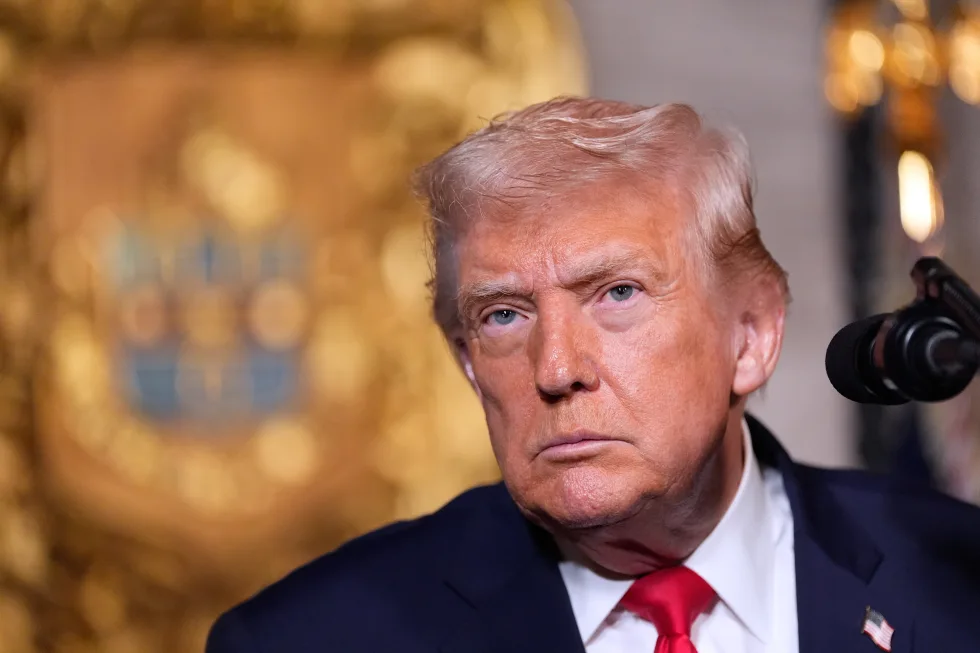
In a Christmas Day message shared on his social media platform, former U.S. President Donald Trump announced that American forces had carried out airstrikes but did not disclose specific details or the level of damage caused.
A senior official from the U.S. Department of Defense, who spoke on condition of anonymity due to the sensitivity of the matter, confirmed that the operation was conducted in collaboration with Nigeria and had received approval from the Nigerian government.

Nigeria’s Ministry of Foreign Affairs later clarified that the partnership involved intelligence sharing and strategic planning carried out in line with international law, respect for national sovereignty, and joint commitments to regional and global security.
Trump stated that the strikes targeted Islamic State fighters whom he accused of brutally attacking and killing innocent Christians. However, residents and security experts have consistently noted that Nigeria’s security challenges affect both Christians, who are more dominant in the south, and Muslims, who form the majority in the north.

The Ministry of Foreign Affairs stressed that violence against any religious or ethnic group — Christians, Muslims, or others — violates Nigeria’s core values and threatens international peace and security.
Nigeria is currently confronting several armed factions, including two linked to the Islamic State: the Islamic State West Africa Province (ISWAP), which emerged from Boko Haram in the northeast, and the lesser-known Lakurawa group operating mainly in northwestern states such as Sokoto. These groups often exploit vast forest areas spanning multiple states as operational bases.

Security analysts believe the recent U.S. strikes may have targeted the Lakurawa faction, which has become increasingly deadly over the past year, launching attacks on isolated communities and security personnel.
Malik Samuel, a Nigerian security analyst with Good Governance Africa, said the group has effectively seized control of territories in Sokoto and neighboring states like Kebbi. He attributed the rise of such extremist groups in the northwest to weak state presence and limited security coverage in affected areas.
Nigeria’s government has previously countered Trump’s claims by stating that victims of extremist violence in the country include people of diverse religious backgrounds, not only Christians.

Last month, Trump directed the Pentagon to begin preparations for possible military action in Nigeria to address what he described as persecution of Christians. Around the same time, the U.S. State Department announced visa restrictions on Nigerians and their relatives accused of involvement in attacks against Christians. Nigeria was also recently designated a “country of particular concern” under the International Religious Freedom Act.
Trump praised U.S. defense officials for what he called successful and precise military operations, adding that the United States would not tolerate the expansion of radical Islamic terrorism.
With an estimated population of 220 million, Nigeria is almost evenly divided between Christians and Muslims. The country has long battled insecurity from various sources, including Boko Haram, which aims to impose its extremist ideology and has also targeted Muslims it considers insufficiently devout.
Analysts note that violence in Nigeria stems from multiple causes, including religious extremism, farmer-herder clashes over shrinking resources, communal disputes, separatist movements, and ethnic conflicts.
Meanwhile, America’s military presence in Africa has reduced in recent years, with several partnerships scaled back or ended. Any large-scale U.S. military involvement in Nigeria would likely require redeploying troops from other regions.
Despite this, Trump has continued to pressure Nigerian authorities amid repeated attacks on schools and places of worship, incidents that experts say affect both Christian and Muslim communities.
U.S. Defense Secretary Pete Hegseth echoed Trump’s stance in a post on X on Thursday night, saying the killing of innocent Christians in Nigeria and elsewhere must stop. He added that U.S. forces were prepared to act, noting that ISIS “found out on Christmas,” and thanked the Nigerian government for its cooperation before wishing the public a Merry Christmas.




