

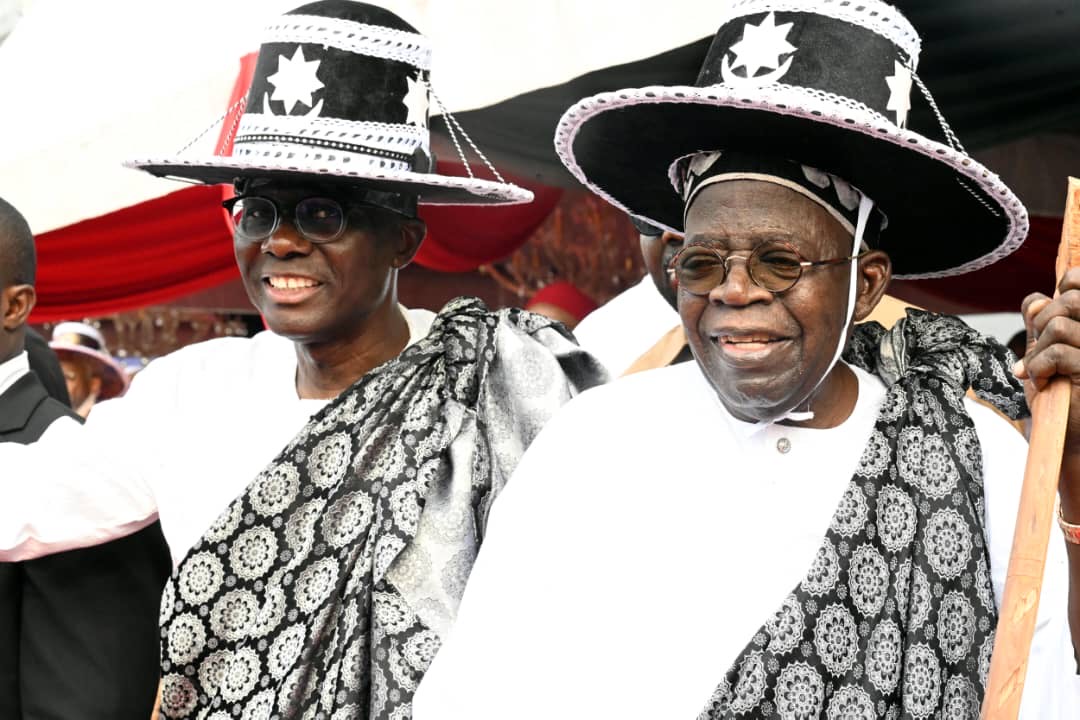
The 2025 Eyo Festival was more than a cultural spectacle; it was a powerful reaffirmation of Lagos’ indigenous identity, historical continuity, and living heritage. After an eight-year hiatus, the return of the Adamu Orisa Play to Lagos Island—culminating at Tafawa Balewa Square—stood as a clear statement: Lagos is not an abstract space or a cultural vacuum. It is a city with owners, history, institutions, and traditions that predate modern migration and commerce.
With President Bola Ahmed Tinubu in attendance, the festival carried both cultural and national significance. His presence reinforced the importance of indigenous institutions within Nigeria’s modern political framework. Thousands of white-clad Eyo masquerades processing through historic routes on Lagos Island was not mere pageantry; it was history in motion—ritualised, preserved, and publicly asserted.
The Eyo Festival has deep roots in Lagos history, traditionally staged to honour departed monarchs, chiefs, or eminent Lagosians, and to mark major transitions in the life of the city. Its rituals, symbols, and procession routes are inseparable from Lagos Island, the historical core of the city. This alone dispels the increasingly popular but historically careless claim that “Lagos is no man’s land.” Cities do not lose their origins because they grow. Expansion does not erase ownership; it builds upon it.
Lagos is, without question, Nigeria’s most diverse and cosmopolitan city. People from every ethnic group have come in search of opportunity, and many have prospered. That reality should be celebrated. But coexistence must not be confused with erasure. The Eyo Festival reminds residents and observers alike that beneath the skyscrapers, bridges, and commerce lies a structured indigenous civilisation with defined customs, leadership, and spiritual heritage.
From an economic and urban perspective, the festival also demonstrates Lagos’ capacity to host large-scale cultural events that activate the local economy. Transportation services, artisans, costume makers, food vendors, security personnel, and hospitality providers all benefit. Comparable global festivals—such as Rio Carnival in Brazil or Oktoberfest in Germany—are leveraged as cultural and economic assets. Eyo sits firmly in this category, with the added distinction of being uniquely ceremonial rather than commercial in origin.
Culturally, Eyo stands apart. Unlike carnivals driven primarily by entertainment, the Adamu Orisa Play is ceremonial, disciplined, and symbolic. Every movement, colour, and chant carries meaning. That seriousness is precisely why it commands respect and why it has endured.
The 2025 edition also served as a tribute to notable Lagos figures who shaped the city’s political, social, and economic landscape. In doing so, the festival linked past leadership with present governance, reinforcing a continuous Lagos story rather than fragmented narratives.
Ultimately, Eyo Festival 2025 was Lagos speaking for itself—calmly, confidently, and unmistakably. It did not shout. It did not insult. It simply showed the truth. Lagos welcomes all who come in peace and purpose, but it is not unowned, unrooted, or undefined. Culture does not need permission to exist; it only needs space to be seen.
And in 2025, Lagos made its culture visible—clearly, proudly, and unmistakably.
Headlinenews.news Special report.



