

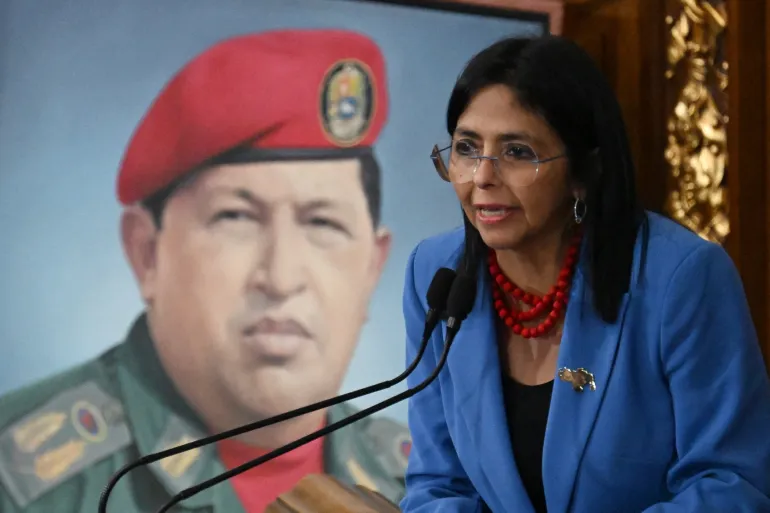
A short-lived leadership gap surfaced in Venezuela amid confusion following the reported abduction of President Nicolás Maduro by the United States.
In the aftermath of intense US airstrikes on Caracas and other locations on Saturday, US President Donald Trump announced that Vice President Delcy Rodríguez had been sworn in as Venezuela’s interim leader. The move appeared to sideline opposition figure María Corina Machado, last year’s Nobel Peace Prize recipient, despite her close alignment with Trump.

Trump openly dismissed Machado, saying she lacked sufficient backing and respect to govern Venezuela. He added that Rodríguez, 56, had already spoken with US Secretary of State Marco Rubio and expressed readiness to cooperate with Washington’s vision for Venezuela’s future.
“She was very gracious,” Trump said, stressing that the US could not risk allowing leadership that would act against the interests of Venezuelans.
However, Rodríguez’s response sharply contradicted Trump’s remarks. She condemned the US military operation as an act of “brutal aggression” and demanded Maduro’s immediate release.
“There is only one president of Venezuela, and that is Nicolás Maduro,” Rodríguez declared on state television, standing alongside senior government officials and military leaders.
This raised a pressing question: who is currently leading Venezuela?

BACKGROUND AND POLITICAL ROOTS
Born in Caracas on May 18, 1969, Delcy Rodríguez comes from a deeply political family. Her father, Jorge Antonio Rodríguez, was a prominent leftist revolutionary and founder of the Socialist League in the 1970s. He died under torture while in police custody in 1976, an incident that left a lasting impact on Venezuela’s political movement, including on a young Maduro.
Her brother, Jorge Rodríguez, currently serves as president of Venezuela’s National Assembly.
A trained lawyer and graduate of the Central University of Venezuela, Rodríguez rose swiftly within government ranks. She has long represented the socialist movement initiated by the late President Hugo Chávez, aligning herself with the Chavista ideology.
Over the years, she has held several top positions, including minister of communication, foreign minister, and head of the Constituent Assembly that expanded Maduro’s authority in 2017.

ROLE IN THE ECONOMY
Though often viewed as more pragmatic than some hardline figures from Chávez’s era, Rodríguez has played a central role in managing Venezuela’s fragile economy.
Serving simultaneously as vice president, finance minister, and oil minister, she has wielded significant influence over economic policy and private-sector relations. Her approach has included more conventional economic measures aimed at curbing hyperinflation.
In August 2024, Maduro expanded her responsibilities by placing her in charge of the oil sector amid tightening US sanctions on the industry.
According to Caracas-based journalist Sleither Fernández, Rodríguez’s prominence made her an appealing interlocutor for Washington during negotiations.
She has reportedly built relationships with US oil executives and Republican-linked figures, including Blackwater founder Erik Prince and Trump envoy Richard Grenell, who sought greater US leverage in Venezuela.
A FIERCE DEFENDER OF THE GOVERNMENT
Despite her reputation for moderation, Maduro has frequently praised Rodríguez’s unwavering loyalty, once calling her a “tiger” for her fierce defence of the socialist government.
When she was appointed vice president in 2018, Maduro described her as courageous, battle-tested, and deeply rooted in revolutionary ideals.

Following Maduro’s abduction, Rodríguez demanded proof that both he and his wife, Cilia Flores, were alive. She strongly warned that Venezuela’s treatment could set a dangerous precedent for other nations.
“What has been done to Venezuela can be done to any country,” she said in a televised address. “This violent use of force to subdue a people’s will threatens the entire world.”
Later on Saturday, Venezuela’s Supreme Court authorised Rodríguez to assume the role of acting president to maintain state continuity and national defence.
The court noted that while she holds the position, certain constitutional provisions may be temporarily limited, potentially restricting the scope of her authority.




