

The United States president has said that a military operation in Colombia “sounds good” to him and warned Mexico to “get their act together,” as tensions escalate across Latin America following Washington’s seizure of Venezuela’s leader.
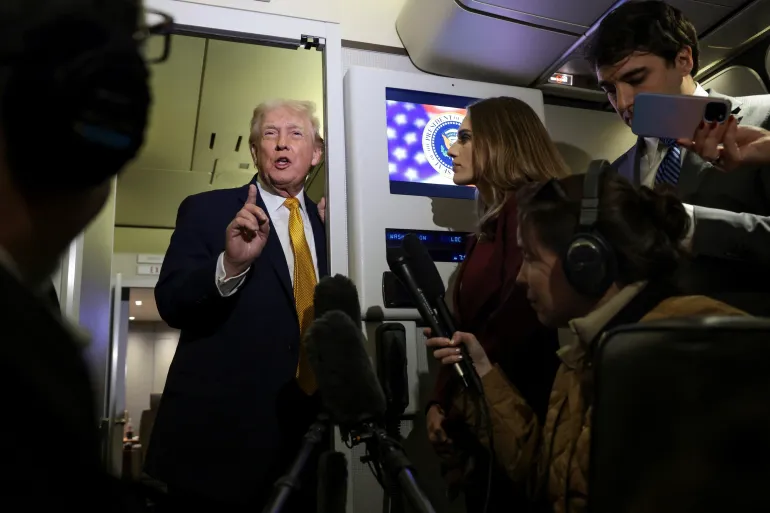
Speaking to reporters aboard Air Force One while traveling from Florida to Maryland, President Donald Trump threatened Colombian President Gustavo Petro and suggested that Cuba’s government could soon collapse. His remarks came amid growing international outrage over the US operation in Caracas that resulted in the capture of Venezuelan President Nicolás Maduro.Several countries, including Brazil, Chile, Colombia, Mexico, Uruguay, and Spain, condemned the US action as a dangerous precedent that threatens peace and regional security.

Trump described Colombia and Venezuela as “very sick” countries and accused the government in Bogotá of being run by “a sick man who likes making cocaine and selling it to the United States.” Referring to Petro, Trump added, “He’s not going to be doing it very long.” When asked whether he was suggesting a US military operation against Colombia, he replied, “Sounds good to me.”
Petro responded sharply, telling Trump to stop slandering him and urging Latin American nations to unite or risk being treated as subservient. In a series of posts on X, Petro noted that the United States was the first country to bomb a South American capital, but stressed that retaliation was not the solution. Instead, he called for regional unity and engagement with the wider world, saying Latin America must look “in all directions, not only to the north.”
US forces seized Maduro in Caracas early Saturday in what Washington described as a law enforcement operation aimed at prosecuting him on narcoterrorism charges. Maduro has denied the accusations, while critics argue that the operation was driven by US interests in Venezuela’s oil reserves.

Trump insisted that the United States remains “in charge” of Venezuela, despite the country’s Supreme Court appointing Vice President Delcy Rodríguez as interim leader. He reiterated threats to deploy US troops again if Venezuela “doesn’t behave.”
The president also claimed that many Cubans were killed during the US raid in Caracas and said military intervention in Cuba would be unnecessary because the island nation appears close to collapse. According to Trump, Cuba has lost its primary source of income following the disruption of Venezuelan oil supplies and is “ready to fall.”
Turning to Mexico, Trump warned that drugs were “pouring through” the country and said the United States might have to take action if the situation does not improve. While describing Mexican President Claudia Sheinbaum as a “terrific person,” he said he had repeatedly offered to send US troops to Mexico. He added that although Mexico is capable of addressing the problem, drug cartels remain extremely powerful.

Trump has openly expressed his desire to expand US influence in the Western Hemisphere and revive the Monroe Doctrine, a 19th-century policy asserting US dominance in Latin America. He has referred to his modern version as the “Don-roe Doctrine.”
Following Maduro’s capture, Trump warned Petro to “watch his a**” and described Cuba as a failing nation whose political situation would eventually require attention.
International condemnation of the US action in Venezuela has continued. In a joint statement, several governments said they firmly reject unilateral military actions on Venezuelan territory, warning that such moves violate international law and the prohibition on the use or threat of force. They said the operation sets an extremely dangerous precedent and puts civilians at risk.

Analysts say it remains unclear whether Trump intends to act on his threats or is using them to pressure governments into compliance. Some argue that the US president often relies on dramatic displays of force to intimidate other countries into cooperation without sustained military engagement.
Observers also note that Trump has pursued regime change through other means, including clashes with Petro over deportation flights, sanctions against a Brazilian judge involved in the prosecution of former President Jair Bolsonaro, support for Argentina’s right-wing government under Javier Milei, and the pardon of former Honduran President Juan Orlando Hernández on drug trafficking charges.
According to analysts, these actions reflect a broader effort to weaken left-wing governments and promote right-leaning leadership across Latin America.

Experts suggest that Cuba could be the primary target of any further US action, given the long history of hostility between Washington and Havana. Relations between the two countries have remained strained since Fidel Castro overthrew a US-backed government in 1959 and established a socialist state allied with the Soviet Union.
Some analysts argue that, given longstanding grievances and strong opposition among Cuban Americans, the risk of US intervention is greater for Cuba than for Colombia.



