

A Vision for Nigeria’s Place in the New World Order.
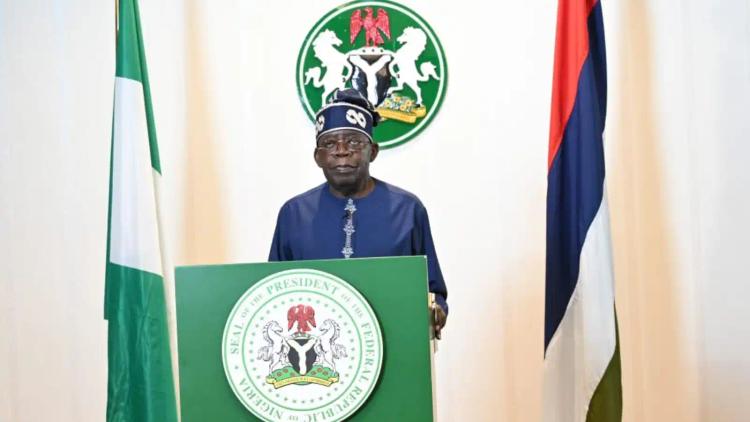
President Bola Ahmed Tinubu on Wednesday delivered a far-reaching and strategically calibrated address at a high-level international summit in Abu Dhabi, United Arab Emirates, reinforcing Nigeria’s intent to reposition itself as a serious partner in global energy transition, climate finance, and sustainable development.
The summit—held on the margins of Abu Dhabi Sustainability Week and convened with the participation of policymakers, sovereign wealth funds, multilateral institutions, and global energy leaders including Masdar—offered Nigeria a rare convergence of capital, influence, and policy alignment.
President Tinubu used the platform to present Nigeria’s reform narrative; an evolving economic reset anchored on realism, scale, and partnership.


Nigeria’s engagement with the global climate and development conversation has historically been defined by a structural paradox: Africa’s largest economy remains energy-poor at home, yet globally relevant in hydrocarbons, population scale, and market potential.
Tinubu’s Abu Dhabi address leaned directly into this reality.
Rather than adopting a defensive tone, the President framed Nigeria’s position around a central thesis: energy transition must be development-enabling, not development-denying.
This argument resonates deeply with emerging economies that have resisted one-size-fits-all climate prescriptions, which ignore domestic poverty, infrastructure gaps, and industrial deficits.
Nigeria, Tinubu noted, cannot decarbonise in abstraction. With a population exceeding 220 million and electricity access still far from universal, the country’s transition pathway must prioritise power generation, grid stability, clean cooking, industrial energy, and job creation—even as it aligns with global emissions-reduction goals.
Nigeria’s Transition.
The President’s intervention was underpinned by data points that strengthen Nigeria’s credibility in international climate finance discussions:
Nigeria’s per-capita carbon emissions remain among the lowest globally, reinforcing the argument that the country is not a historical polluter.
The government’s Energy Transition Plan (ETP) targets net-zero emissions by 2060, with interim milestones tied to power, transport, cooking fuels, and industry.
Gas flaring—long a reputational and environmental liability—was presented as a low-hanging reform opportunity, capable of simultaneously reducing emissions, increasing power supply, and unlocking billions in private investment.
By grounding his message in these realities, Tinubu avoided the common pitfall of aspirational climate rhetoric detached from execution capacity.
Why Abu Dhabi Matters.
Abu Dhabi has quietly become one of the most consequential convening spaces for the future of energy and climate finance.
Unlike purely advocacy-driven forums, Gulf-hosted platforms increasingly focus on bankable projects, blended finance, and sovereign-backed risk mitigation.
Nigeria’s presence at this summit, therefore, carries strategic weight.
Countries such as Morocco, Egypt, and Vietnam have successfully leveraged similar platforms to attract long-term energy and infrastructure capital.
Tinubu’s speech signalled Nigeria’s intention to compete in that same league—by offering scale, reform momentum, and political commitment.

However, the comparison also exposes Nigeria’s vulnerability: execution credibility.
Investors in Abu Dhabi value price policy consistency, regulatory clarity, and delivery timelines ruthlessly.
The President’s remarks implicitly acknowledged this by repeatedly emphasising reform discipline and institutional rebuilding.
Domestic Implications: Diplomacy Meets Public Expectation.
At home, Tinubu’s international engagements are closely scrutinised against economic hardship, inflationary pressures, and public impatience.
The Abu Dhabi speech, therefore, carries a dual audience: global financiers and Nigerian citizens.
Its success will not be measured by applause or headlines, but by outcomes Nigerians can verify—new power projects, concessional financing lines, gas-to-power execution, jobs, and visible infrastructure delivery. Foreign credibility must translate into domestic legitimacy.
President Tinubu’s Abu Dhabi address was articulate, strategic, and aligned with global development realities.
It positioned Nigeria not as a passive recipient of climate finance, but as an active negotiator seeking fair, growth-compatible partnerships.
Yet the speech also sets a high bar. Follow-through will be decisive. Signed project frameworks, transparent financing structures, and accelerated implementation will determine whether this moment becomes a turning point—or another well-received address lost to execution inertia.
For now, Nigeria has spoken clearly on the global stage. The world has listened.
What comes next will define the credibility of the message—and the legacy of the reform agenda it represents.
“President Bola Ahmed Tinubu’s address in Abu Dhabi was more than a diplomatic appearance; it was a clear statement of intent. Nigeria is no longer content with the margins of global decision-making.
The President articulated a reform-driven vision that places Nigeria within the emerging architecture of the new world order—where energy transition, capital flows, and strategic relevance define national influence.
The National Patriots welcome this clarity of purpose and reassure Nigerians that the country is being deliberately repositioned for recognition, partnership, and long-term prosperity. The speech demonstrated that Nigeria understands its strengths: scale, population, resources, and strategic geography.

Nigeria’s primacy in the Gulf of Guinea is not a matter of ambition; it is a matter of scale. In energy alone, the numbers are decisive. Nigeria holds about 37 billion barrels of proven oil reserves and over 200 trillion cubic feet of natural gas, accounting for more than half of total hydrocarbon output across the Gulf. No neighbouring state comes close in depth, diversity, or export capacity.
Geography reinforces that advantage. Nigeria’s 850-kilometre coastline and vast Exclusive Economic Zone host some of Africa’s most economically valuable offshore fields, linked to global markets through major export terminals and the region’s busiest ports. Lagos, in particular, functions as the commercial hinge of West and Central Africa, connecting inland economies to Atlantic trade routes.
Security capacity completes the picture. Nigeria operates the largest navy in the Gulf of Guinea and remains the only regional state with credible blue-water ambitions. Sitting between Sahelian instability and Atlantic energy corridors, it carries a security burden that directly affects regional and global interests.
However, vision must be matched with regional practicality. This moment offers a timely opportunity to advance the establishment of a Union of Gulf of Guinea States—a strategic bloc that can consolidate energy resources, hydrocarbons, maritime security, and shared development across the Gulf.
Countries like Angola, Ghana and Equatorial Guinea play important roles, but on a far smaller scale. If a Union of Gulf of Guinea States is to work, Nigeria is the natural anchor—not by dominance, but by capacity.


Nigeria is best positioned—economically, diplomatically, and historically—to lead this initiative, translating President Tinubu’s global strategy into tangible regional growth and collective advancement.”
Nigeria’s position in the Gulf of Guinea is defined by capacity, not ambition. Nigeria holds Africa’s largest proven oil reserves—about 37 billion barrels—and over 200 trillion cubic feet of natural gas, accounting for more than half of the Gulf’s hydrocarbon output. No neighbouring state matches this scale or diversity.
Its 850-kilometre coastline and vast offshore zone host some of the continent’s most valuable energy assets, linked to global markets through the region’s busiest ports in Lagos. Nigeria also maintains the largest navy in the Gulf of Guinea and the only credible blue-water ambition, sitting at the strategic junction between Sahelian instability and Atlantic energy routes.
States such as Angola and Ghana play important roles, but on a smaller scale. Any effective Gulf of Guinea union, therefore, rests on Nigeria—not by dominance, but by capacity.
Princess G. A. Adebajo-Fraser MFR.
President, the National Patriots Movement.
CEO, Fraser Consulting Consortium.



