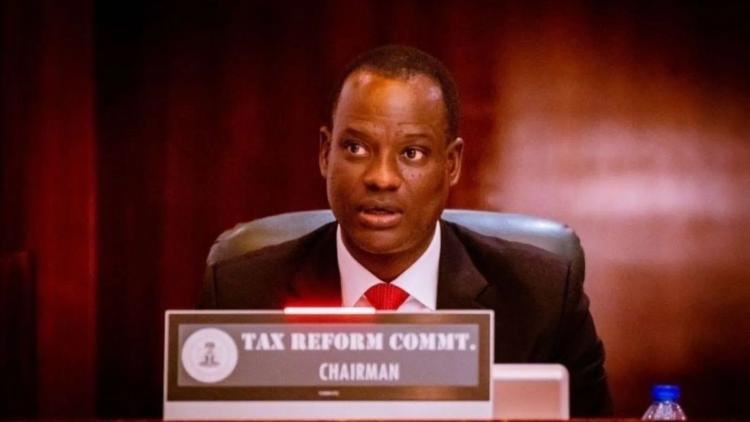
The Federal Government has halted the issuance of implementation guidelines for Nigeria’s new tax laws, citing uncertainty over which version of the laws is the official final copy.
The disclosure was made by Taiwo Oyedele, Chairman of the Presidential Tax Reform Committee, who said relevant agencies have been directed to wait until the confusion is resolved.

WHY HAVE THE GUIDELINES BEEN SUSPENDED
Speaking in Lagos after delivering a keynote address at the 2026 Economic Outlook organised by the Institute of Chartered Accountants of Nigeria (ICAN), Oyedele said he instructed the Nigeria Revenue Service (NRS) and the Joint Revenue Board (JRB) to pause action.
According to him, guidelines cannot be issued when there is no certainty about the authentic version of the law.
“We are not 100 per cent certain that this is the final official position,” Oyedele said.
WHAT CAUSED THE UNCERTAINTY
Oyedele explained that concerns arose after lawmakers disputed the version of the tax laws published by the government printer, insisting it did not reflect what the National Assembly passed.

He revealed that:
-
His team attempted to purchase printed copies from the government printer
-
They were told the documents were not for sale
-
The National Assembly reportedly collected all printed copies pending completion of its review
This, he said, has reintroduced uncertainty into the tax reform process, even though legislative review is normal.
ALTERED LAWS CLAIM
The controversy began after the tax laws—
-
National Revenue Service (Establishment) Act
-
Joint Revenue Board of Nigeria (Establishment) Act
-
Nigeria Tax Administration Act
-
Nigeria Tax Act
—which took effect on January 1, were accused of being altered after passage.
In December, Hon. Abdussamad Dasuki (PDP, Sokoto) raised a matter of privilege in the House of Representatives, alleging discrepancies between what lawmakers passed and what was gazetted.

The House later:
-
Set up a seven-man committee
-
Released Certified True Copies (CTCs) on January 3
-
Disowned the controversial gazetted versions
‘CHANGES ARE MINIMAL’ – OYEDELE
Reacting to the allegations, Oyedele downplayed the impact, saying any changes identified do not affect core provisions such as:
-
Tax rates
-
Tax burden
-
Filing deadlines
“There are a few items that shouldn’t affect the main thing people need,” he said.
MISINFORMATION AND MARKET SHOCK
Oyedele also warned about the dangers of misinformation surrounding the reforms, revealing that false narratives wiped ₦4.6 trillion off the stock market in a single day in November 2025.
He claimed some individuals were paid to protest against the reforms and said panic selling occurred despite provisions that exempt small businesses earning up to ₦150 million annually.
“That fake news led to real losses for people, including pension funds,” he said.
EXPERTS CALL FOR BETTER EXECUTION
At the event:
-
Dr. Chinyere Almona, DG of LCCI, called for inter-agency coordination and a centralised tech-driven system
-
Segun Ajayi-Kadir, DG of MAN, urged inclusive policy implementation without harming competitiveness, citing ₦2 trillion in unsold inventory across the manufacturing sector
ICAN President, Mallam Haruna Nma Yahaya, described accountability as critical to sustaining Nigeria’s fragile economic recovery, warning that weak institutions and poor enforcement could derail reforms.
As uncertainty lingers over the tax laws’ final form, full implementation is now