

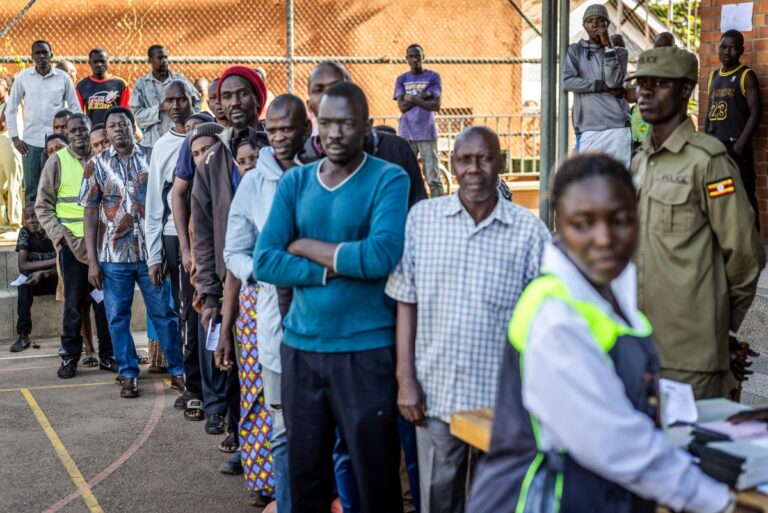
Uganda’s opposition has accused authorities of deliberately delaying voting during the country’s general election as President Yoweri Museveni seeks to extend his decades-long rule, amid an ongoing internet blackout and a heavy security clampdown.
President Museveni, who has ruled Uganda for several decades, is widely expected to secure another term, with critics pointing to his firm grip on state institutions and the security apparatus. However, the election has been fiercely contested, particularly by opposition candidate Bobi Wine, a popular singer-turned-politician who has drawn strong support from urban communities, especially in Kampala.

Across several parts of the capital and surrounding areas, voting failed to commence hours after polling stations were scheduled to open. Reports from multiple locations indicated that biometric voter verification machines were malfunctioning, while essential materials such as ballot boxes arrived late or not at all. In some cases, officials were forced to switch to manual verification, further slowing the process.

Opposition leaders linked the disruptions to the government-imposed internet blackout, which began days before the election despite earlier assurances that access would not be cut. According to the opposition, the shutdown affected coordination, logistics, and transparency at polling centres.
Officials from the ruling government acknowledged technical challenges but insisted the issues were not widespread and said voting was proceeding once alternative verification methods were introduced. Voting was reported to have started on time in areas close to military facilities, a contrast that further fueled opposition claims of deliberate interference.

Tensions remained high as voters expressed frustration over long delays, with some accusing authorities of attempting to discourage turnout by exhausting the electorate. Security forces were heavily deployed across major cities, and police issued warnings against protests or actions they described as criminal.

The election period has been marked by arrests of opposition supporters, restrictions on civil society groups, and reports of harassment of journalists. Bobi Wine has repeatedly alleged plans to rig the vote and has vowed to mobilise protests if irregularities persist. International observers and rights groups have raised concerns over the internet shutdown and the broader crackdown on opposition activities.

Despite the controversy, some voters continued to express confidence in President Museveni, crediting him with maintaining stability and security, while critics argued that corruption, repression, and democratic backsliding have overshadowed those gains.
As ballots were eventually cast in many areas, uncertainty lingered over the credibility of the process, with both domestic and international attention focused on whether the election would reflect the will of the Ugandan people or deepen the country’s political tensions.




