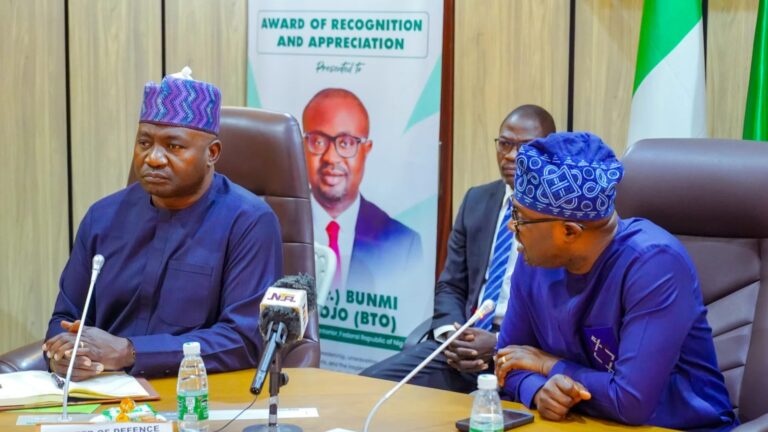
Interior and Defence Ministers Meet to Strengthen Nigeria’s National Security Architecture.
Nigeria’s Minister of Interior, Olubunmi Tunji-Ojo, and the Minister of Defence, Mohammed Badaru Abubakar, have held a high-level strategic meeting in Abuja aimed at strengthening coordination across Nigeria’s security institutions, as the Federal Government intensifies efforts to confront evolving internal and transnational threats.
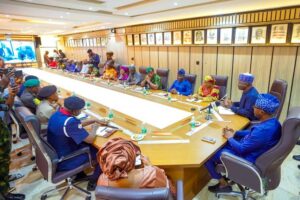
The meeting focused on tightening operational synergy between civil security agencies under the Ministry of Interior and the Armed Forces supervised by the Ministry of Defence.
Discussions extended beyond protocol, addressing intelligence sharing, border management, joint response mechanisms, and the need for clearer operational alignment in tackling terrorism, banditry, kidnapping, arms trafficking, and organised crime.

Recognising the increasingly interconnected nature of Nigeria’s security challenges, both ministers reportedly agreed that fragmented responses are no longer sustainable.
Instead, they emphasised a whole-of-government security framework that integrates military capability with internal security, border control, and civil protection institutions.
Border security featured prominently in the discussions.
Nigeria’s extensive and porous land and maritime borders have long been identified as a major vulnerability, enabling the movement of terrorists, weapons, and illicit goods.

The ministers explored measures to strengthen border surveillance, align military operations in border regions with immigration and civil defence functions, and improve the use of biometric data, advanced passenger information systems, and digital identity platforms.
This focus aligns with sustained policy advocacy from the National Patriots, which has formally submitted strategic recommendations identifying border security as the backbone of Nigeria’s national security framework.
The group has consistently warned that porous borders undermine internal stability by enabling terrorism, arms proliferation, and transnational crime, making domestic security efforts largely reactive.

These policy positions mirror a body of investigative and analytical reporting by HeadlineNews.News, which has repeatedly documented structural weaknesses in Nigeria’s border governance and called for technology-driven surveillance, biometric integration, and tighter inter-agency coordination.
Analysts note that the convergence of ministerial action, civic advocacy, and evidence-based reporting strengthens the case for urgent border security reform.

Beyond border control, the meeting reviewed the role of intelligence and technology in modern security management.
Both ministries underscored the need for seamless intelligence flow between civil and military channels, harmonised technology platforms, and rapid-response mechanisms capable of addressing threats before they escalate.
The engagement is consistent with President Bola Ahmed Tinubu’s directive for a more coordinated, professional, and results-oriented security architecture.
While no immediate policy announcements were made, the meeting signals a deliberate shift toward coherence in Nigeria’s security governance.
As Nigeria confronts persistent and evolving security pressures, the effectiveness of this renewed inter-ministerial collaboration will ultimately be judged by tangible outcomes on the ground.
For now, the Interior–Defence meeting marks a strategic step toward aligning institutions, policy advocacy, and operational execution in pursuit of a more secure nation.
Dr. G. Fraser. MFR
Headlinenews.news Special Investigative Report.