

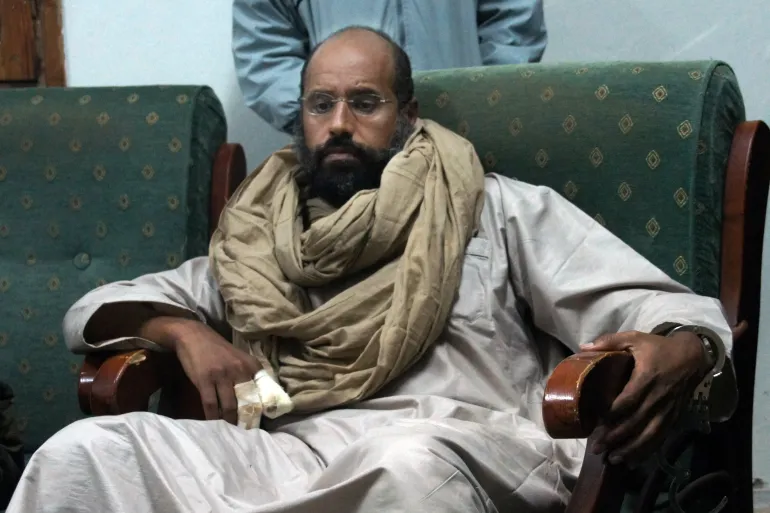
Saif al-Islam Gaddafi, the most prominent son of late Libyan dictator Muammar Gaddafi, has been killed in an armed attack at his home in the western Libyan town of Zintan, according to his political team, lawyer, and local media reports.
Khaled al-Zaidi, Saif al-Islam’s lawyer, and Abdulla Othman, his political adviser, announced the 53-year-old’s death in separate posts on Facebook on Tuesday. They provided no further initial details.

Libyan news outlet Fawasel Media quoted Othman as saying that armed men killed Gaddafi inside his residence in Zintan, located approximately 136 km (85 miles) southwest of Tripoli.
A subsequent statement from Gaddafi’s political team described the incident as a “cowardly and treacherous assassination” carried out by “four masked men” who stormed his house. The statement claimed Gaddafi clashed with the assailants, who disabled the home’s security cameras “in a desperate attempt to conceal traces of their heinous crimes.”

Khaled al-Mishri, former head of the Tripoli-based High State Council (an internationally recognized advisory body), called for an “urgent and transparent investigation” into the killing via social media.
Saif al-Islam Gaddafi held no formal government position but was widely regarded as his father’s de facto second-in-command from around 2000 until the 2011 uprising that ended Muammar Gaddafi’s 42-year rule.

Background and Role in the Gaddafi Regime
Born in June 1972 in Tripoli, Saif al-Islam was the second son of Muammar Gaddafi. Western-educated (including at the London School of Economics) and fluent in English, he cultivated an image as a progressive reformer in the early 2000s. He played a central role in Libya’s efforts to normalize relations with the West, leading negotiations for Libya to abandon its weapons of mass destruction program and securing compensation for victims of the 1988 Lockerbie bombing of Pan Am Flight 103.
He publicly advocated for constitutional reform, civil society involvement, and respect for human rights, with his academic dissertation focusing on civil society’s role in global governance reform.

However, when the 2011 Arab Spring-inspired rebellion erupted against his father’s rule, Saif al-Islam aligned firmly with the regime. He became a key figure in the brutal crackdown on protesters, whom he famously referred to as “rats.” In interviews at the time, including with Reuters, he vowed that the government would fight “to the last man, woman, and bullet,” warning of rivers of blood and decades of chaos if the regime fell.
“We fight here in Libya, we die here in Libya,” he declared. “All of Libya will be destroyed. We will need 40 years to reach an agreement on how to run the country, because today, everyone will want to be president, or emir, and everybody will want to run the country.”

Legal Troubles and Post-2011 Life
By February 2011, Saif al-Islam was placed on a United Nations sanctions list, banned from international travel, and sought by the International Criminal Court (ICC) for alleged crimes against humanity committed during the uprising.
After rebels captured Tripoli, he attempted to flee to Niger disguised as a Bedouin tribesman but was captured by the Abu Bakr Sadik Brigade militia on a desert road and transferred to Zintan.
Libyan authorities secured the right to try him domestically rather than hand him over to the ICC. In 2015, a court in Tripoli sentenced him to death in absentia for war crimes.
He was released from detention in 2017 under a general amnesty and had lived quietly—but under threat—in Zintan ever since, largely staying out of the public eye to avoid assassination attempts.

In November 2021, he controversially announced his candidacy for Libya’s presidential election. His bid was rejected due to his 2015 conviction, and attempts to appeal the disqualification were disrupted when armed fighters blockaded the court. The episode contributed to the broader collapse of the electoral process and Libya’s continued political stalemate.
Saif al-Islam Gaddafi’s killing marks a significant and violent development in Libya’s long-running post-Gaddafi instability, where rival factions, militias, and unresolved grievances continue to fuel conflict and assassinations. Calls for a thorough investigation are growing amid concerns over accountability in the fractured nation.




