

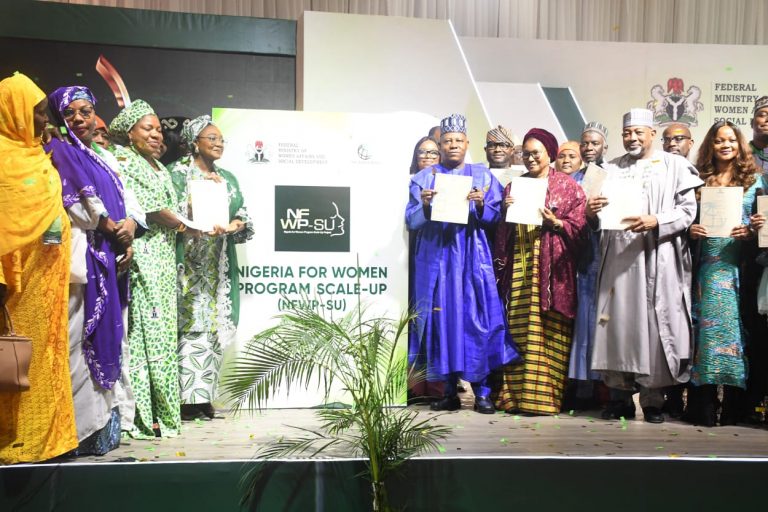
President Bola Ahmed Tinubu on Thursday announced the expansion of the Nigeria for Women Programme, now scaled up to reach 25 million beneficiaries nationwide, unveiling a digital platform designed to connect women to finance, skills, markets, essential services, and government support.
The initiative, renamed the Nigeria for Women Programme Scale-Up (NFWP-SU), was launched at the State House, Abuja, with Vice President Kashim Shettima representing the President.

Tinubu emphasised that sustainable national growth cannot be achieved without placing women at the centre of national planning, describing the scale-up as a key pillar of his administration’s social and economic inclusion agenda.
“A nation that relegates its women is a nation bound for implosion. That is why this administration has not only placed women at the forefront of decision-making but has also entrusted them with leadership in causes that redeem our national promise,” he said.
The expansion follows a successful pilot in six states, which reached over one million beneficiaries. As part of the scale-up, the government launched the Happy Woman App, a secure digital platform connecting women to empowerment opportunities, including financial services, skills training, market access, protection services, and social support.

The programme, headed by Dr. Hadiza Maina, is co-financed by the World Bank, the Federal Government, and participating state governments. It is designed to strengthen women’s economic empowerment, financial inclusion, and social development nationwide.
Tinubu set a national target to reach 25 million women and called on the World Bank to deepen its support in financing, technical assistance, and innovation to sustain the initiative. He also designated 2026 as the “Year of Social Development and Families in Nigeria,” directing coordinated action across all levels of government.
Minister of Women Affairs and Social Development, Hajiya Imaan Sulaiman Ibrahim, described the initiative as a structural shift in Nigeria’s governance, signalling that women, children, and families are now primary drivers of economic, social, and democratic stability.

The minister noted that Phase I of the programme had established 26,577 Women Affinity Groups, encompassing over 560,000 members, who collectively saved over ₦4.9 billion and used inter-loans to expand businesses, cover health expenses, and pay school fees.
She highlighted that the $540 million programme would directly reach at least five million women across all 36 states and the FCT, supporting national priorities such as job creation, food security, rural revitalisation, and financial inclusion.
Ibrahim also emphasised that the programme had strengthened civic identity among women beneficiaries. In Niger State, for example, many women obtained formal identification, including voter cards, for the first time, making them politically visible.
Regarding the digital rollout, the minister announced that the Happy Woman App would serve as a central hub for women’s empowerment, targeting 10 million verified registrations within the next ten months.

World Bank Regional Representative for Africa, Robert Chase, stressed that investing in women remains the most impactful investment a nation can make. Similarly, Uche Amaonwu of the Bill & Melinda Gates Foundation highlighted that empowering women directly improves family health and household security.
Minister of Agriculture and Food Security, Senator Abubakar Kyari, pledged his ministry’s support for women-focused initiatives, while Senator Ireti Kingibe, representing the Senate President, reaffirmed the National Assembly’s commitment to expanding women’s access to governance and economic resources.

The Deputy Governor of Katsina State, Malam Faruk Jobe, delivering a message on behalf of the Nigeria Governors’ Forum, confirmed that state governments would provide counterpart funding, noting that Katsina State had allocated ₦4 billion in its budget to support the programme.



