

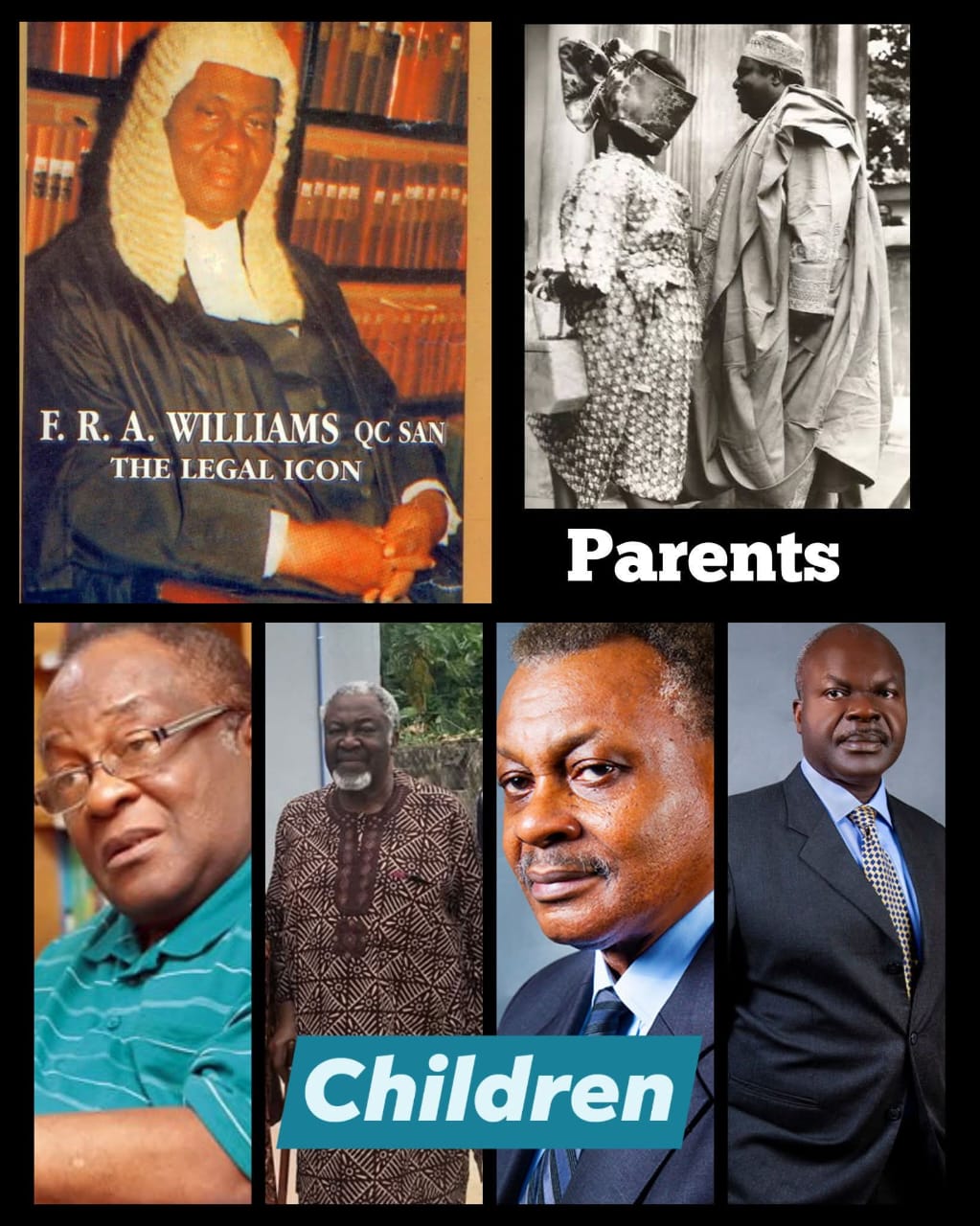
As a lover of Nigerian history and an avid reader, the name Chief Frederick Rotimi Alade Williams, popularly known as FRA Williams, appeared everywhere in books on law and politics.
He was reportedly Nigeria’s first Senior Advocate of Nigeria and was stupendously rich as a lawyer, with many estates to his name.

For years, this was all I knew about him. He was also blessed with four sons who were well educated, and he lived long enough to celebrate his 85th birthday before his death in 2005. What a grace.
However, it always saddens me to hear that 21 years after his death, his four sons reportedly refused to share his vast estate, said to be worth about ₦26 billion as at 2022.
Why? How could a man who helped write Nigeria’s first constitution and handled many landmark cases die without leaving a WILL?

It remains strange. The children are also reportedly divided: the first two sons, Ladi Williams, SAN, and Kayode Williams, on one side, and the last two, Folarin Williams, SAN, and Tokunbo Williams, on the other.
To imagine that they are all from the same mother makes it worse. We often hear people say polygamous families are the problem that ilé olorogun le, but this case challenges that belief.

Similar stories are told about the children of MKO Abiola, where disagreements and refusal to share property reportedly led to the waste and abandonment of many valuable assets. The excuse people gave for Kola Abiola and his many siblings was that they are from different mothers and too many women caused trouble for Chief MKO’s legacy.
For Chief FRA Williams, a comprehensive report I once read stated that the children had been fighting even before the patriarch died, especially between Ladi, the first son, and Folarin, the third son. Many believed the father favoured Folarin and appointed him to the boards of several blue-chip companies while the others were allegedly excluded. This perception of favouritism appears to have deepened the conflict.

Strangely, all of them are learned in the law and hold SAN titles, yet they reportedly fired legal actions at one another in court, and all attempts by numerous senior judges in Nigeria to resolve the dispute proved abortive. I also read that the first son allegedly stopped Folarin from becoming a SAN in 2012 by filing multiple petitions against him.
The Yoruba would describe such a situation as kìígbọ́ kígbà (Adamant traits). It appears that only the second son, Kayode, does not practise law, though I am not entirely sure, and he has quietly gone on to build his own wealth.

Sadly, the first son, Ladi Williams, SAN, passed away in 2021 from COVID-19, and up until his death, their father’s property remained unshared. One would think the crisis would end with the children, but reports suggest that the grandchildren have also inherited the feud, while the remaining sons are growing old.
This is truly a sad tale of one of Nigeria’s wealthy families, a drama the Yoruba would call Ilé ọlá níyọnu. Nothing is more painful than seeing the properties of very rich men in Nigeria wasting away while people ask where the children are.

More often than not, the problem is disagreement over sharing.
Some time ago, I wrote about the Ado-Ekiti billionaire, Chief Lawrence Omolayo, who built a multi-million-naira private hostel that is now reportedly overgrown with trees. Many who commented said such abandoned properties exist in other places within Ado-Ekiti state Capital of Ekiti.
In Ile-Ife, there is a large estate called Eyiowuawi which, for years, has been freely occupied by some people who cannot afford rent because the children reportedly abandoned it.

I also know of an Iwo man, popularly known as Adepiti, said to have been a meat seller in his days, who left behind a massive mansion that his children have reportedly not stepped into for over forty years, leaving the property to decay.
When you look at all these, you begin to ask yourself: what am I struggling for? These kirakita struggle to be rich, my kids must not suffer, are we sure these children will look after it? Will conflict not turn a lifetime of labour into waste?
I believe that beyond education and financial support, parents must deliberately build love among their children. That love, more than wealth, is what keeps a family together long after the parents are gone.
I sincerely hope the remaining members of the Rotimi Williams family will look inward and mend their ways.
Elu Ọmọ Elu




