

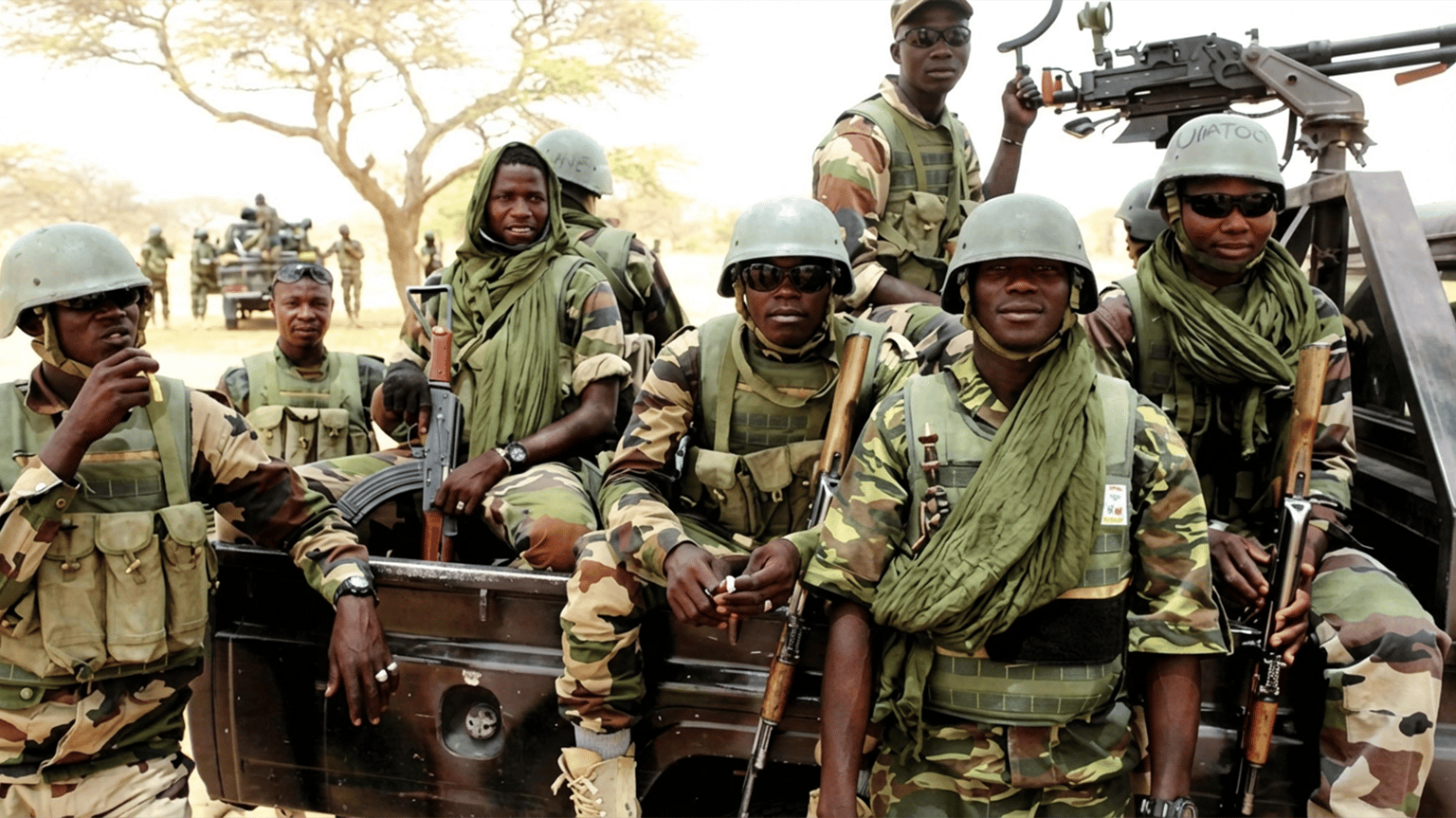
Troops of the Joint Task Force (North East) Operation HADIN KAI (OPHK) have neutralised at least 16 Islamic State West Africa Province (ISWAP) terrorists in Borno State through a series of decisive operations.

In a statement issued on Tuesday, February 11, 2026, OPHK Media Information Officer, Lieutenant Colonel Sani Uba, said the troops demonstrated exceptional resolve and operational superiority by repelling an attack and launching a devastating counter-offensive.

“On 5 February 2026 at approximately some minutes to midnight, ISWAP terrorists conducted a failed attack on Forward Operating Base (FOB) Auno. Troops of Sector 1 thwarted the assault with disciplined firepower and tactical precision,” Lt. Col. Uba stated.

Building on that success, on 9 February 2026, troops, working in synergy with the Civilian Joint Task Force (CJTF), launched a bold counter-offensive along the Komala axis in Konduga Local Government Area.
“The troops engaged the retreating terrorists up to the Gidan Kaji axis neutralising sixteen (16) terrorists, forcing scores to flee in disarray with severe injuries,” he added.

During the operation, troops recovered over 20 bicycles, a large cache of logistic items, weapons, and other supplies essential to terrorist operations.
In a further blow to ISWAP logistics, troops arrested suspected logistics suppliers conveying a large quantity of drugs intended for terrorists around the Bukarti axis on the same day.

Separately, on 9 February 2026, troops foiled a terrorist kidnap attempt along the Buratai-Kamuya road. After detecting the activity, troops pursued the attackers, forcing them to abandon their victims and flee into the bushes.
Two victims, Mallam Idris Adamu and Mallam Muhammadu Safiyanu, were rescued and safely reunited with their families in Buratai.
Additionally, following a distress call along the Chibok-Damboa axis on the same day, troops successfully rescued nine kidnapped victims.
Lt. Col. Uba emphasised that these operations underscore OPHK’s unwavering commitment to dismantling terrorist networks, disrupting their logistics, protecting civilians, and supporting humanitarian efforts across the North East region.




